These beaked hazel catkins look as if they have just opened but they actually flowered last fall and are (like the rest of us) waiting for spring when they will pollinate female flowers with the help of insects.
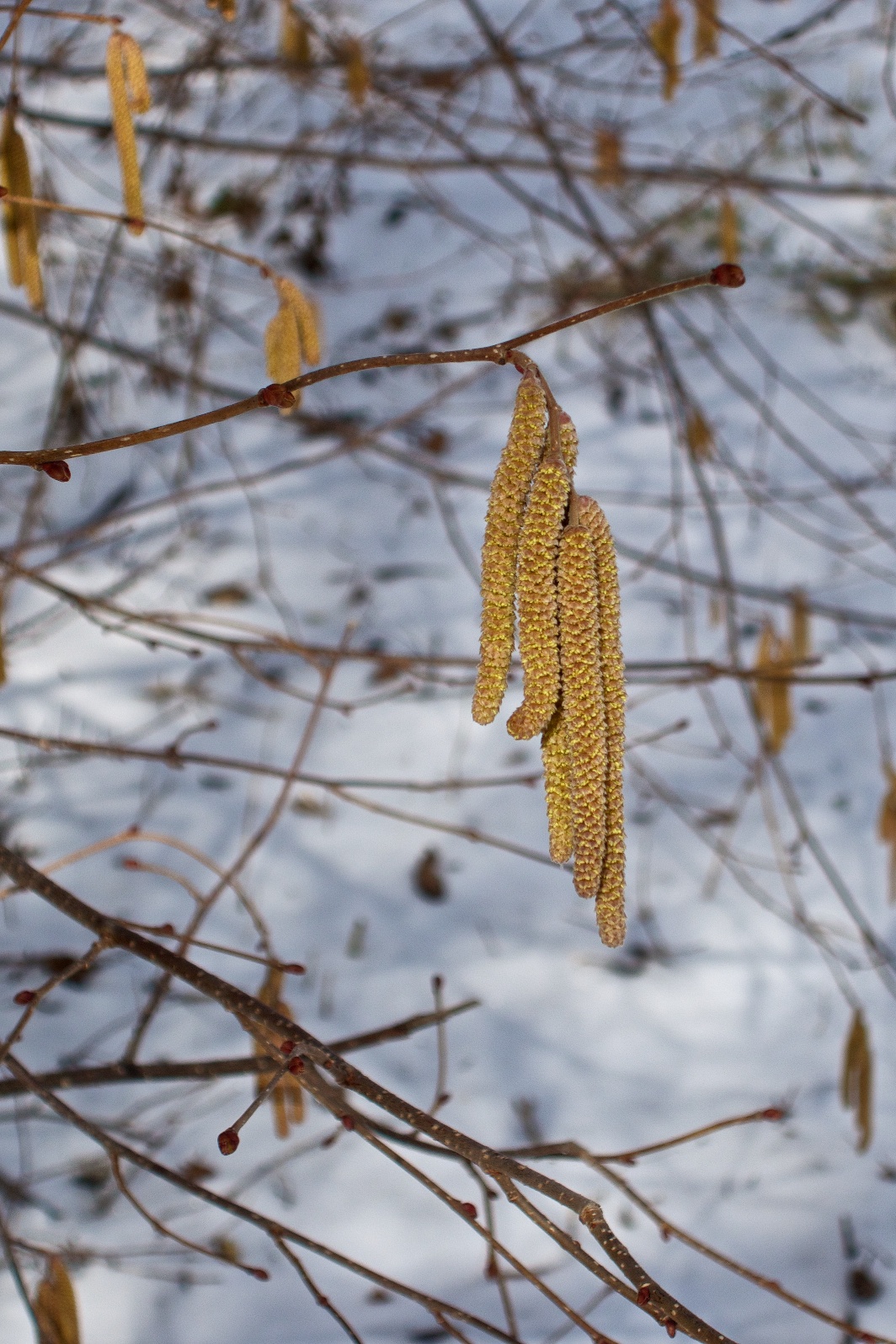
This is the male flower.
These beaked hazel catkins look as if they have just opened but they actually flowered last fall and are (like the rest of us) waiting for spring when they will pollinate female flowers with the help of insects.
This is the male flower.

More snow today on the edge of a major winter storm that luckily just missed us. Another day of winter is disappointing to humans but wildlife is really feeling the pinch. There were redwing blackbirds in the park a few days ago but there’s no trace of them now. Nothing has budged from its winter state so spring is still some time away. Because of thick cloud cover, the more powerful March sunshine is neutralized.
On days like these, I usually have the park to myself.
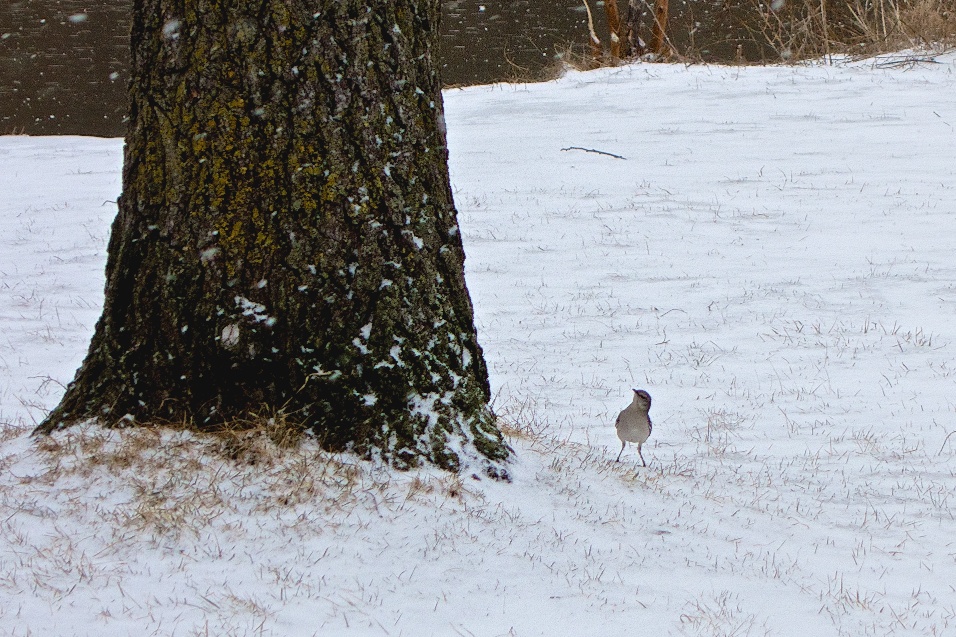
A Grey Jay looks for food.
Fresh snow covers the ground and the temperature barely cracked 0°C today.
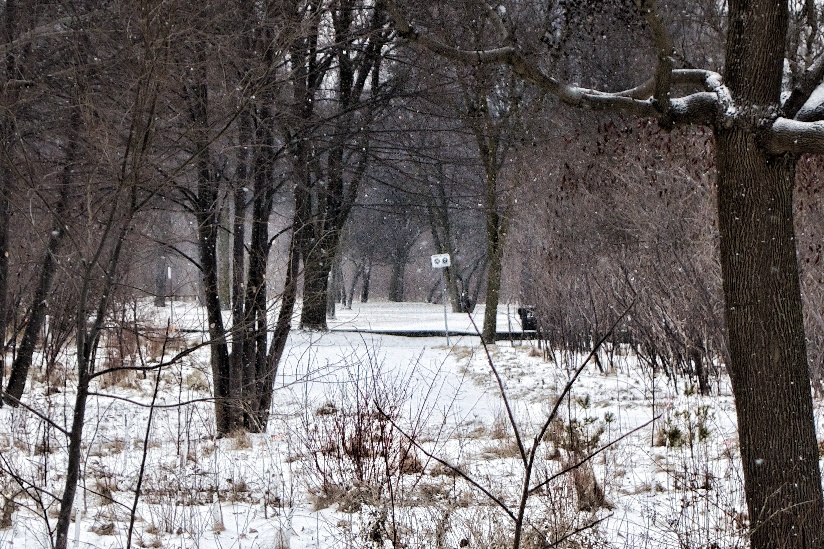
Looking north to the path by the weir.
At the weir the water had an interesting oily look that the camera was able to capture quite nicely.
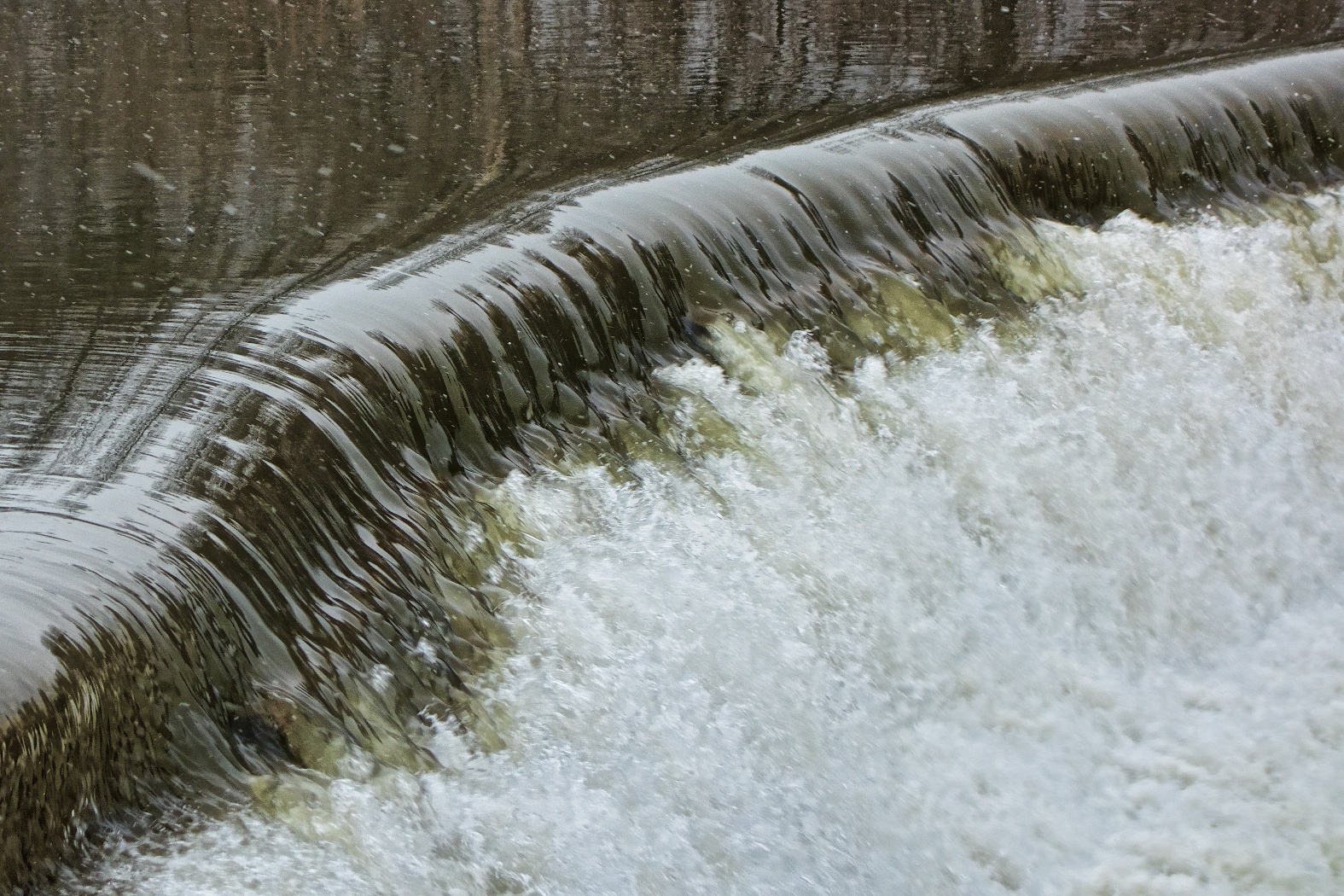
Snow flakes and an oily texture you can almost touch.

Flood waters are peaking and the Humber is sending billions of litres along with much flotsam and jetsam to Lake Ontario. Today’s photographs don’t do the event justice so here is a short movie together with some views of the raging torrent.
Let’s start with some wildlife – these ducks (in the centre of the image) are conserving energy by resting in a quiet eddy away from the maelstrom.
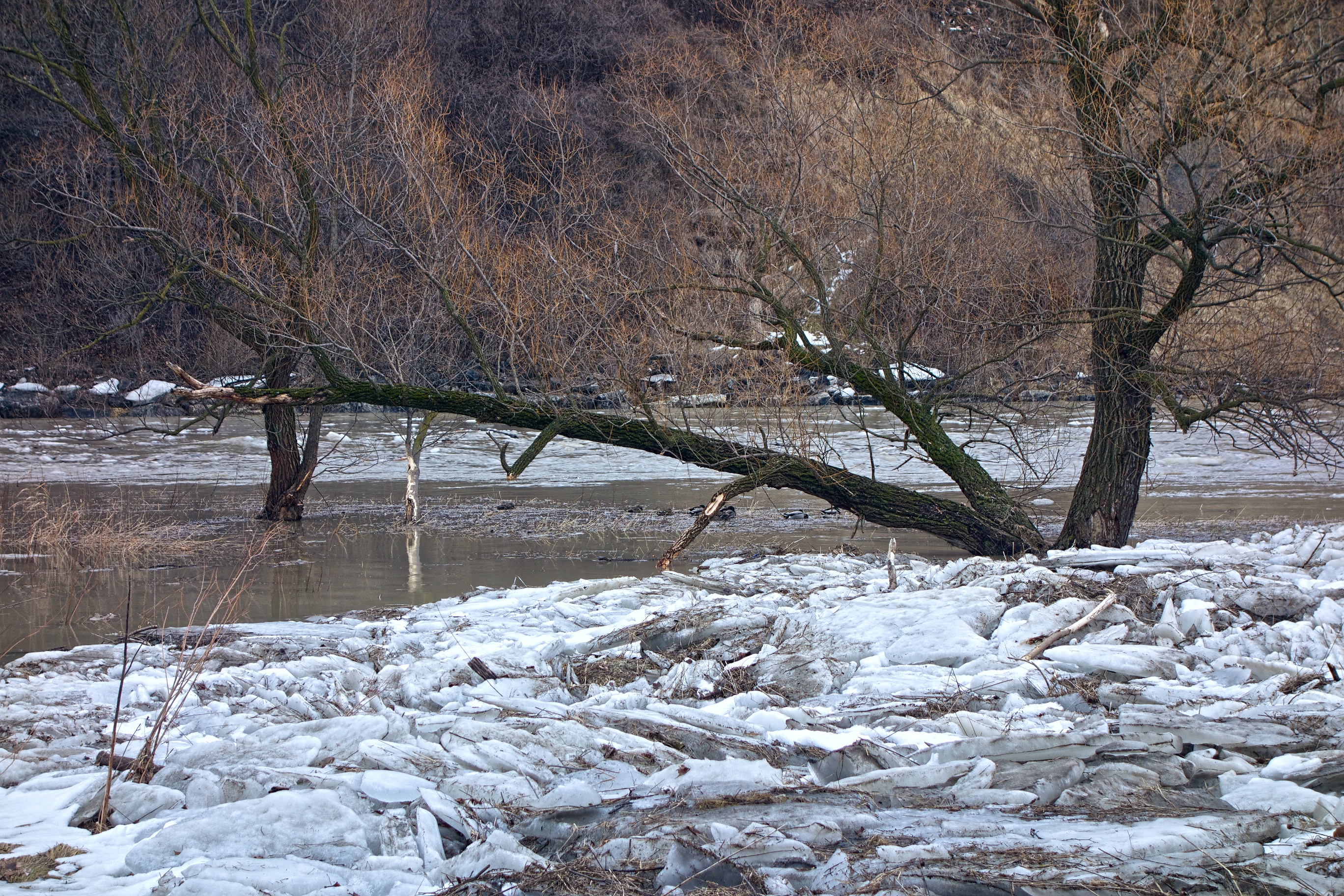
Ducks find refuge in calm waters.
The amount of lumber going downriver is quite remarkable.
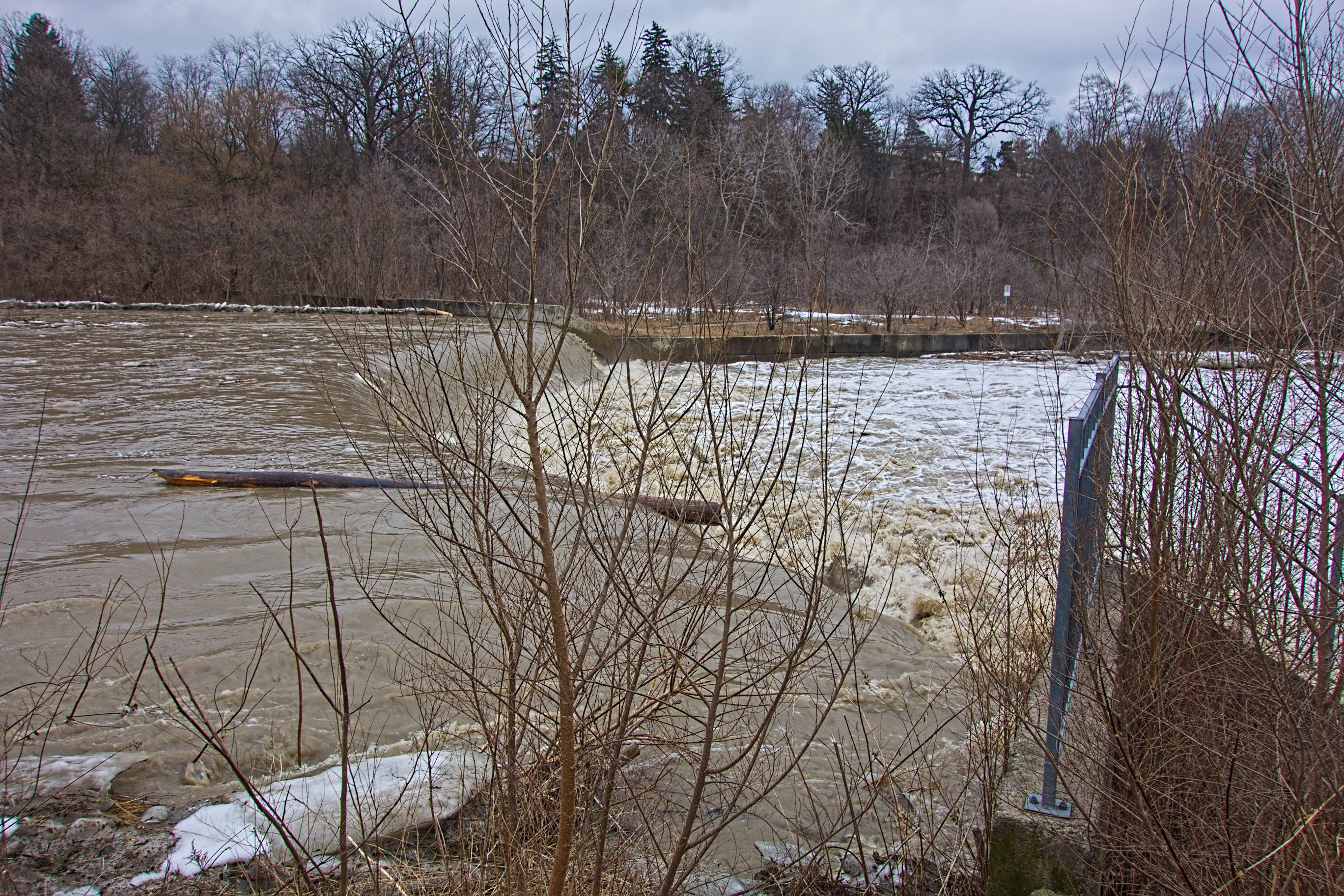
Huge amounts of lumber are being transported – a log is just about to go over the weir.
Standing close to the weir is quite the sensory experience with the thundering of the water (now much closer to bystanders) punctuated by the thumping of logs and ice blocks.
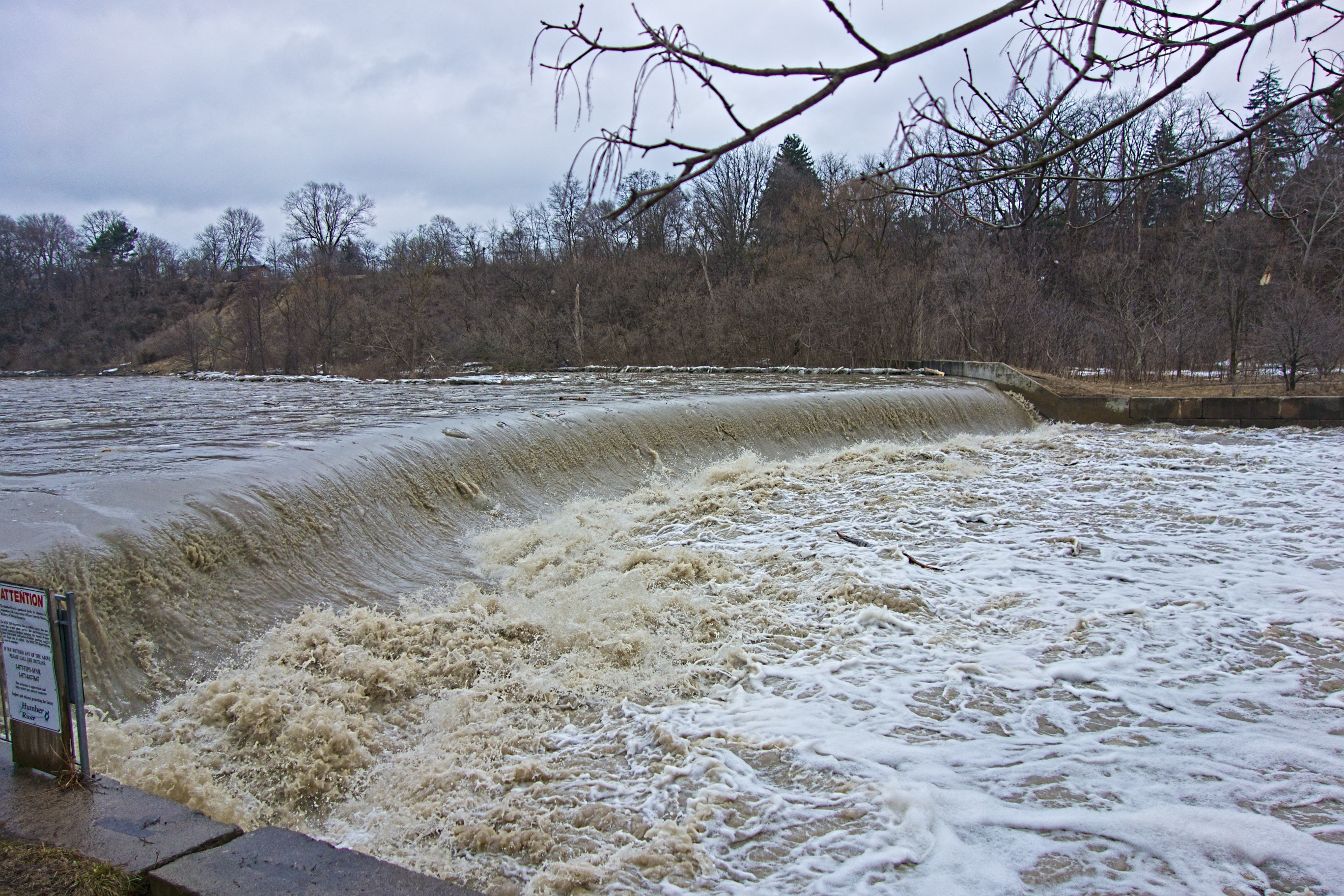
It’s a very intense experience to stand close to the water.
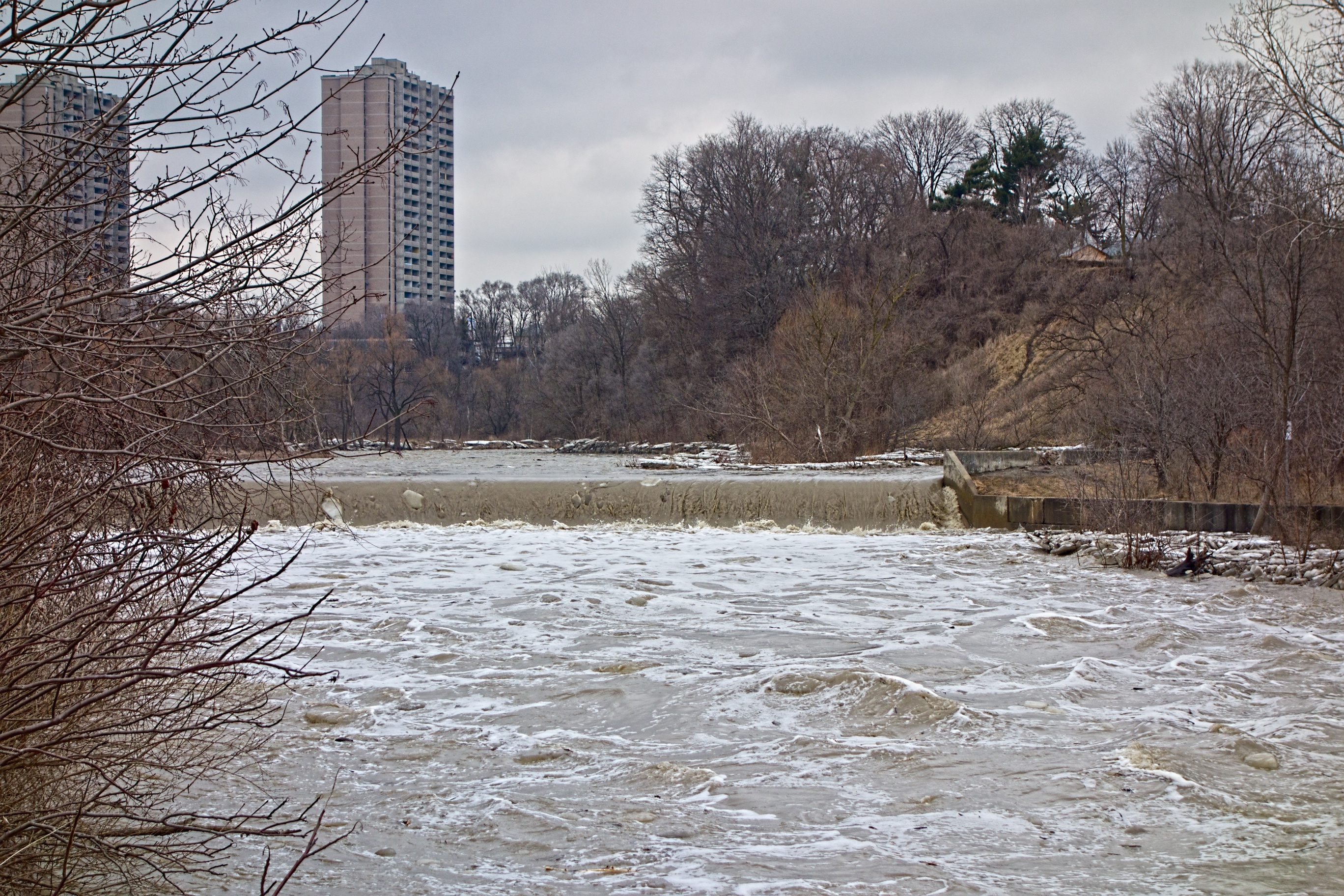
The twin carbuncles bear witness as chunks of ice and other debris are carried over the weir.
In a few days, water levels will be back to normal but for now, the power of nature is a reminder of how puny we are.

Raymore Park is at the exact latitude of Florence in Italy. Despite this, our climate is about 12°C (22°F) colder in winter because Florence has the Alps blocking the path of arctic weather. Our closest mountains of influence (the Rockies) usually block mild westerlies from the Pacific, leaving us vulnerable to cold northerly winds in winter. Although the Great Lakes provide a moderating influence, ours is a continental climate with short transitions between seasons. Land warms and cools quickly and seasons tend to advance (and retreat) without too much fanfare.
Wildlife is poised to return in force. Many animals are already on their way through migration. Monarch butterflies for example have already begun the trek from Mexico, each generation moving north as conditions permit. Billions of creatures in the park will spring to life from the seeds and eggs left behind by their ancestors, killed in the mass extinction that occurs every Fall. Atlantic salmon are preparing to spawn, triggered by rising water temperatures. Geese and other water birds are pairing up and aimlessly mooching around the river like teenagers in a shopping mall while plants are awaiting the signal that tells them it’s safe to emerge.
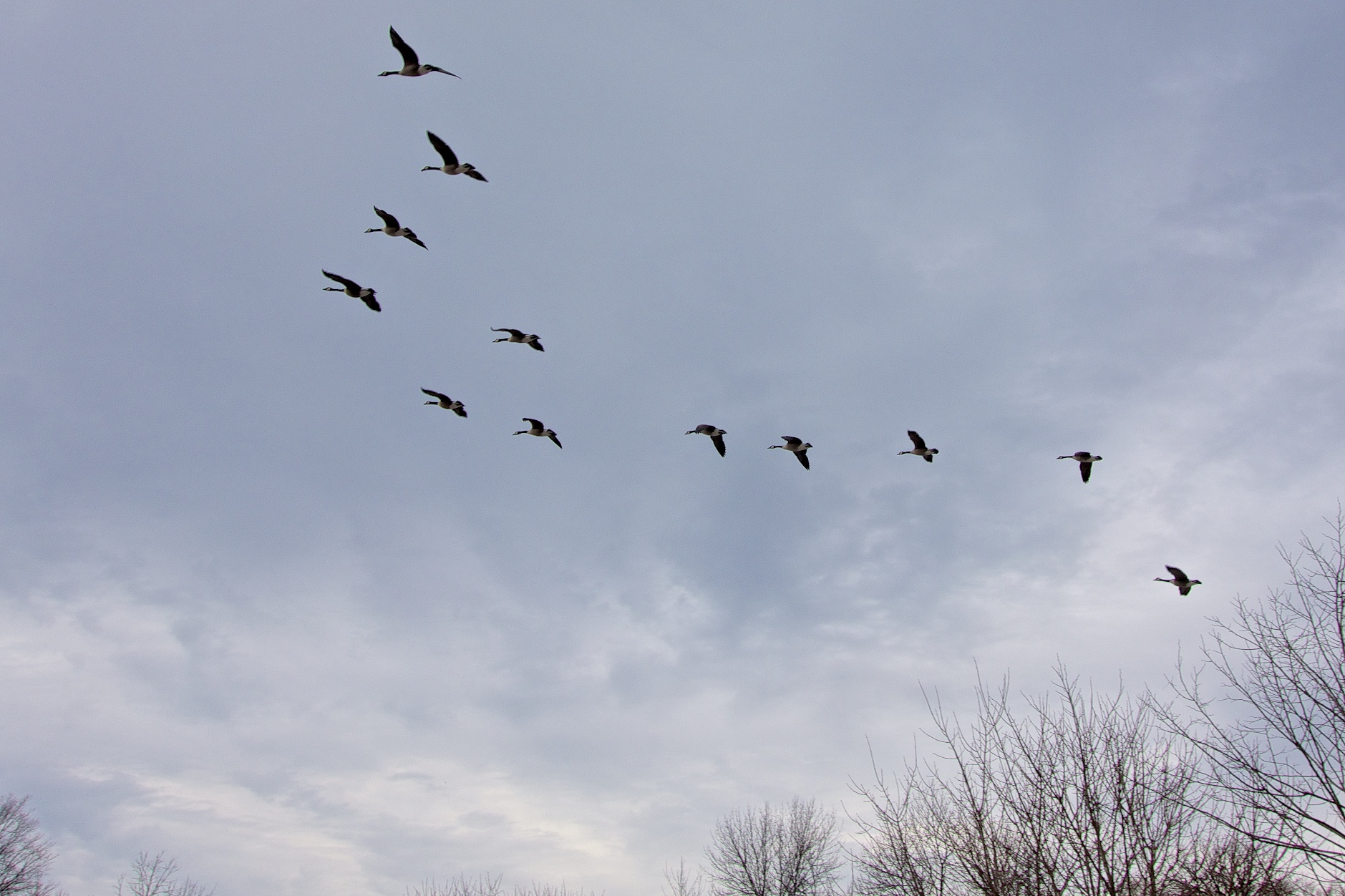
Mooching geese under a leaden sky.
Huge amounts of sediment laden water are draining off the land from tributaries all along the Humber. The ground is fully saturated ready to nourish plants when they start growing.
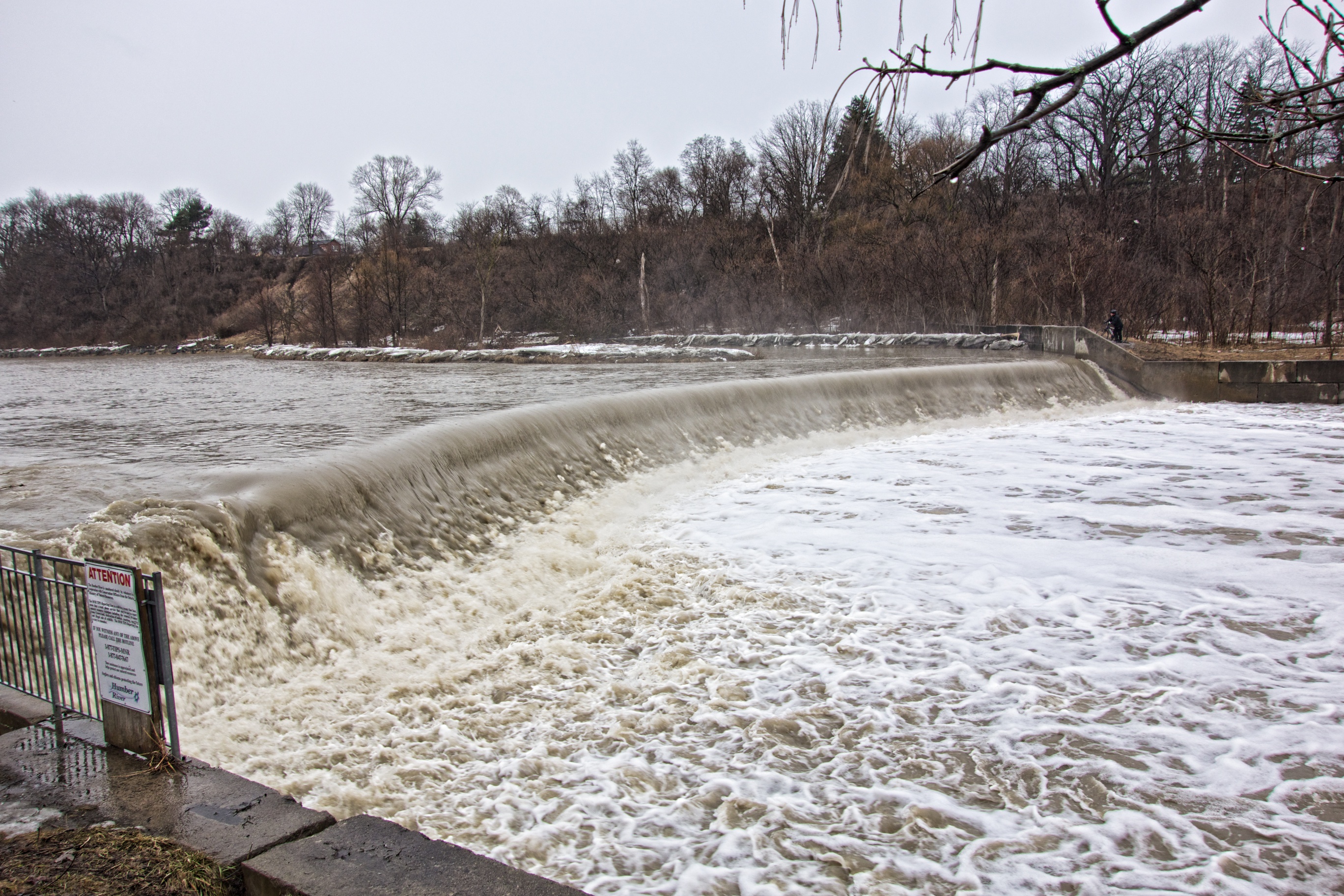
Huge amounts of water are draining into the Lower Humber.
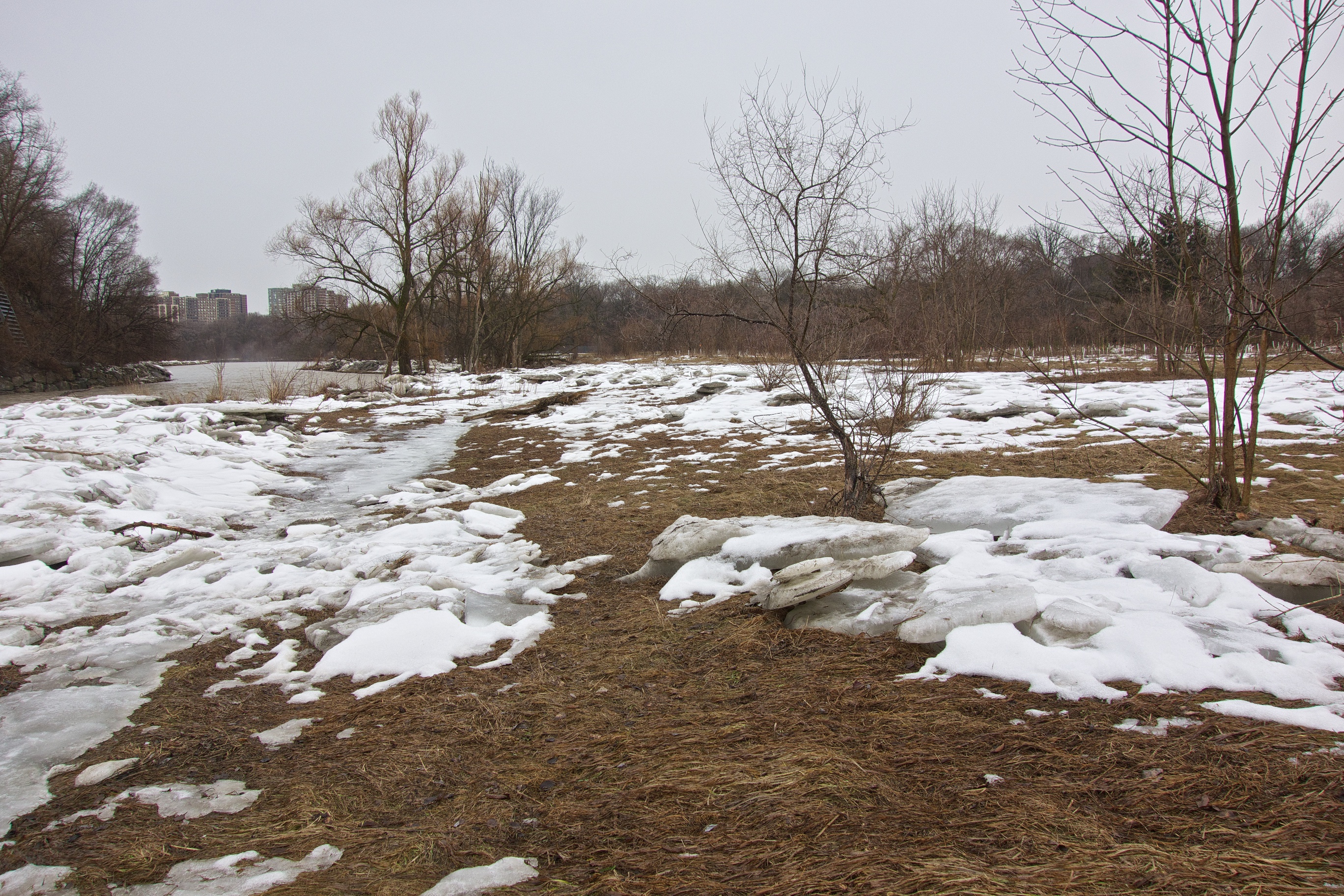
The land is saturated as snow and ice melt.
For now though, it’s quiet.

Staghorn sumac is a wonderful plant and there is lots of it in Raymore Park. What’s so wonderful?
For starters, it’s native and seems to be resistant to pests.
Second, it’s attractive with a kind of tropical look to it in the summer and a vivid red colouring in the fall. Its red flowers stay on the plant all winter.
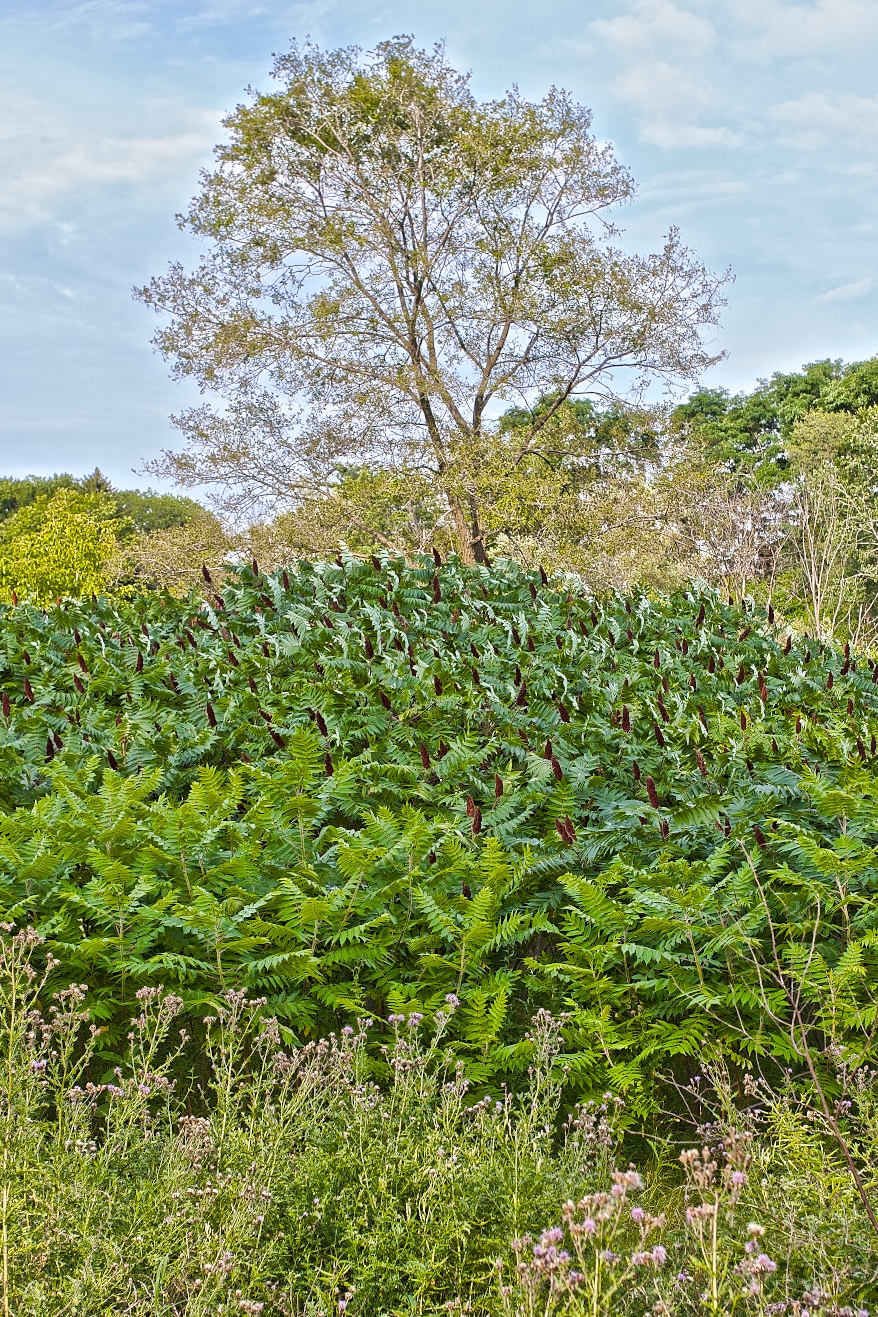
A stand of sumac in the wild area in August.
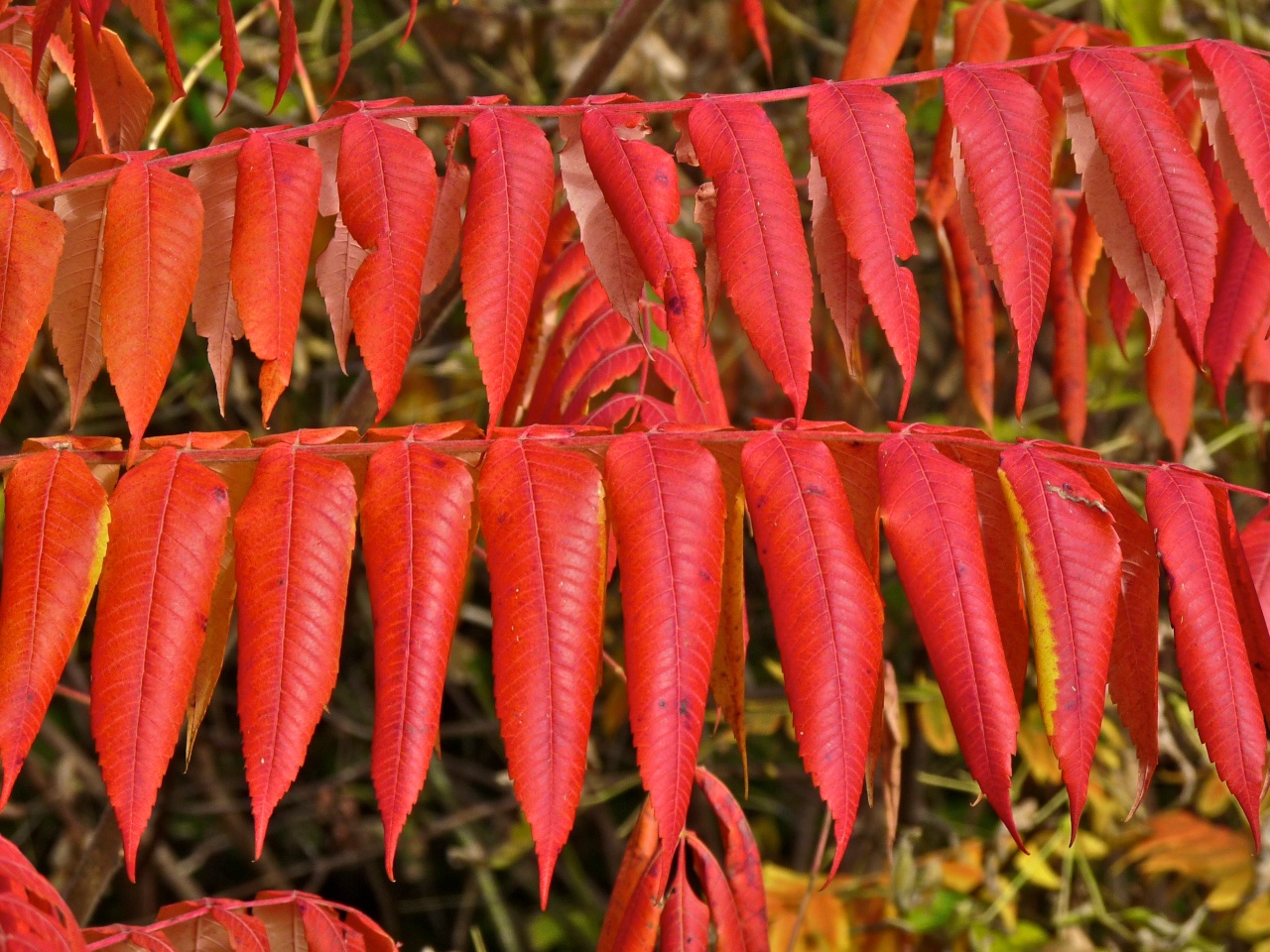
Sumac, brilliant in mid-October.
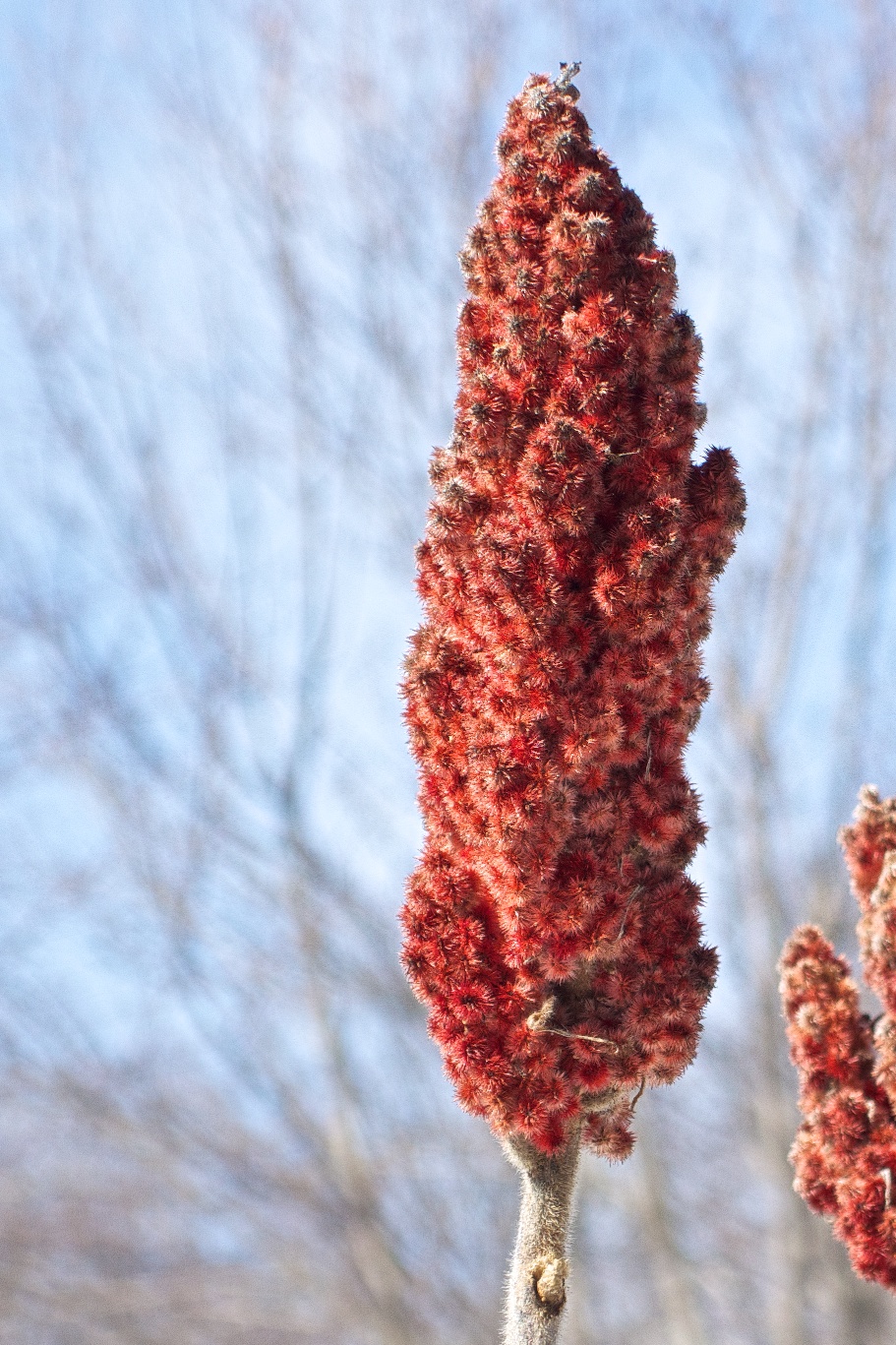
A sumac flower – note the velvet on the stem that gives the ‘staghorn’ name (March 9, 2013).
Third, it benefits wildlife by encroaching, in spite of human efforts to control it. Mowers have to give encroaching sumac an ever-wider berth as sumac leans out as it grows, allowing the roots to put out new shoots. Its deep shade starves less worthy plants of sunshine.
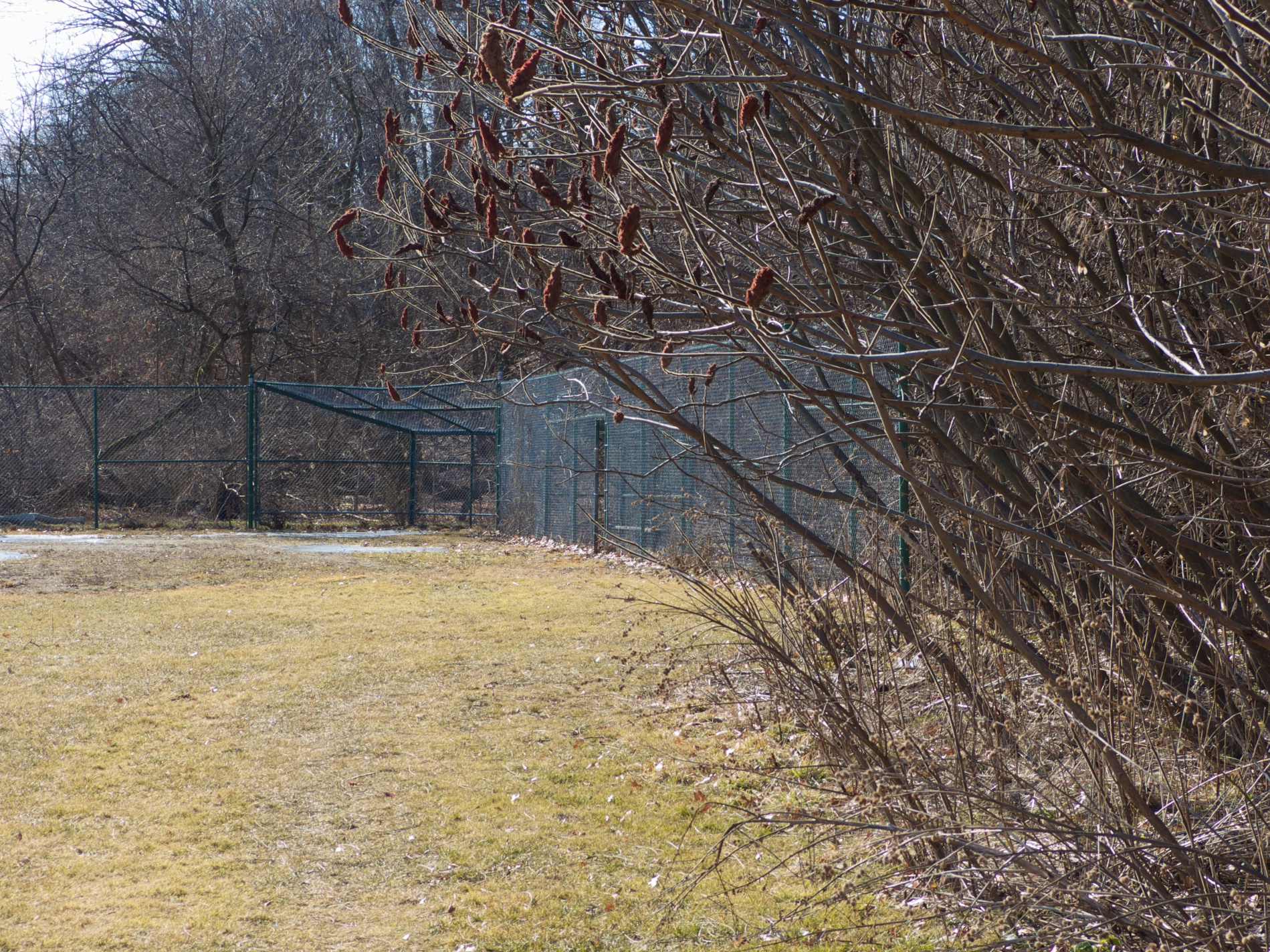
This disused baseball diamond is turning into woodland (slowly).
Fourth, it supports a variety of native wildlife from the insects that feed on its nectar to birds feeding on the flowers that stay throughout the winter. Deer along with other mammals eat the foliage and branches.
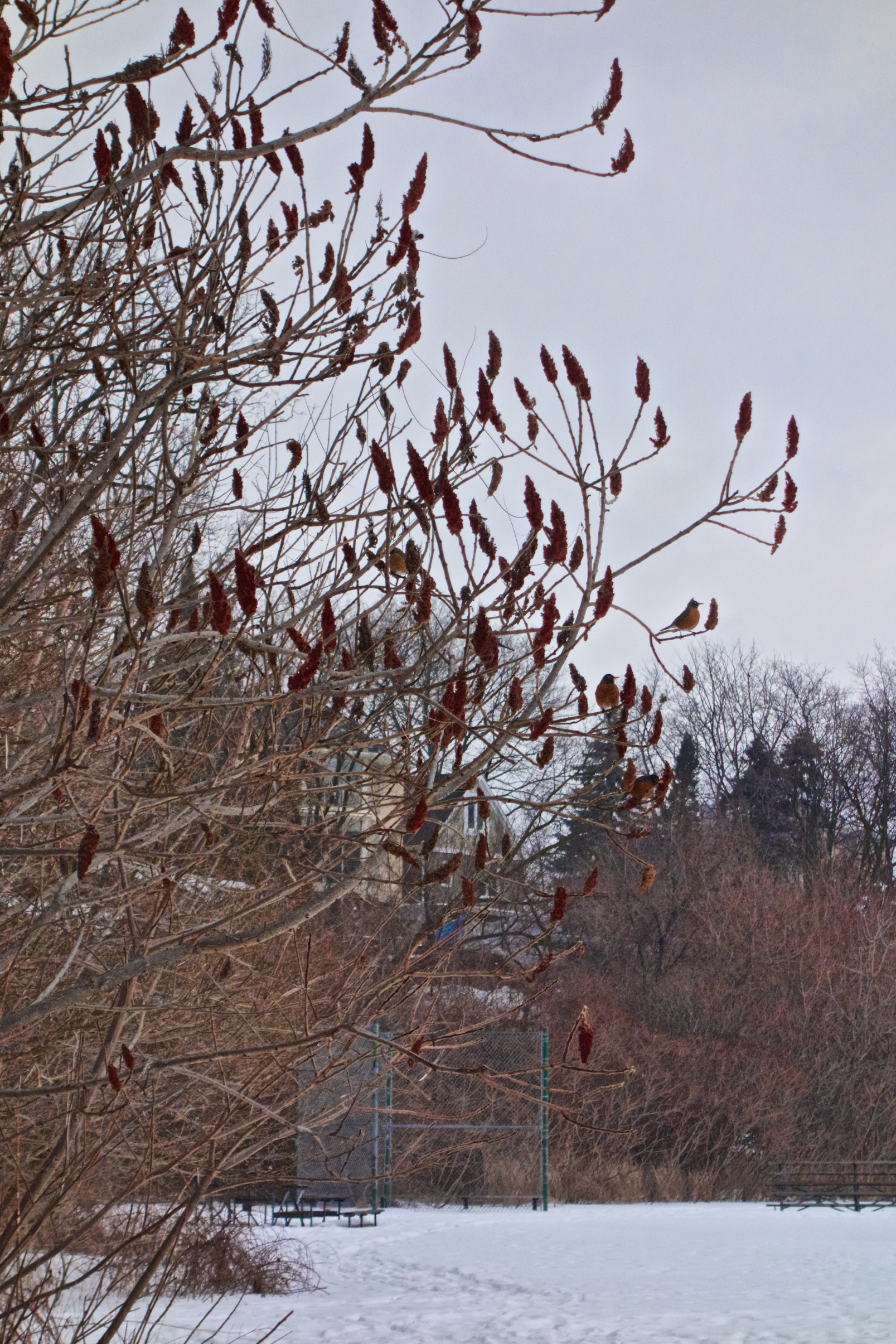
Count the overwintering robins enjoying a meal.

Raymore Park is under the jurisdiction of a variety of agencies. For example, the Federal government is in charge of how close you can fish to the weir. The provincial government controls other aspects of fishing – don’t ask me how that was decided. The city of Toronto takes care of by-laws concerning usage of the park and parking; the Toronto and Region Conservation Authority (TRCA) manages the watersheds around Toronto. Some park signs are relics of the past while others aren’t that carefully worded. It’s doubtful whether people creating the signs have given much thought to either the appearance or the wording. To announce in large letters the words, ‘Park Closed’ is misleading, not to mention unwelcoming.
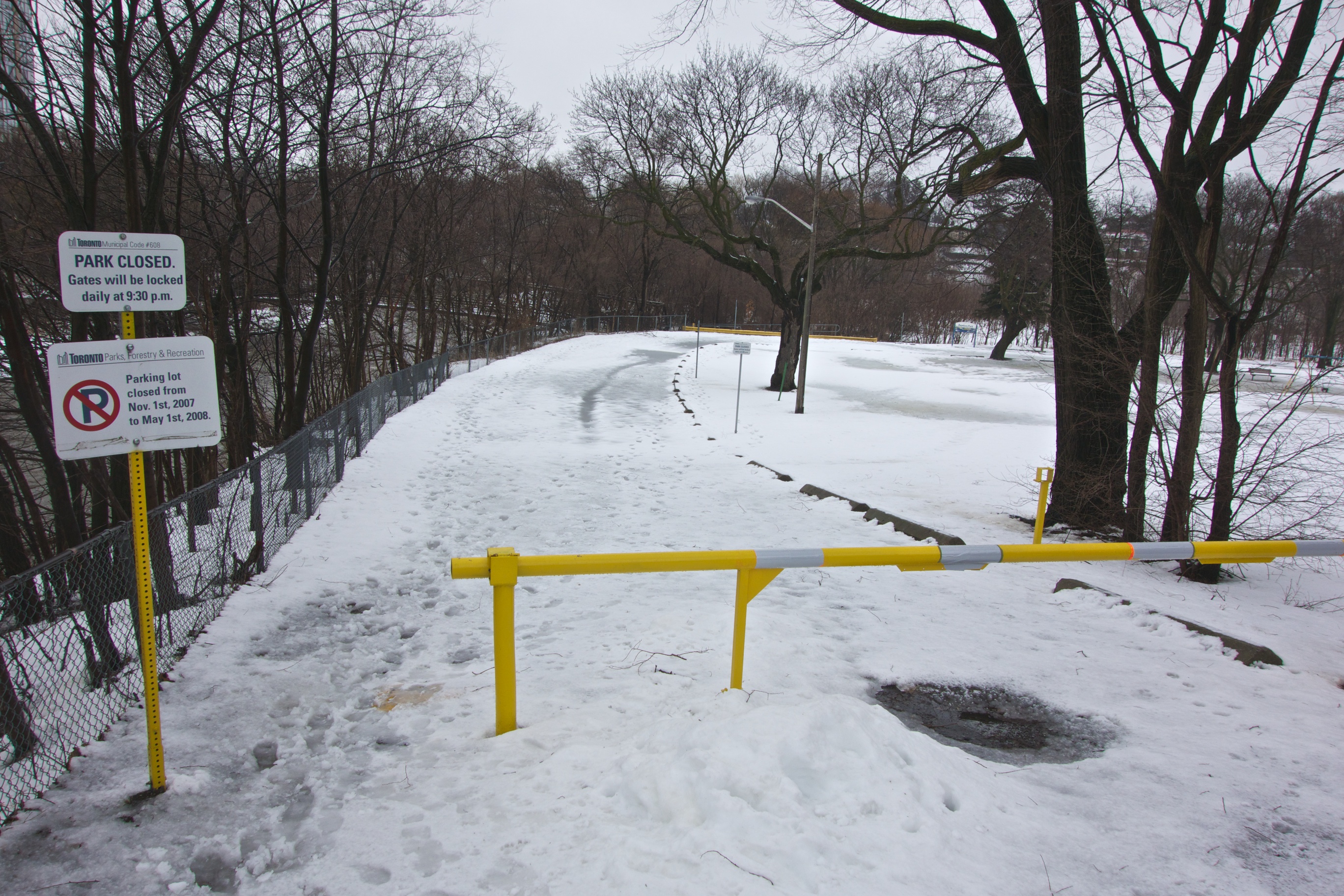
The misleading and inauspicious road entrance to the park and a sign that has outlived its specific timeframe.
Somehow, the signmakers couldn’t figure out how to tell people that the park is closed to vehicles during winter and after 9:30pm. Another unstated point, the park is never closed to pedestrians. This is important to mention as Toronto is a city of immigrants and many newcomers need help understanding how parks operate.
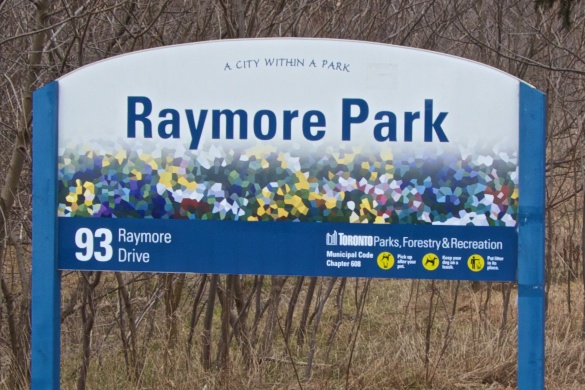
A city within a park? Where?
Thousands of dollars worth of city employee time was probably spent coming up with this trite little slogan. No doubt many committees spent hours labouring mightily over the five words. Unfortunately when viewed in context on the sign, people must wonder what it all means – there’s a city in Raymore Park?
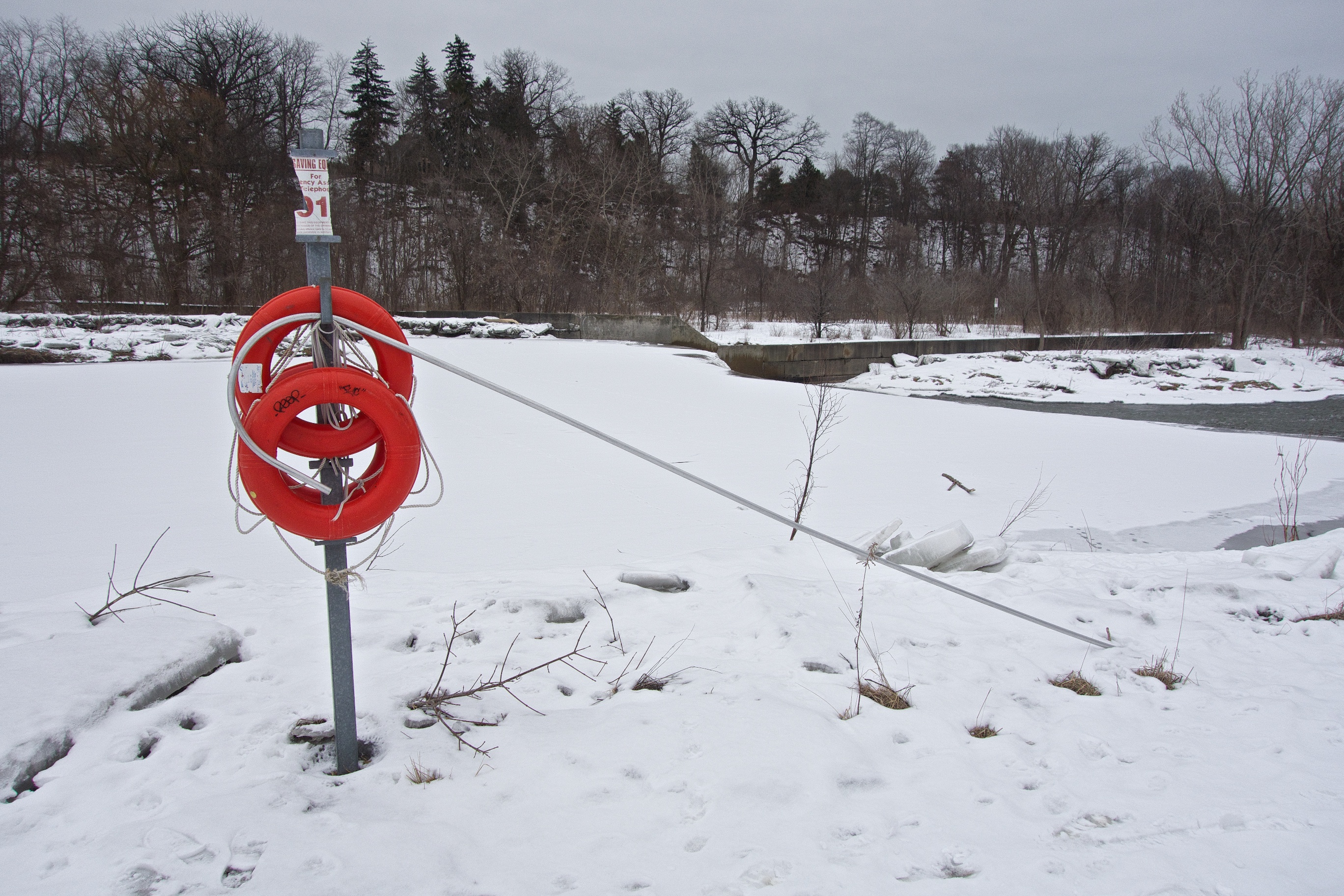
It’s not clear who manages this lifebuoy station by the weir but it sure could do with a bit of maintenance.
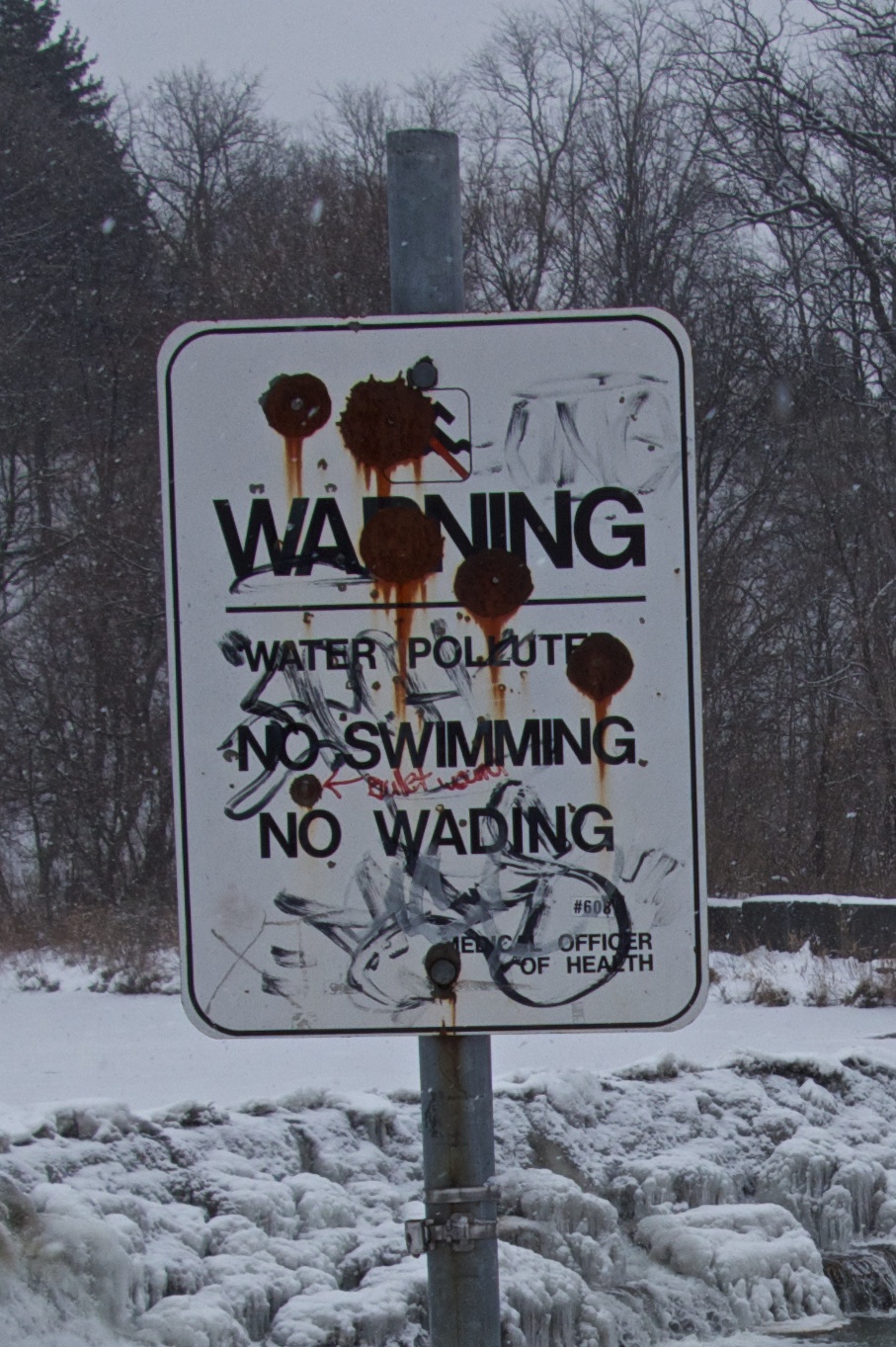
OK, we get it – it’s an unmitigated shithole. If you survive the pollution, you’ll be shot.
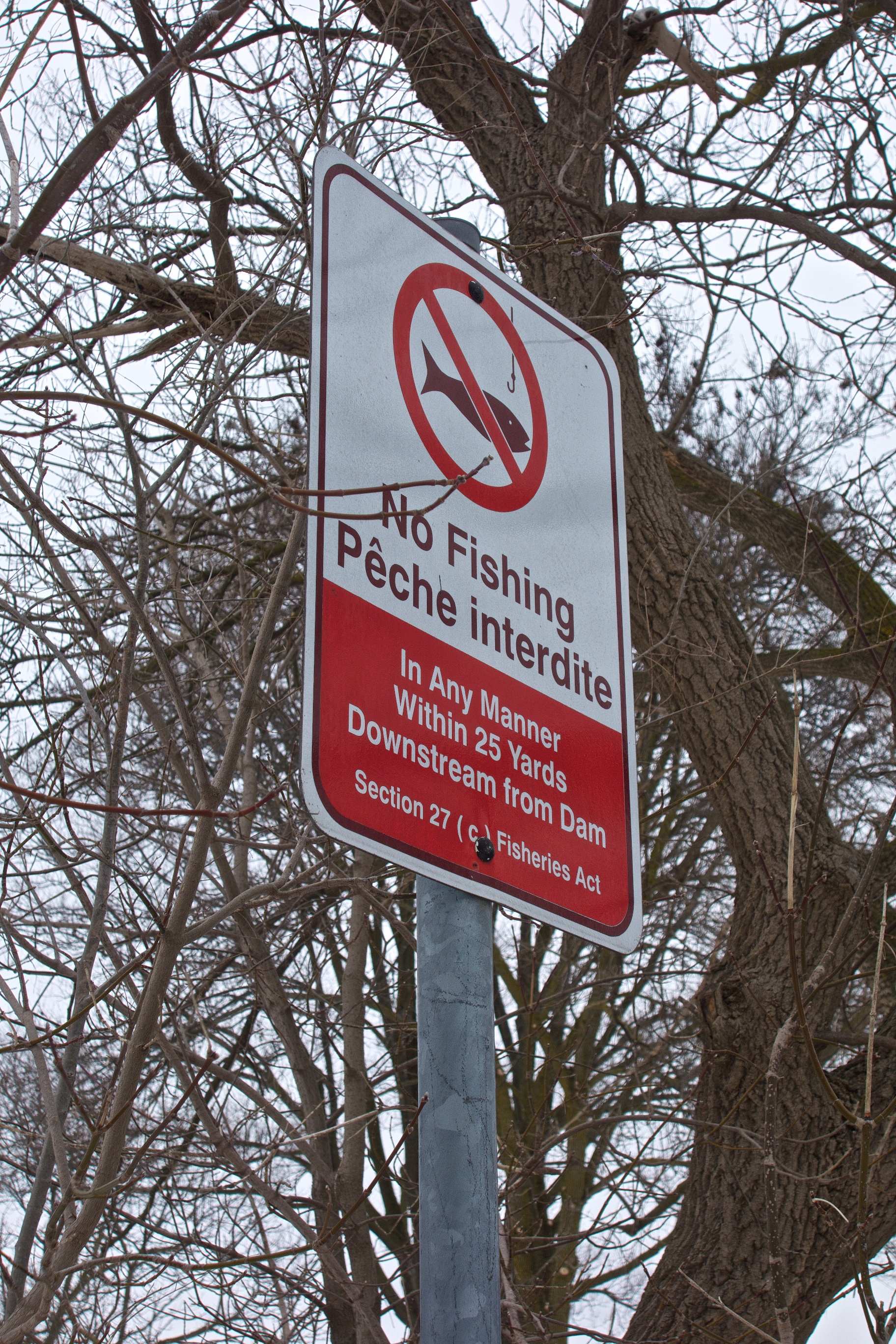
The Feds’ bilingual sign is (helpfully) 25 yards from the weir and faces the river although it never seems to stop anyone (didn’t we go metric?).
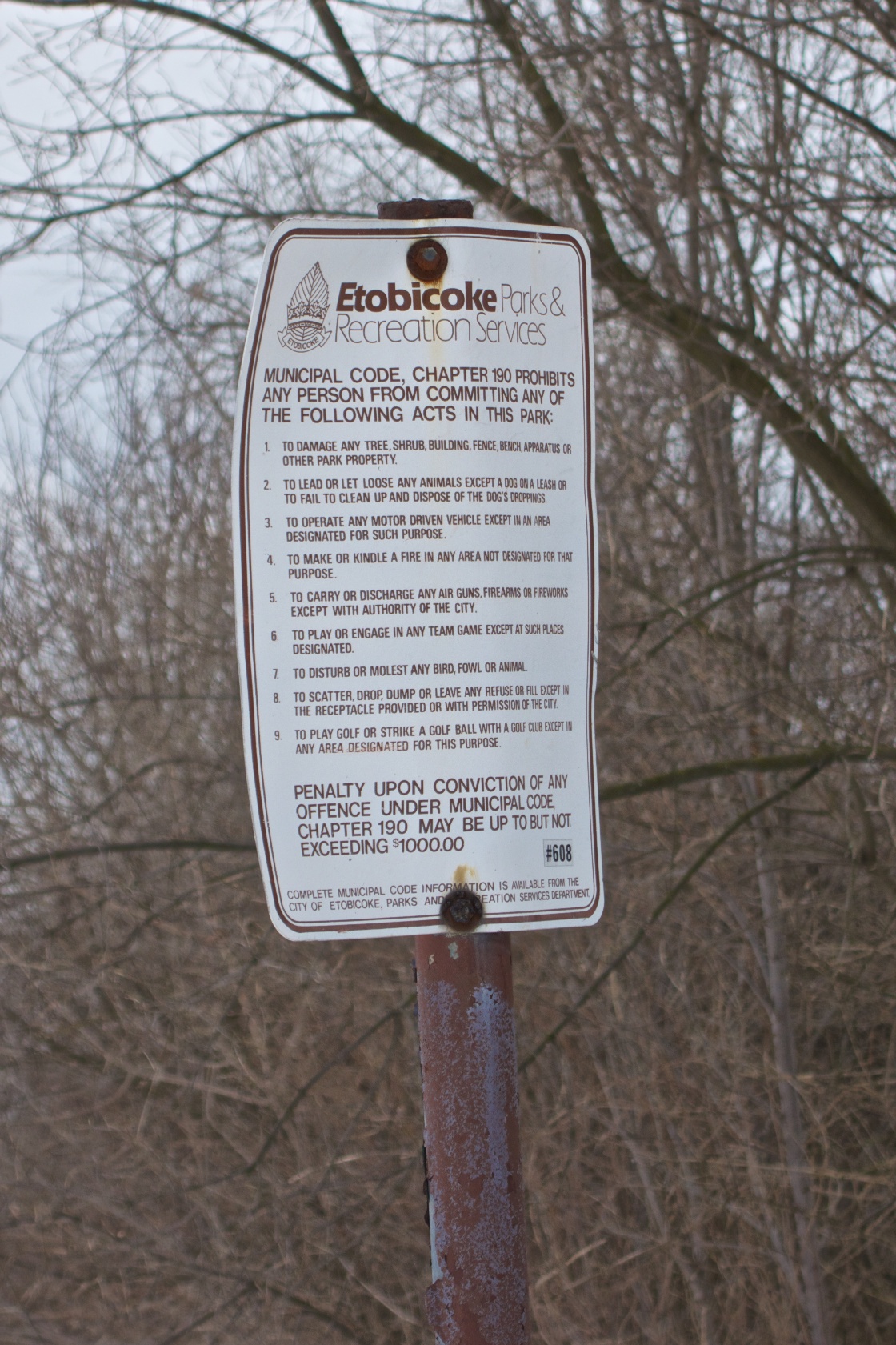
Toronto amalgamated in 1998 but this sign is a relic that has stood the test of time.
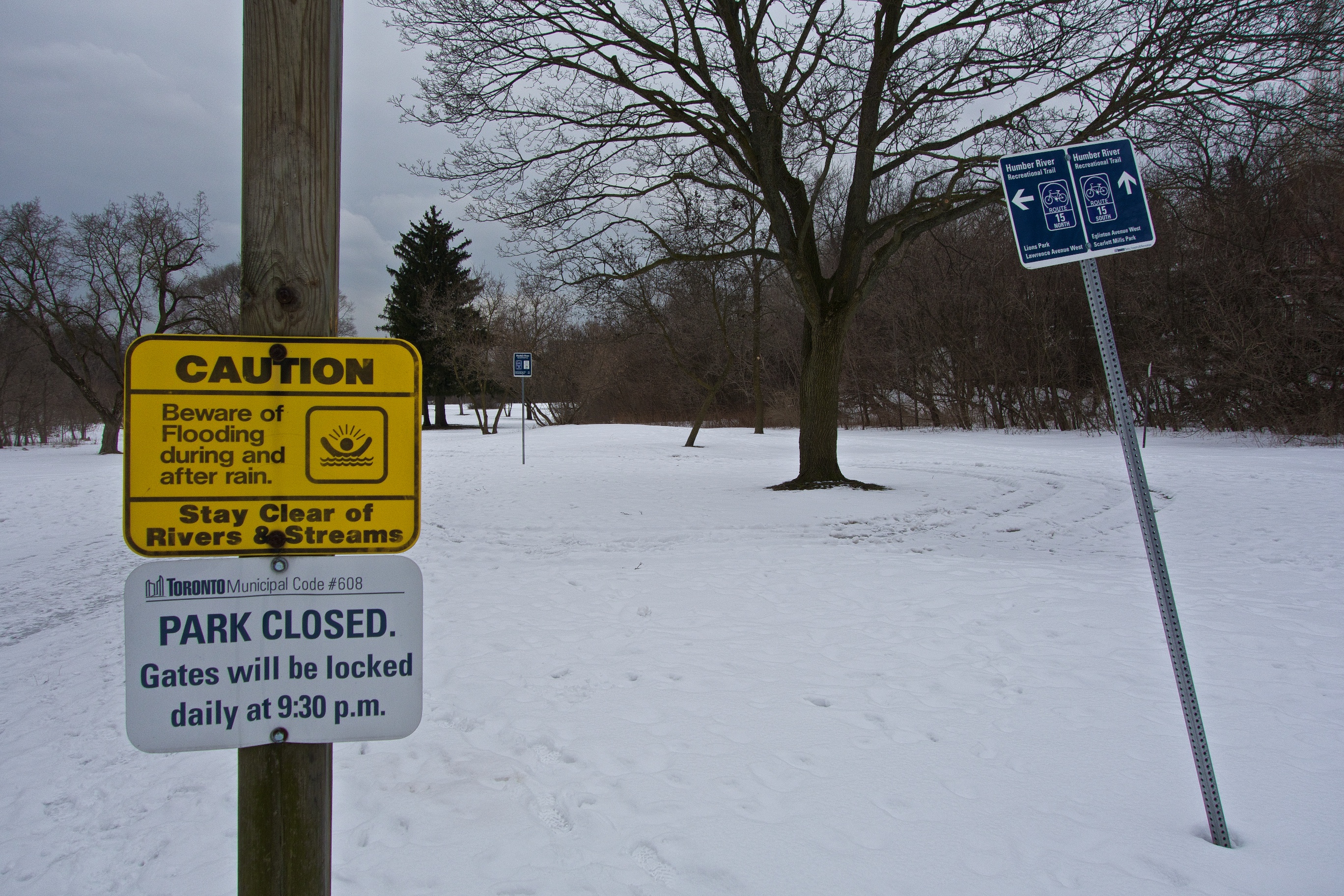
This dilapidated set of signs faces the parking lot. Another ‘Park Closed’ sign. The yellow one may be a TRCA sign while the blue signs help walkers and cyclists navigate the trails. There was another sign above the ‘caution’ one (outlining park by-laws) but it fell off months ago and has since disappeared.
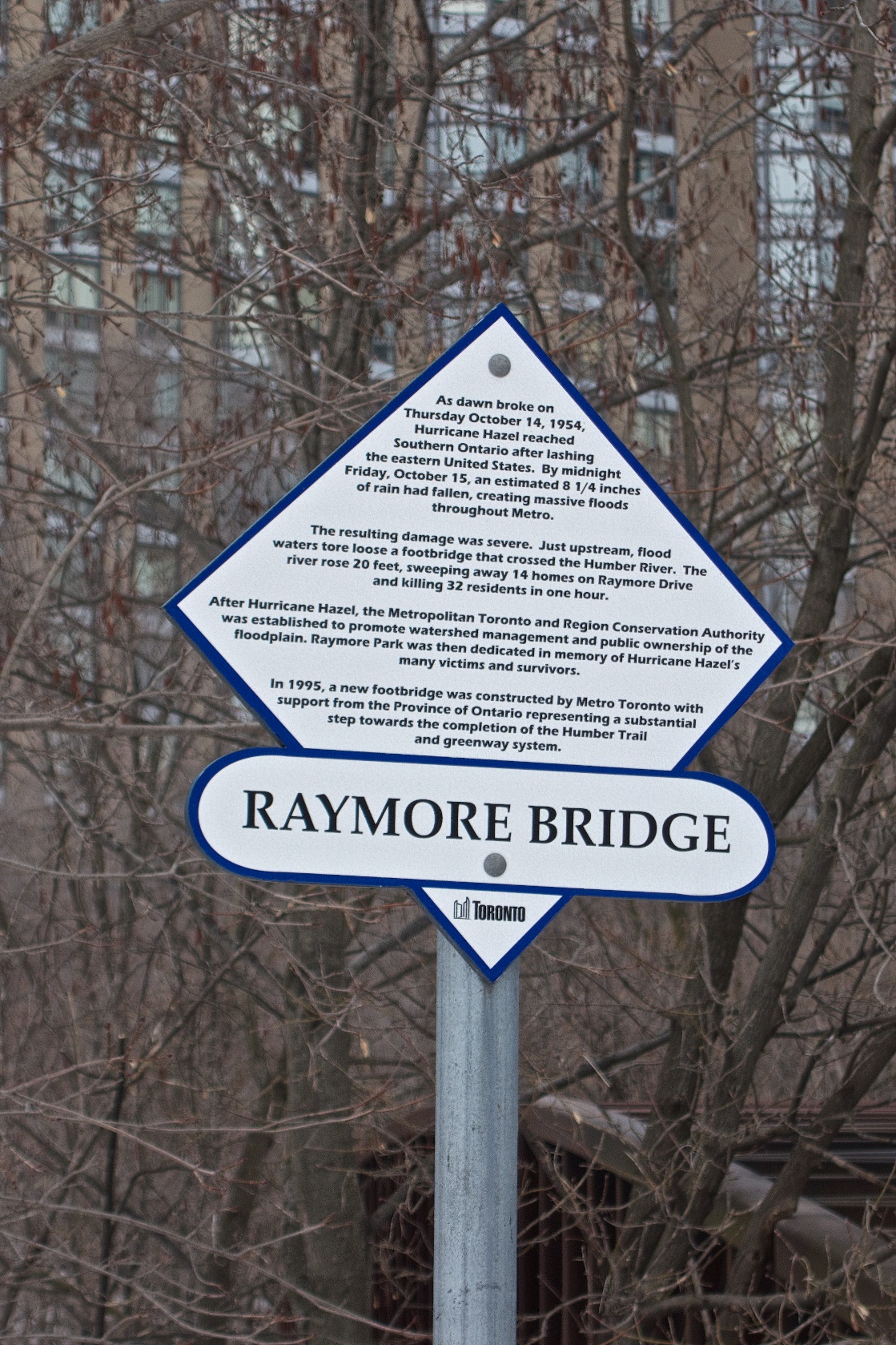
This plastic City of Toronto sign replaces the beautiful original made from cast metal which was stolen within days of its appearance.
I doubt that much thought has been given to many of the various signs that are scattered throughout the park; especially on the part of the people who order, design and write them. It would be a good idea to coordinate and consolidate signage so that there is a consistency of appearance. In addition, outdated and missing or damaged signs are actually harmful as they imply a lack of order that can encourage anti-social behaviour.

Yesterday was a sloppy slushy rainy day with rain and mild temperatures. A pair of geese standing on wet ice in the river prompted a quest for reflections. The closer one was quite relaxed and was in its sleeping position.
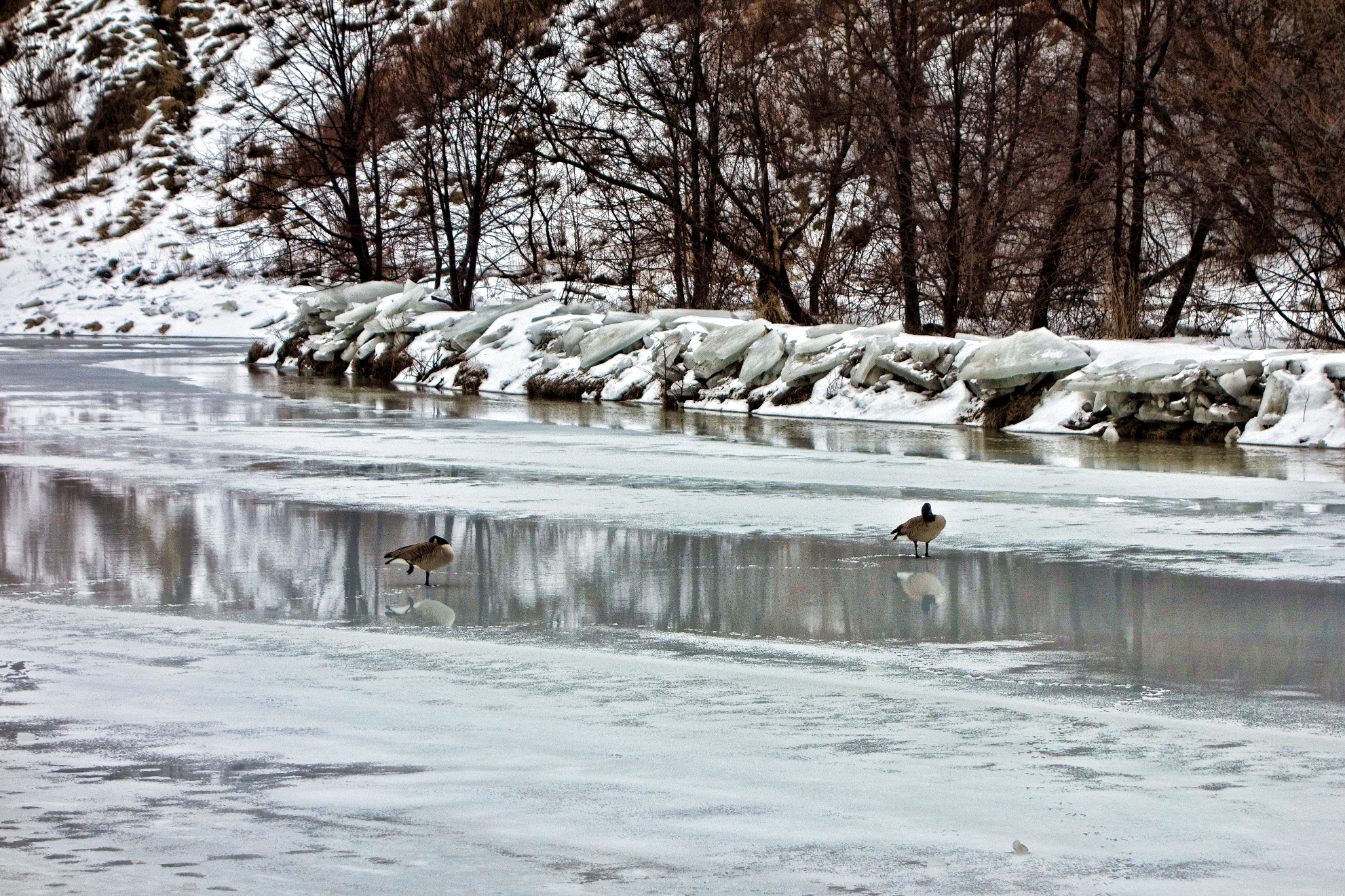
A pair of Canada Geese spend some quiet time on the river.
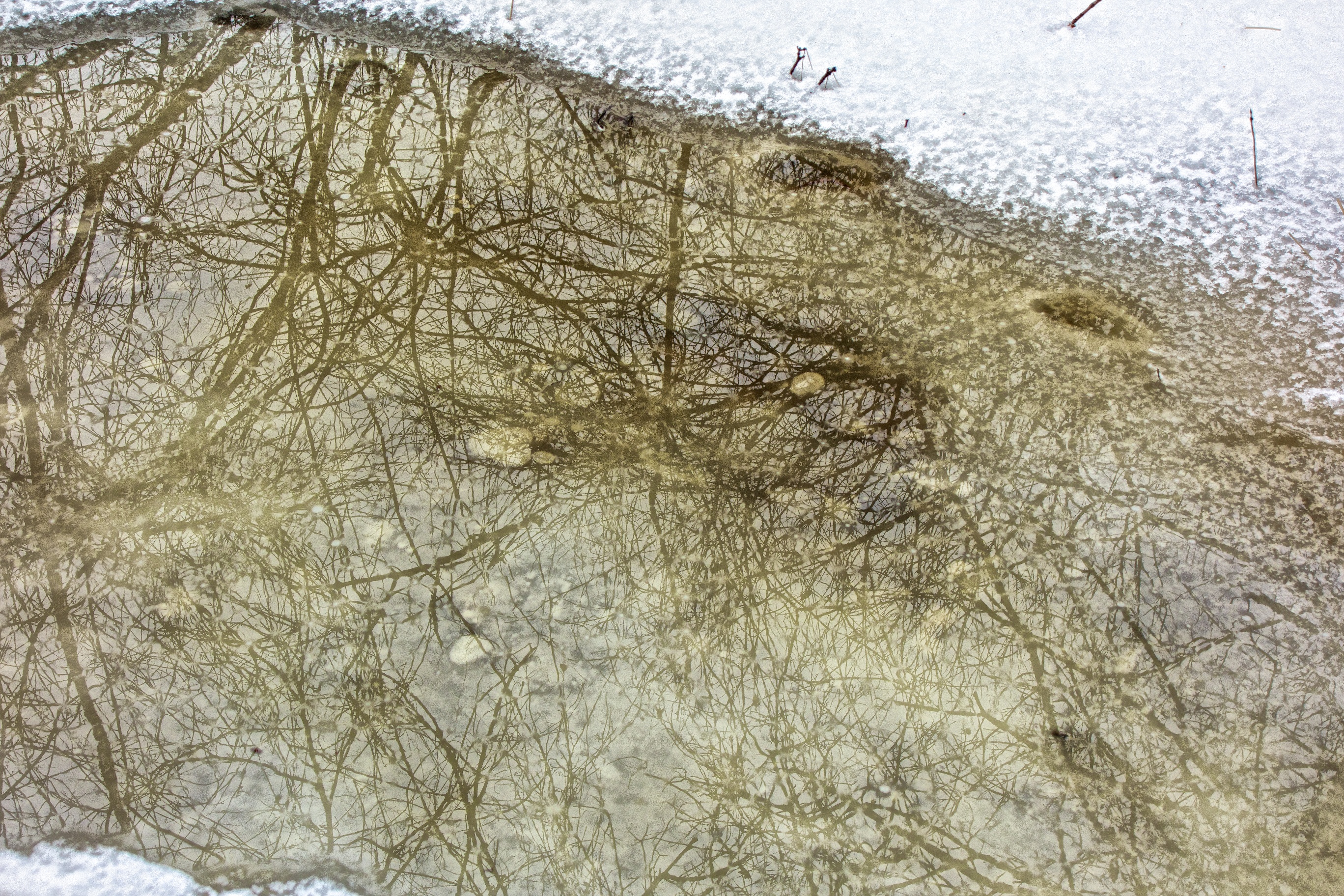
Large pools of earth-tinted water form in depressions allowing another view of the trees.
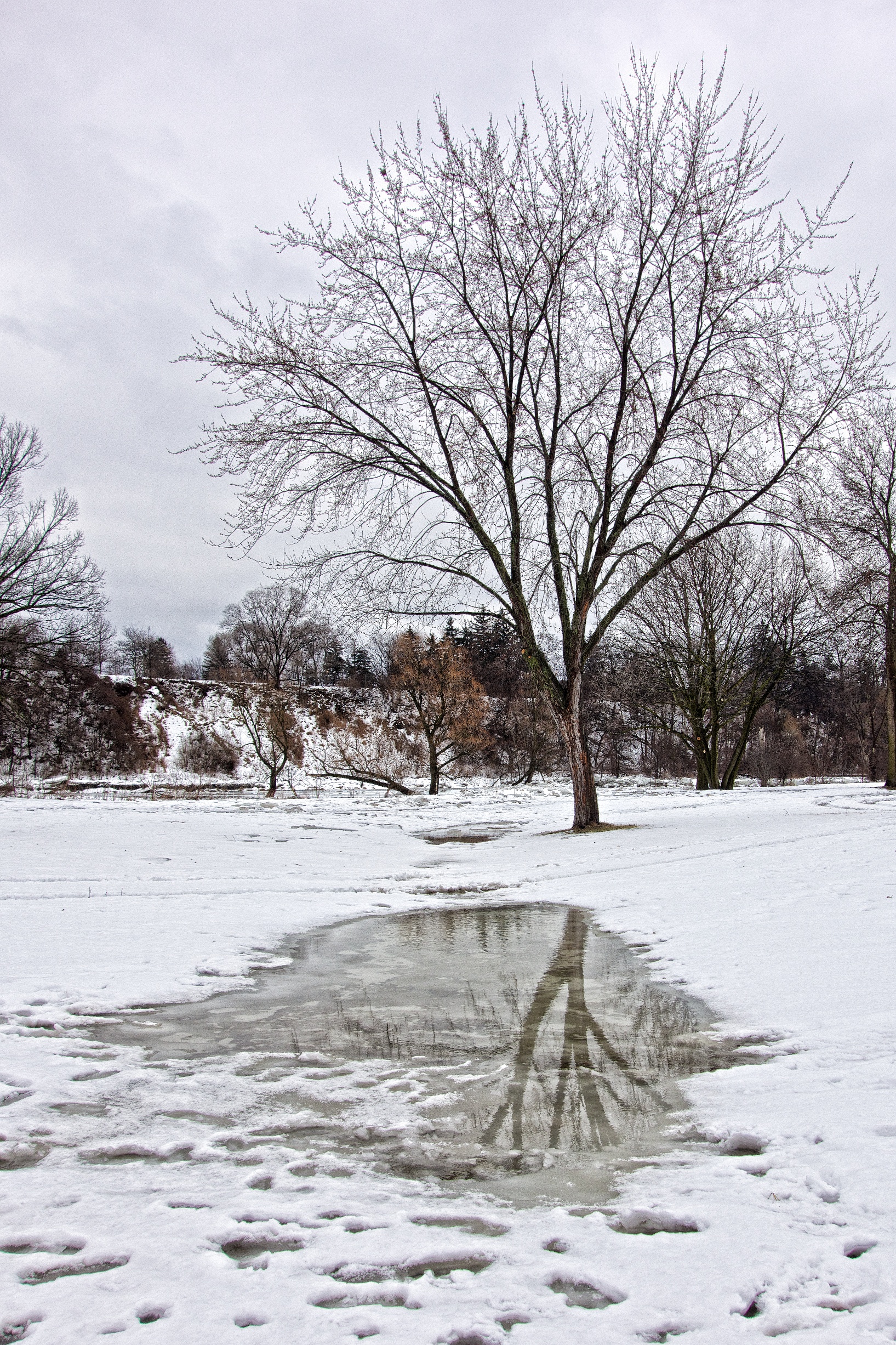
A maple is mirrored in slushy water.
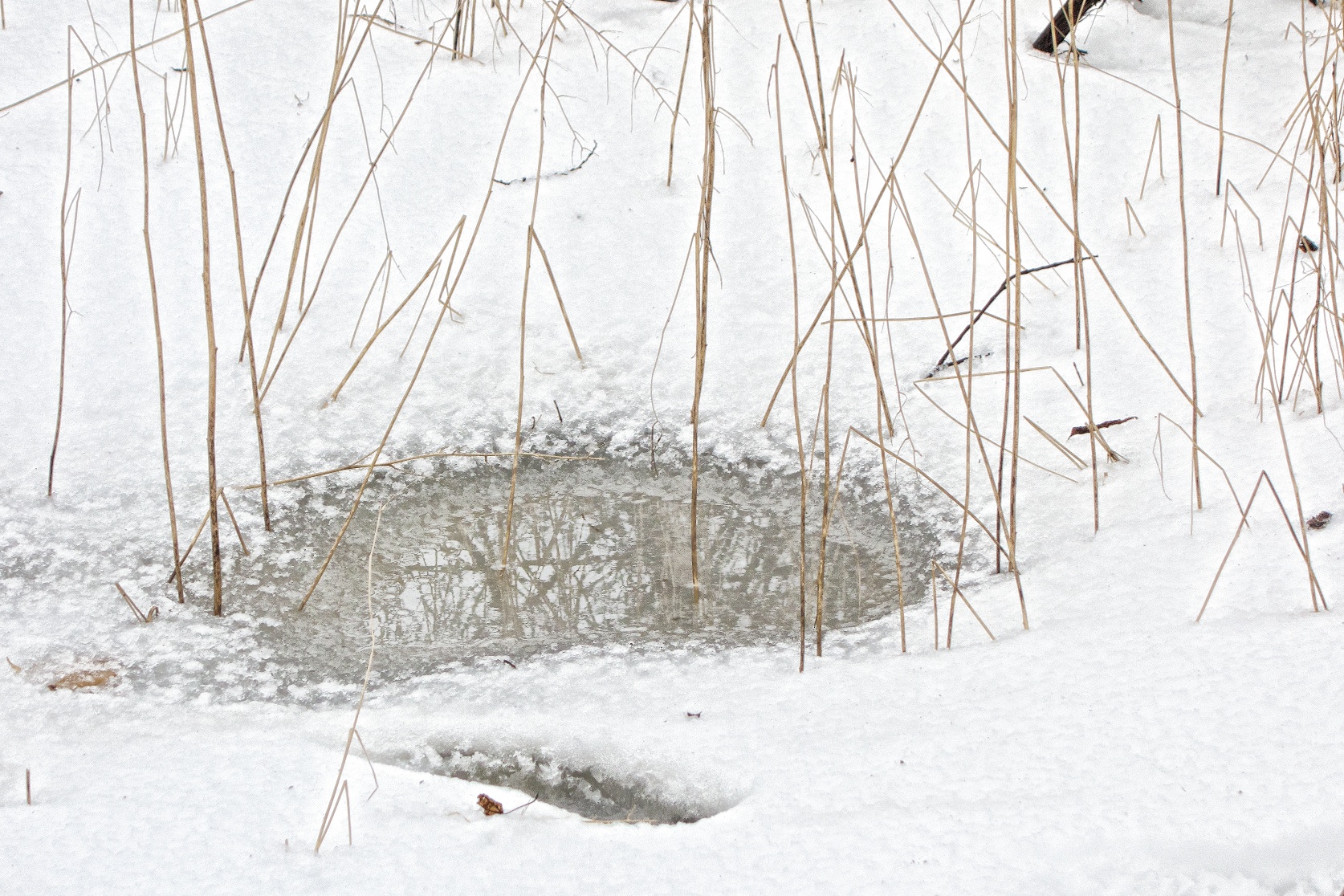
Last year’s grasses stand around a small depression.
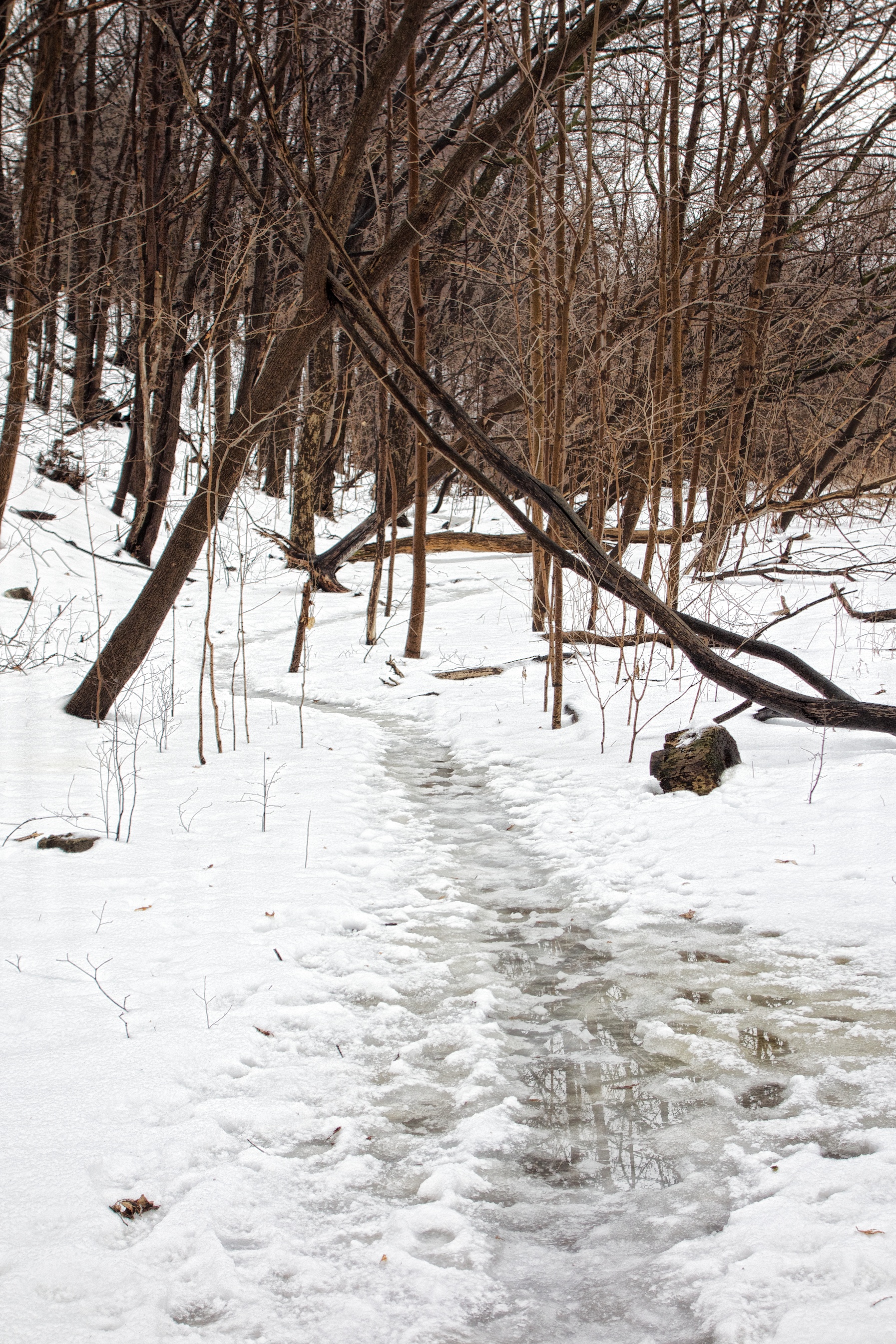
Wet branches are darker and more colourful in the rain.

After a couple of days absence from the park it was good to be back outside again. The last couple of days were bone chilling with wind chill readings below -20°. Mugsey and I had to make do with the treadmill.
The sun feels so much stronger now – the U.V. index for today was 3 and you can pretty well double that when walking in snow. The temperature however ensures that only the ‘bare’ minimum of flesh is exposed.
A fresh fall of snow allows a clean slate for tracks in the snow – these look to be from a mouse or other tiny creature.
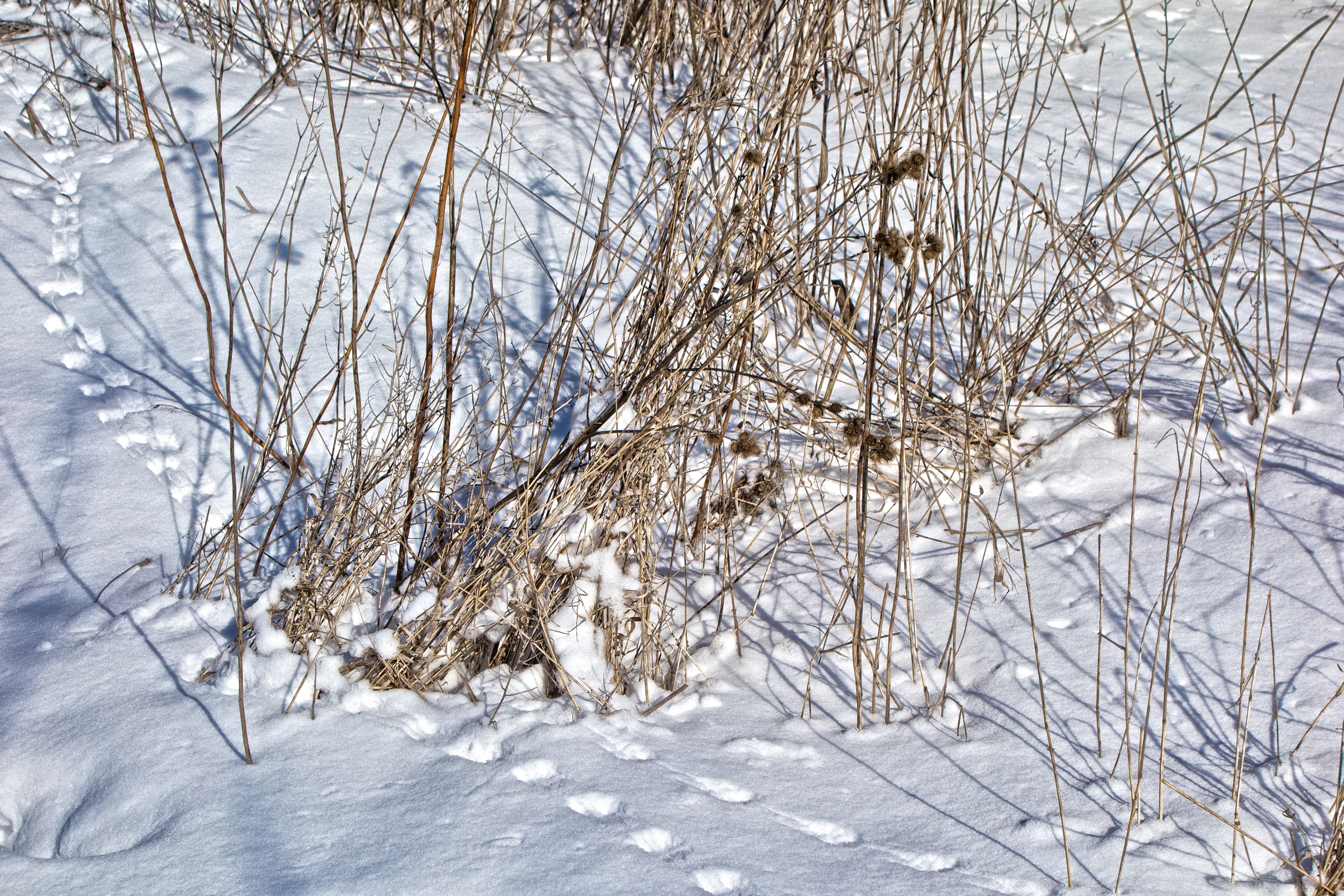
A tiny animal with a tail comes and goes through some burdock and dog strangling vine.
As with a large number of trees, many of the plants in the park are also foreign invaders. Dog strangling vine is one of these and unlike invasive species that are quite attractive such as purple loosestrife or phragmites (a tall feathery grass), DSV is as attractive as its name. More about invaders another time.
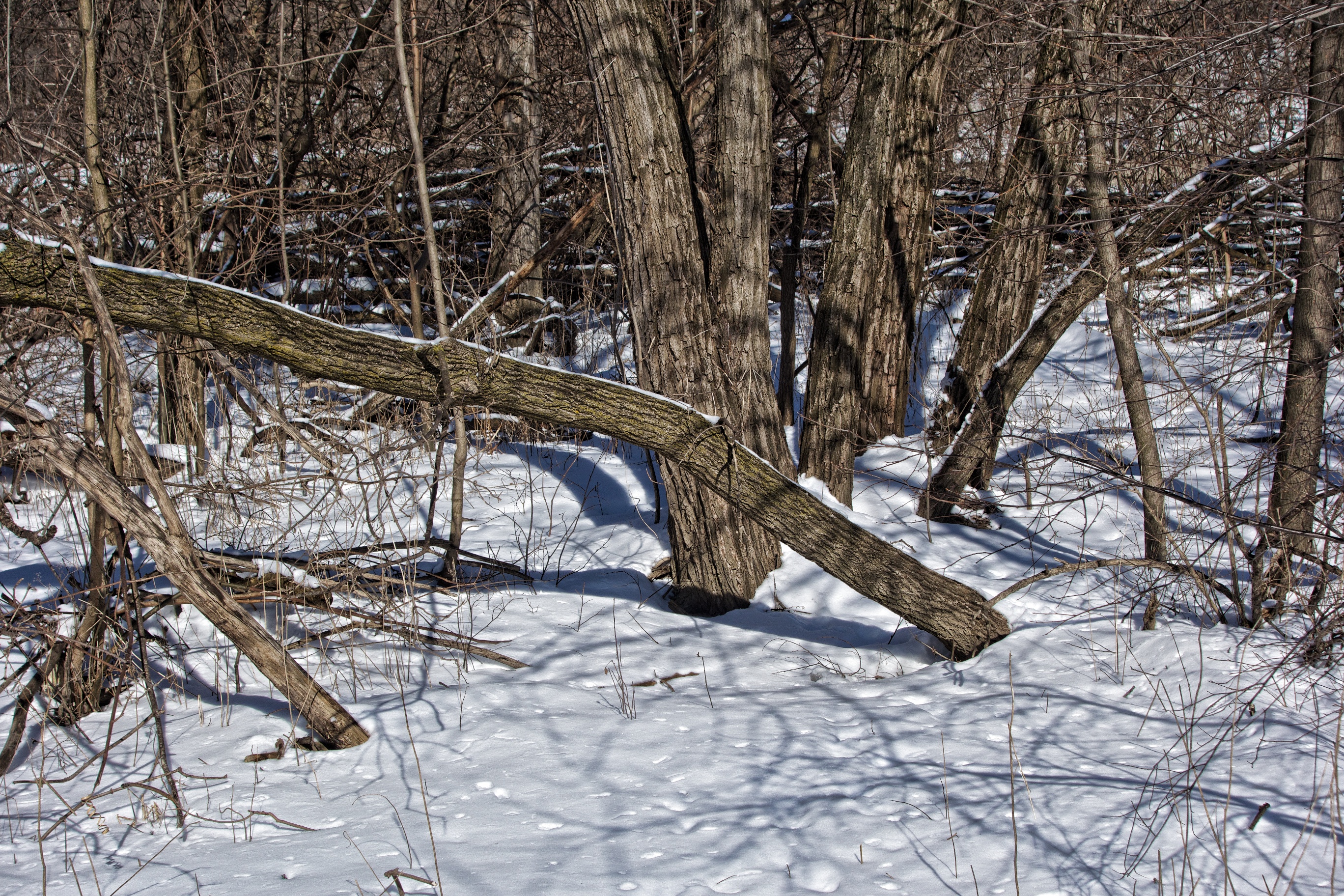
In the background, downed trees have been stacked by floodwaters to form a natural fence along the riverbank.
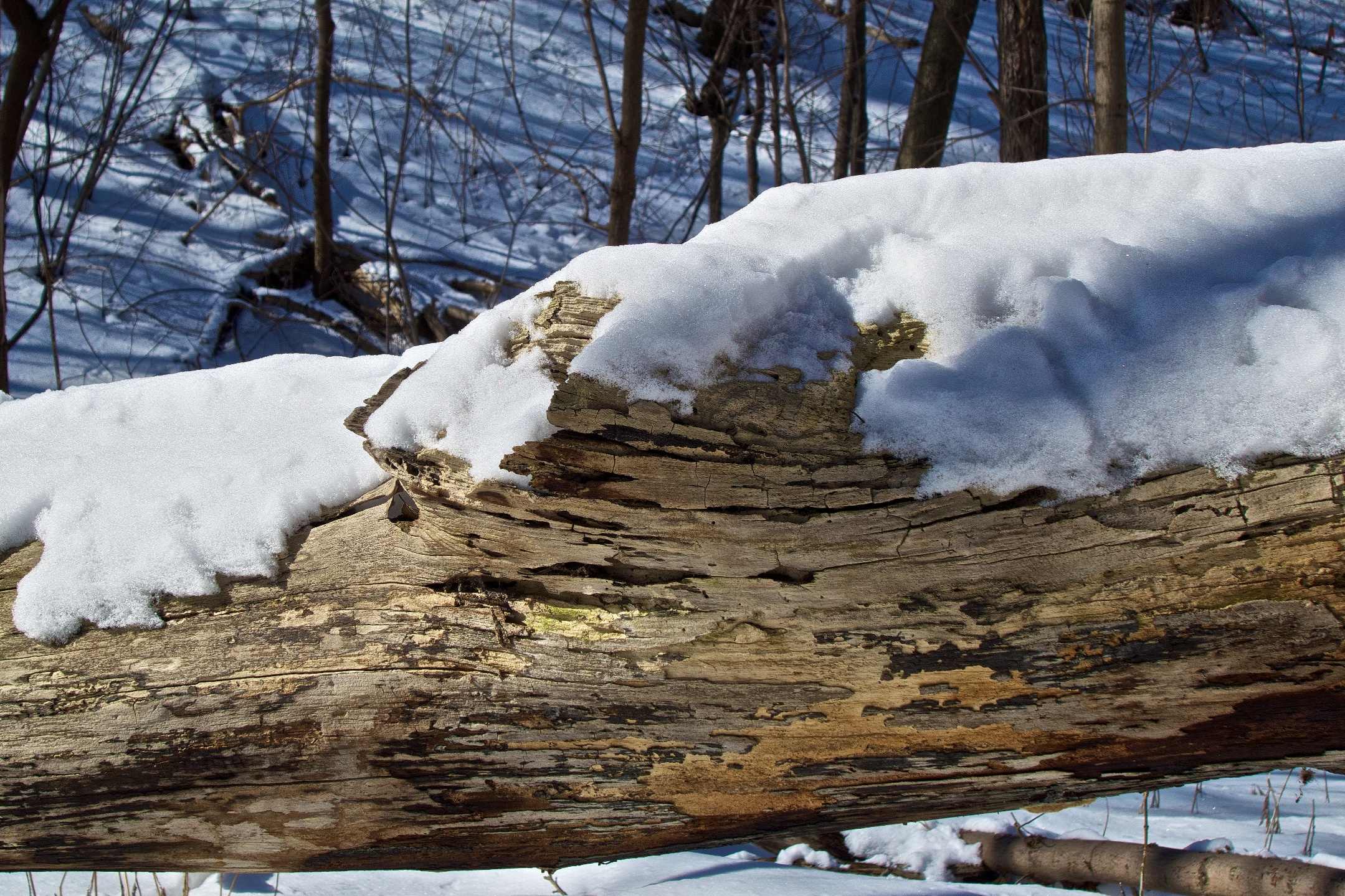
Old and new together.

Here are a couple of shots taken today. The first is a log in the snow that had a surprising amount of colour in it. The snow is granular now and adds a nice contrast in texture.
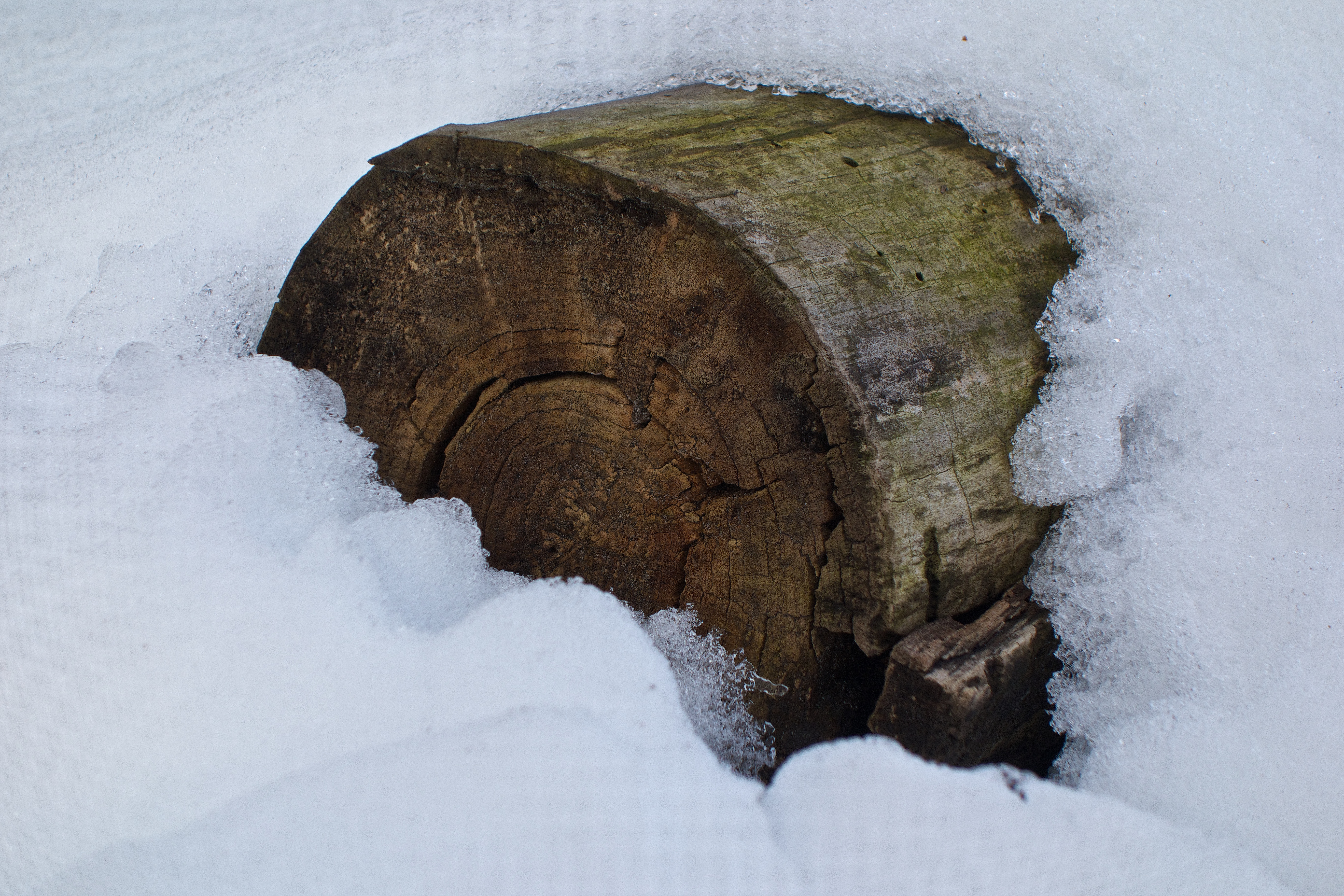
The next shot is pretty desolate – the old bleachers set against some ominous clouds, the trees of the park and the patterns of foot traffic in the snow
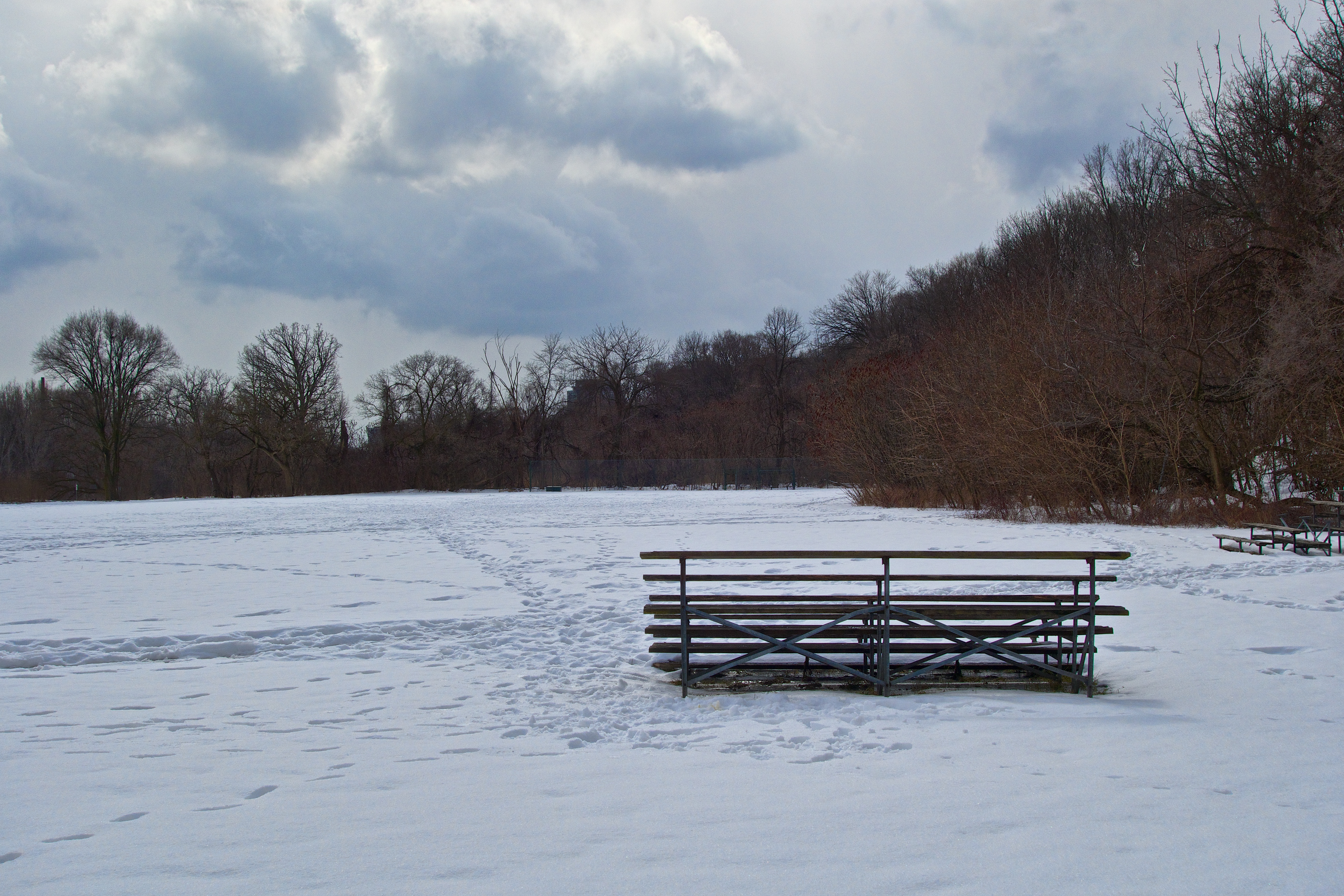 .
.

This morning snow was coming down thickly in the park. Over breakfast I watched a squirrel unerringly locate and then enjoy a treat it had stored last fall. This was a timely reminder of a show I watched on CBC this week demonstrating that squirrels don’t randomly bury food and forget about it. They can actually remember its location.
I experimented with the multiple shot feature of the Sony RX100 this morning. Normally when you take a photo during a snowstorm, the shutter speed isn’t fast enough to capture the flakes without blurring and you get a series of streaks. The multi-shot feature is designed to cut down on noise in night photography and the camera does this by shooting several images at high shutter speeds and combining them in camera. Here is one of the combination shots taken from the refuge of some spruce trees.
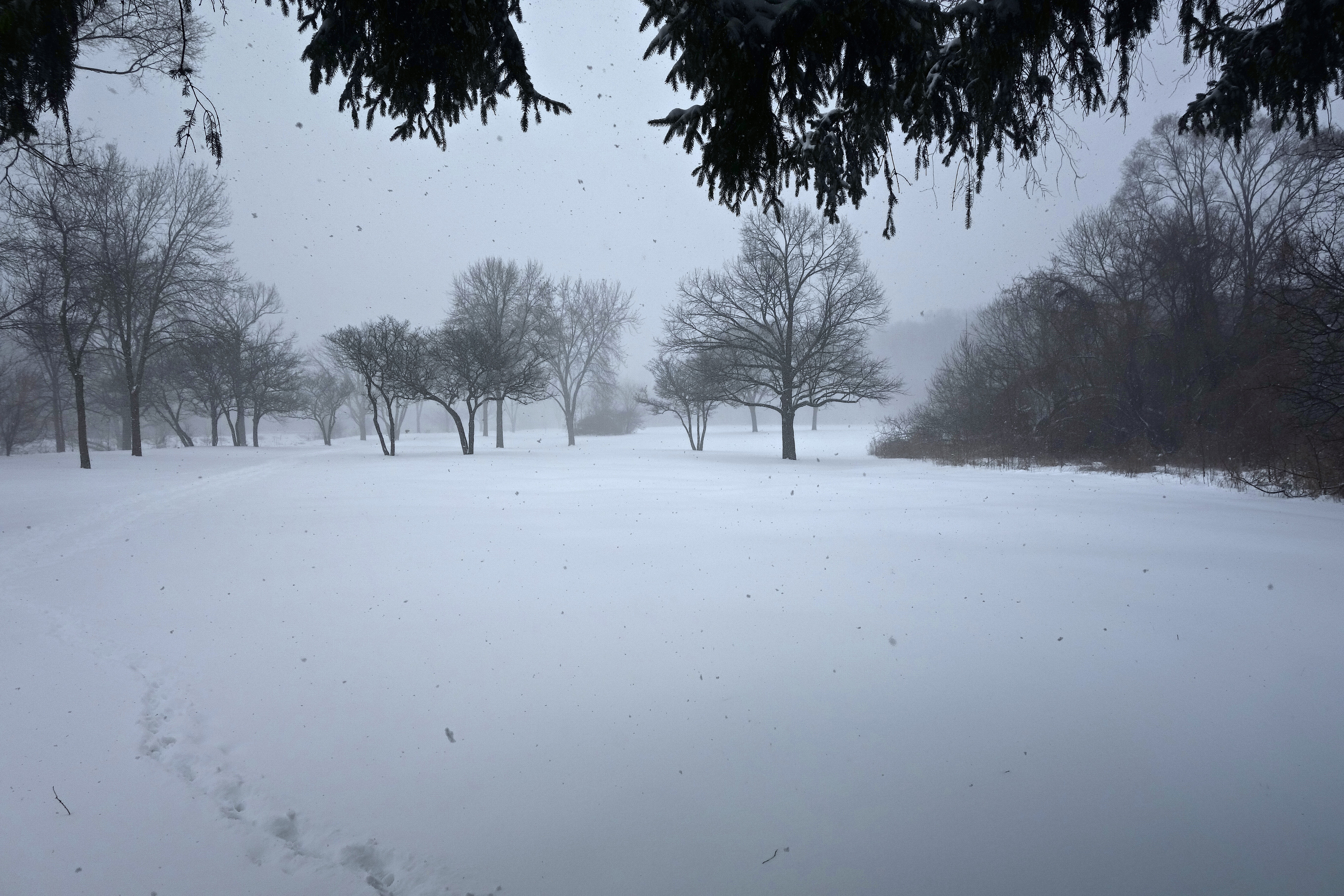
Looking south towards Eglinton.
The snow was deep enough for snowshoes today and so they were dusted off. It took a few minutes to adjust all the straps make sure they were firmly attached to my feet and off we went. Wearing snowshoes takes a bit of getting used to as it’s quite easy to tread on your own feet. The good thing is that if you fall, it’s a soft landing.
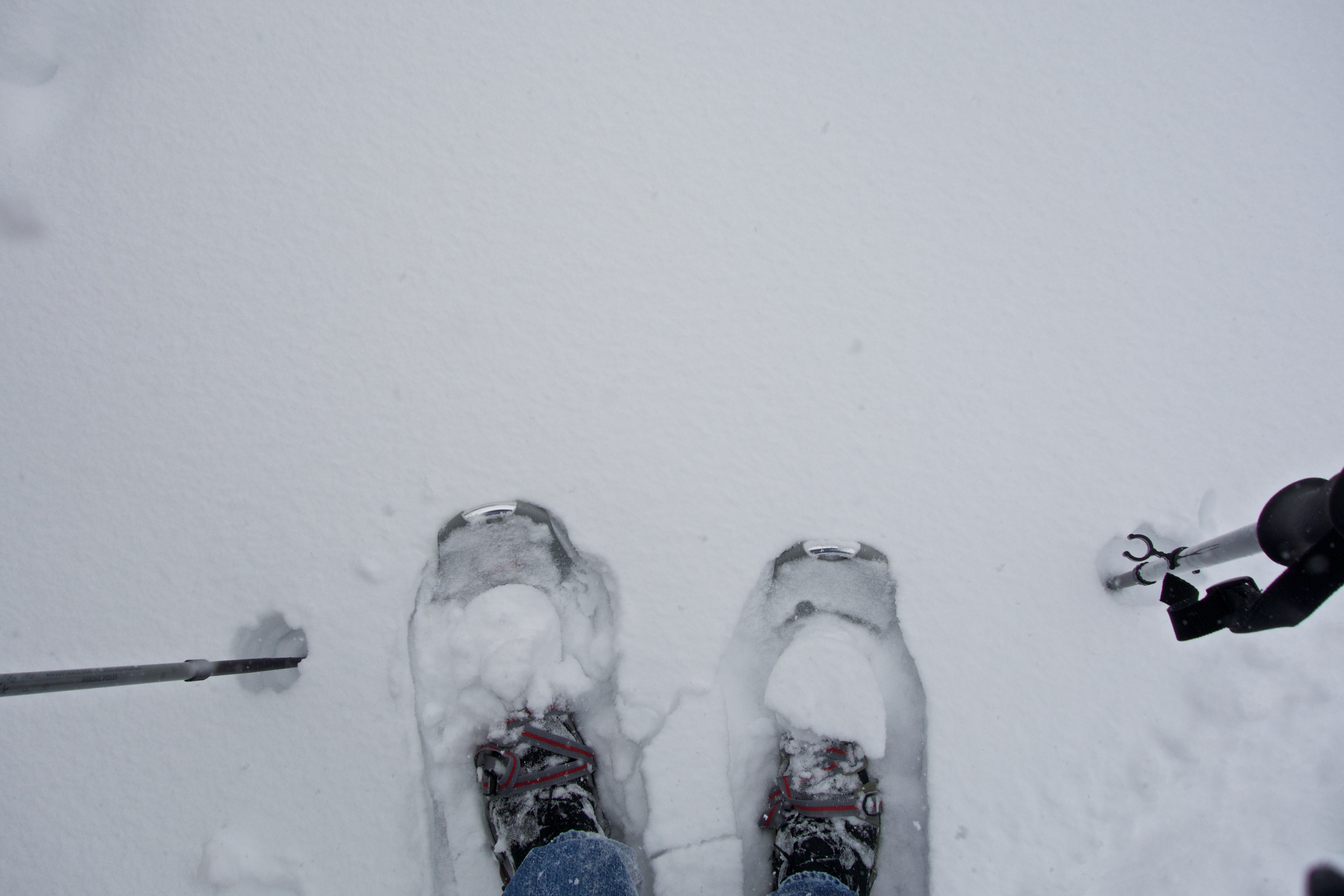
Paging Ronald McDonald.
Since your body weight is spread out over a larger surface, the idea is that you don’t sink as far as you might otherwise. Another advantage is that they help keep snow from getting into your boots. I used to imagine that snow shoes allowed you to walk on top of the snow. Not so; you’d be surprised how far you sink. What they do provide is stability and perhaps a slight reduction in effort. Even so, deep snow gives you a good workout and I was very warm after a short time.
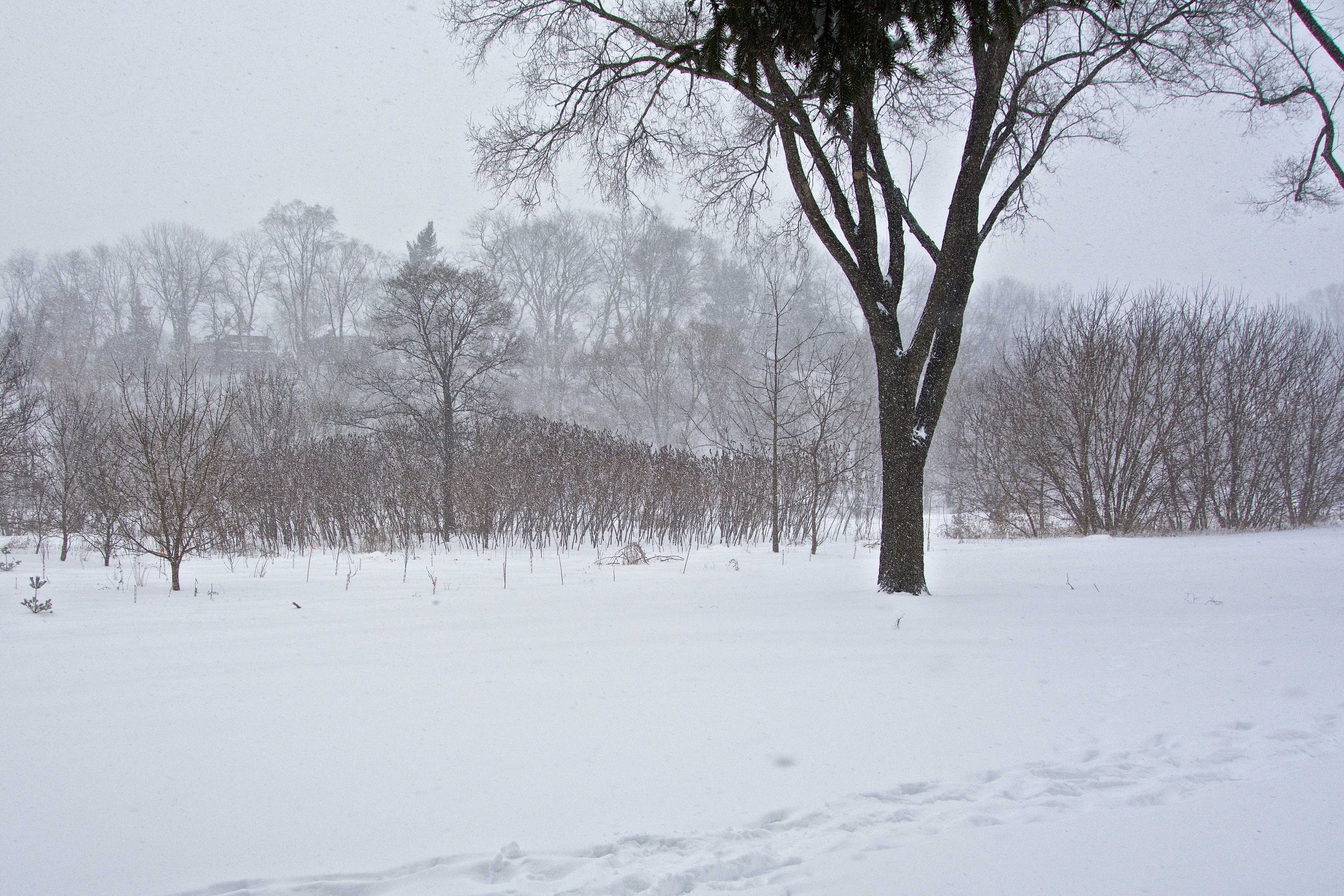
A stand of sumac sticks out in the snow.
As you can see, I was not the first to walk through the park today. Since the construction of the footbridge over the Humber in 1995, the park path has provided a vital short cut for many people making their way to and from stores in Weston and has probably saved many a car trip. The GO train now operates from Weston Road south of Lawrence and is also an easy walk. Maybe one day, Toronto City Council will recognize this and clear these important pathways after a snowstorm.

 Friends of Raymore Park