Tag Archives: Toronto

Exploring Toronto’s Aerial History: Raymore Park Before Hurricane Hazel

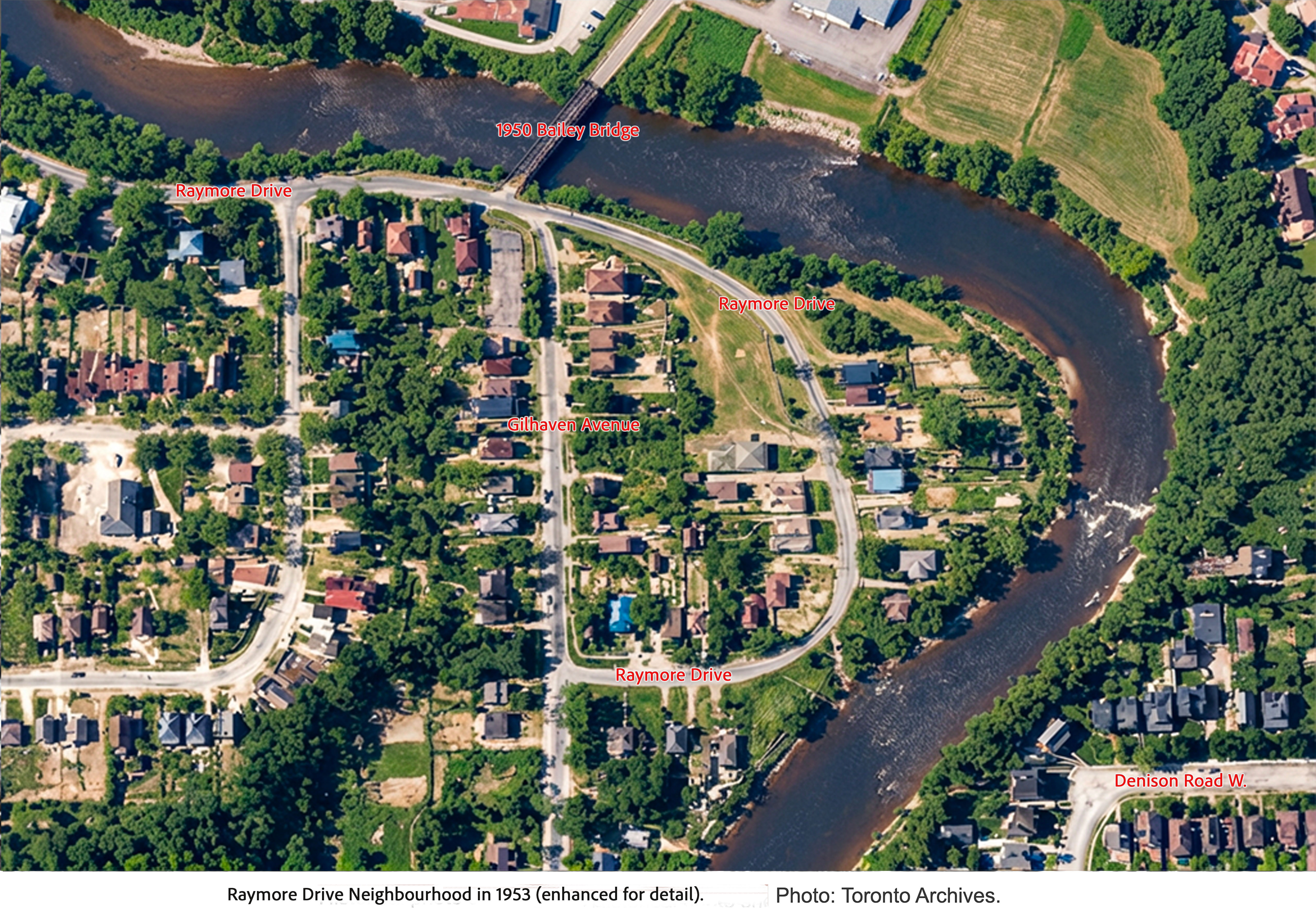
In the City of Toronto Archives there are extensive aerial photos of the city taken between 1947 and 1992. They are black and white images but reasonably detailed. While researching Hurricane Hazel I was able to download an image of what is now Raymore Park to reveal the community that existed just over a year before Hurricane Hazel struck in October 1954. Colourizing and sharpening the photo makes it resemble today’s satellite images (details are unchanged but colours are arbitrary and not historically accurate) from Google and help appreciate the extent of community that existed back then. I have labelled relevant streets.

Raymore Drive extended into what is now the park, hugging the river’s edge before heading south and looping back onto Gilhaven Avenue.
Click to enlarge.

I was surprised at the size of the community with houses occupying much of the flood plain land and stretching a considerable way down Gilhaven Avenue (now the approximate location of the bike path). It looks as if it was an idyllic place to live – riverside dwellings but with city amenities. There was even a beach for the kids. Many of the homes were cottage style on blocks while some had full basements. Most are a lot smaller than our modern dwellings. The homes destroyed seem to have been along the river’s edge at the far right and lower edge of the peninsula. The people who died lived on this stretch of Raymore.

At the top of the image, on the other bank of the river, parts of the (now demolished) water filtration plant can be seen.

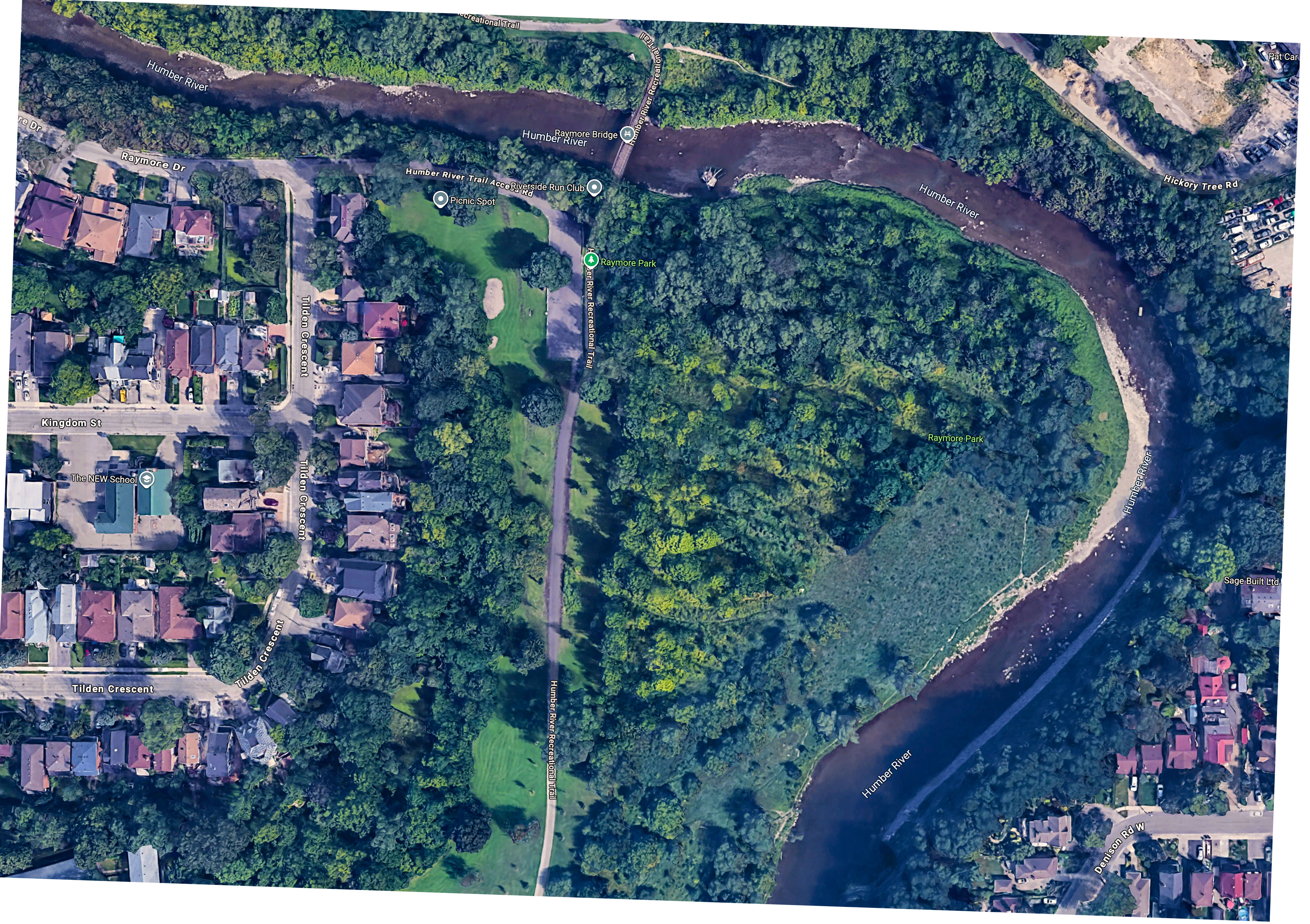
Below is a recent satellite image and I have adjusted the size and rotation to match that of the 1953 photo.
From Google. Click to enlarge.

The Bailey Bridge seen in the upper photo was put there in 1950 and both of the old abutments can be seen to this day. The current footbridge was installed in 2005.

Some of the homes along what is now the bike path were undamaged apart from flooded basements but authorities at the time elected to remove all homes in the flood plain leaving only Tilden Crescent intact. Raymore Drive was ended at Tilden and Gilhaven Avenue ceased to exist.

Very few of the buildings on surviving streets from 1953 exist today – I recognize the house that once stood at the east corner of Raymore and what is now Tilden, Westmount Gospel Chapel on Kingdom and some homes on Denison. Readers are welcome to add discoveries of their own.

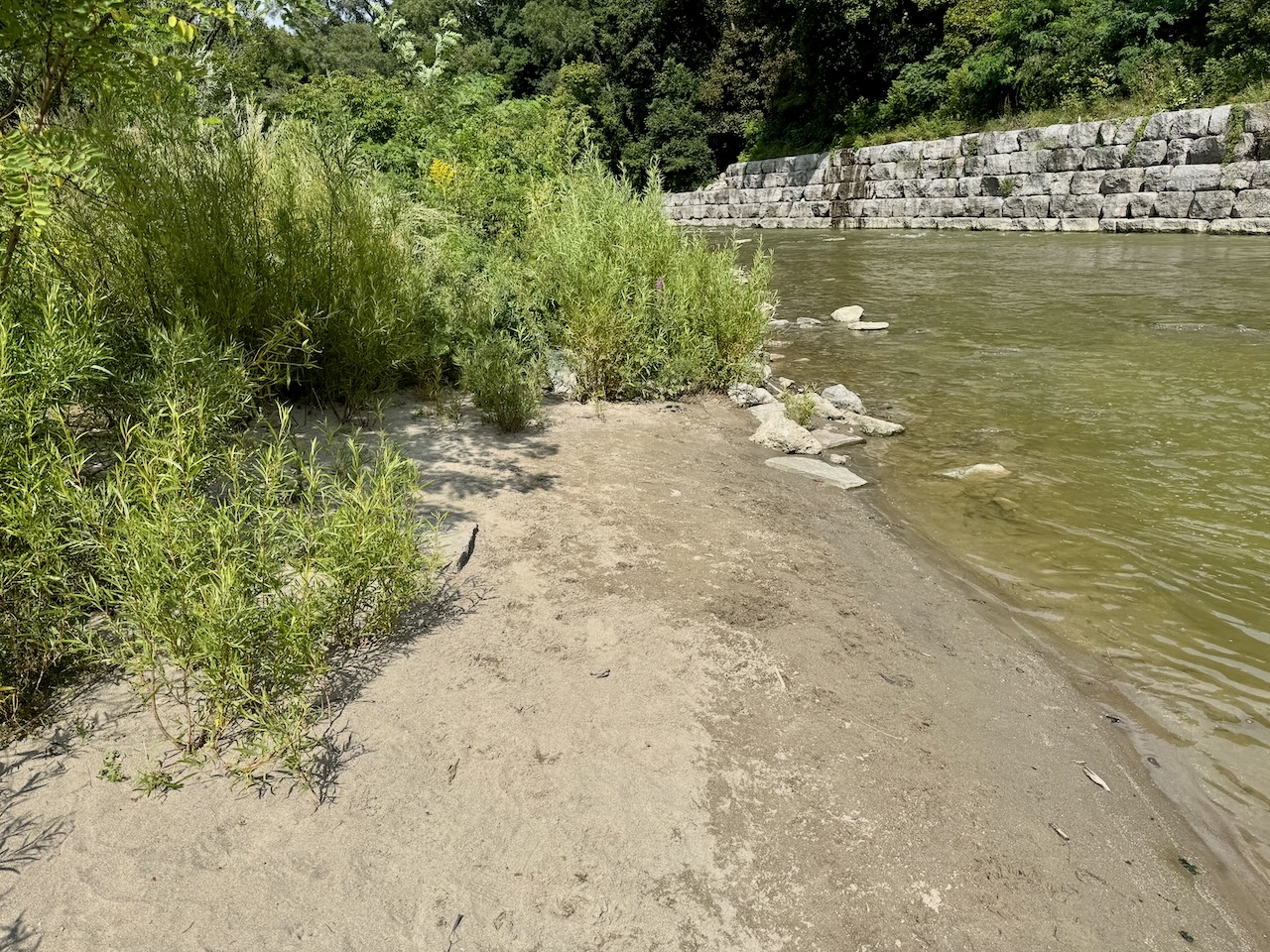
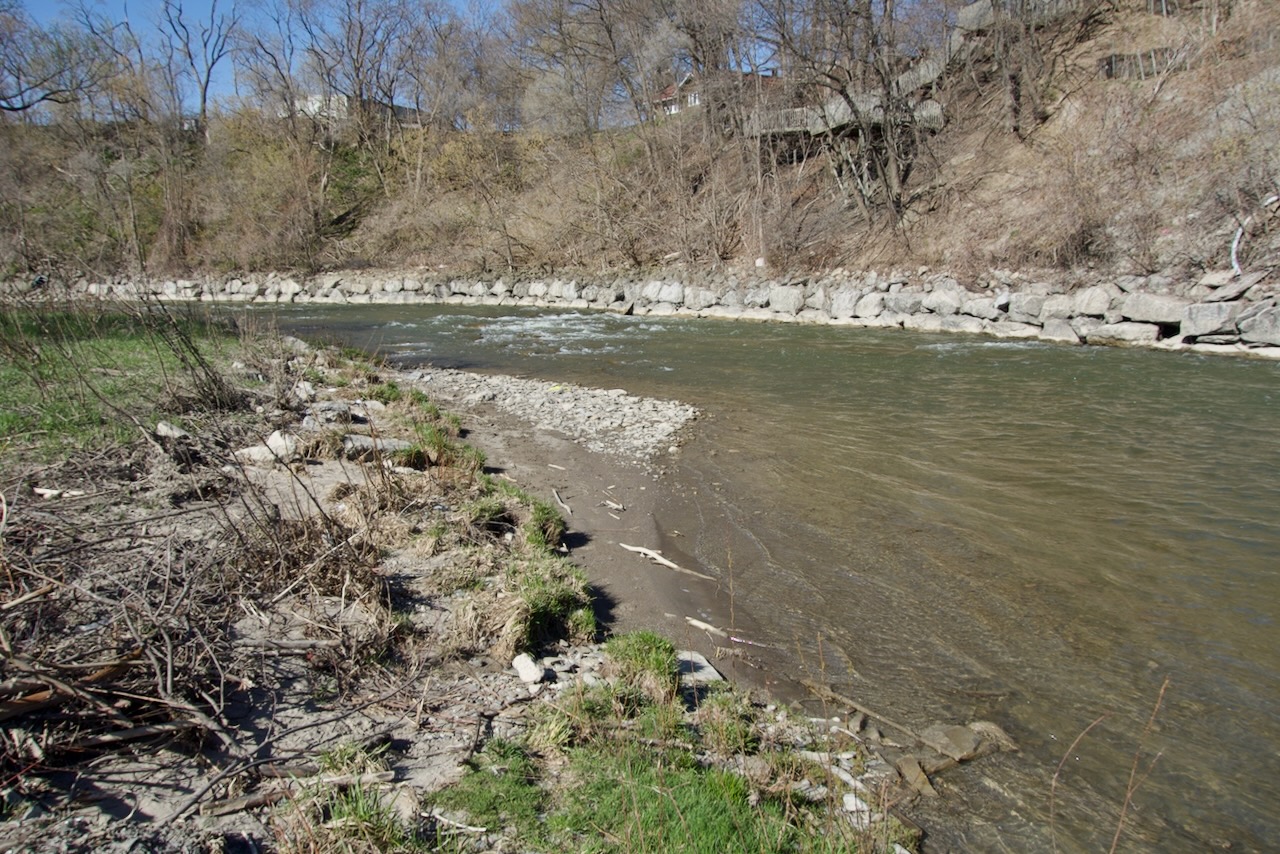
Raymore Park’s Beach is back.

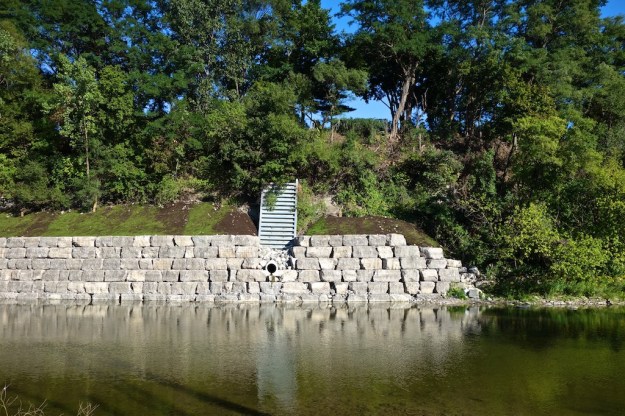
Looking north towards the retaining wall.

The Humber makes an almost 90° turn inside Raymore Park and as the current slows down on the inside of the curve, sand is gently deposited on the western bank. When the river level is high, the sand is flushed downstream towards the lake. The sand comes from the Oak Ridges Moraine where it was dumped by glaciers that melted over 12,000 years ago.

The beach in May 2014 from about the same spot showing the old retaining wall.

This is the beach that was used by children from the subdivision destroyed by Hurricane Hazel in October 1954. The beach is a dynamic thing; some years it isn’t much at all; sometimes expanding and sometimes shrinking but the sand will continue to be be deposited for the next several thousand years until there’s none left upstream.

Read more about the beach here and about what washes ashore here.

Make do and mend.

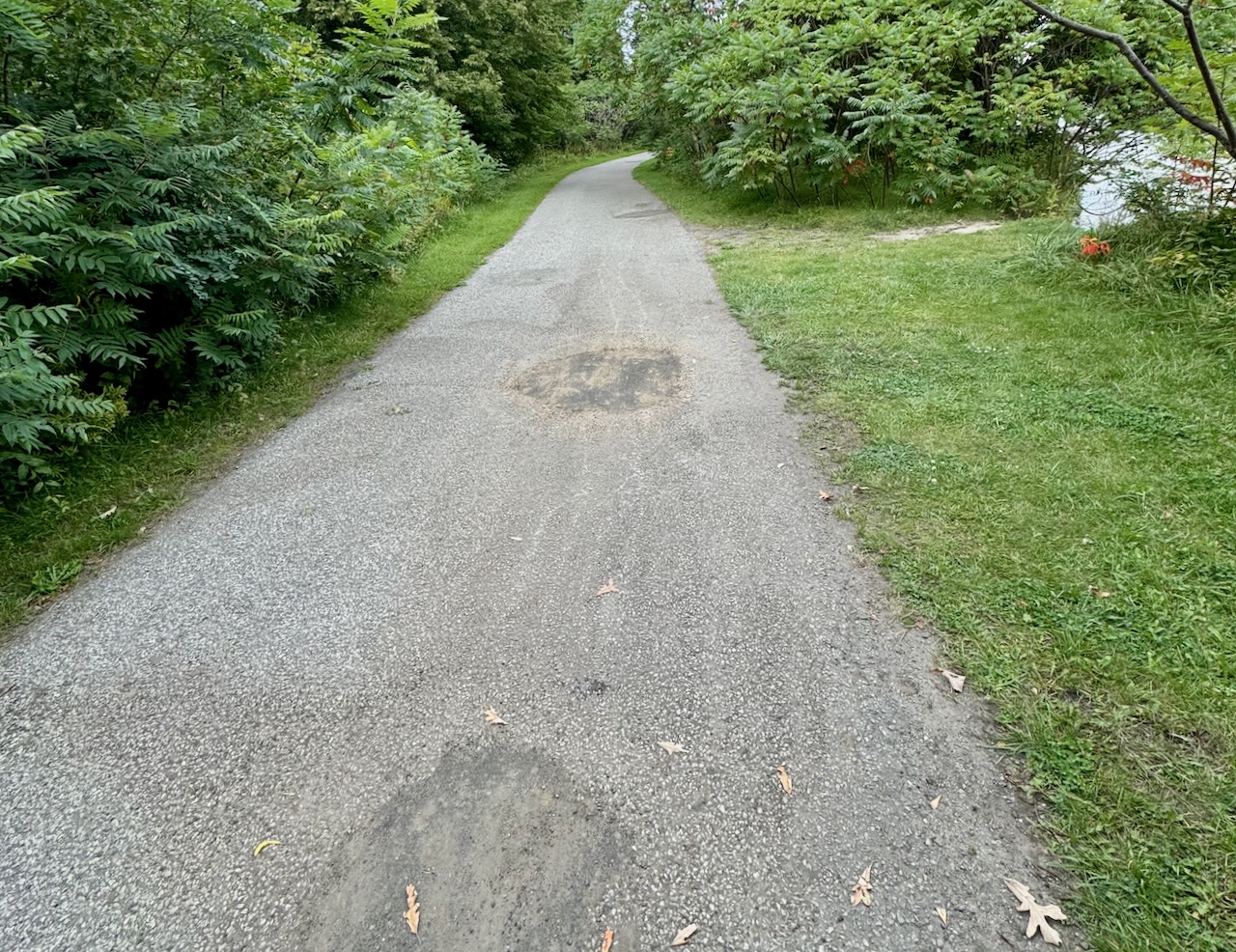
Looking north towards the weir along the Humber Trail in Raymore Park. August 2024.

Crews have finally repaired sinkholes in the bike path south of the Weir. Some of these were decades old, quite deep and particularly dangerous to inattentive cyclists. Often they would fill with water, freeze and a layer of snow would hide the slip hazard.

This section of the trail was newly paved at least 30 years ago.

Read more here.

Infrastructure problems affect Raymore Park

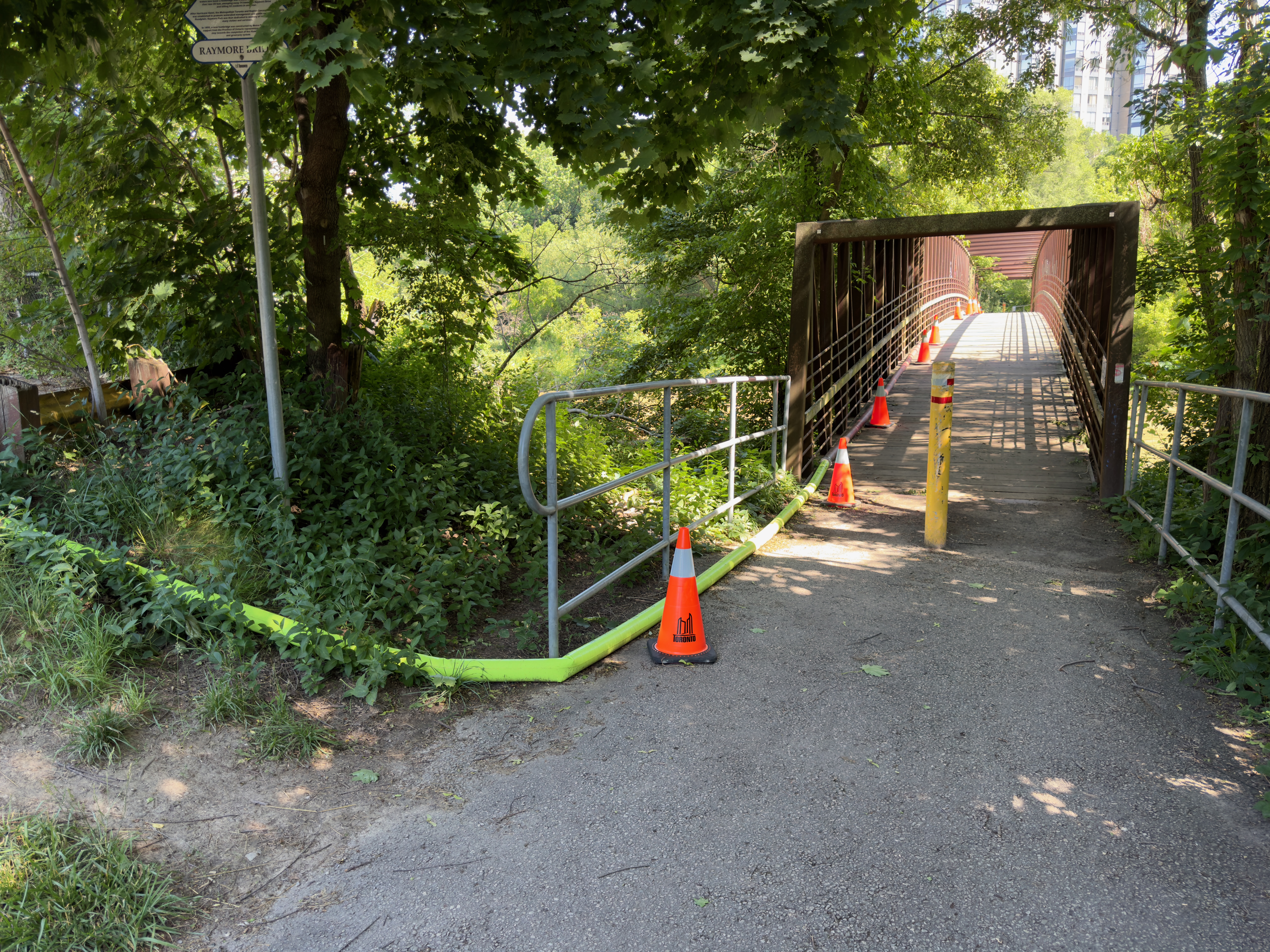
Visitors to Raymore Park may have noticed loud diesel pumps at the entrance and a rubberized pipe crossing the footbridge onto the Weston side.

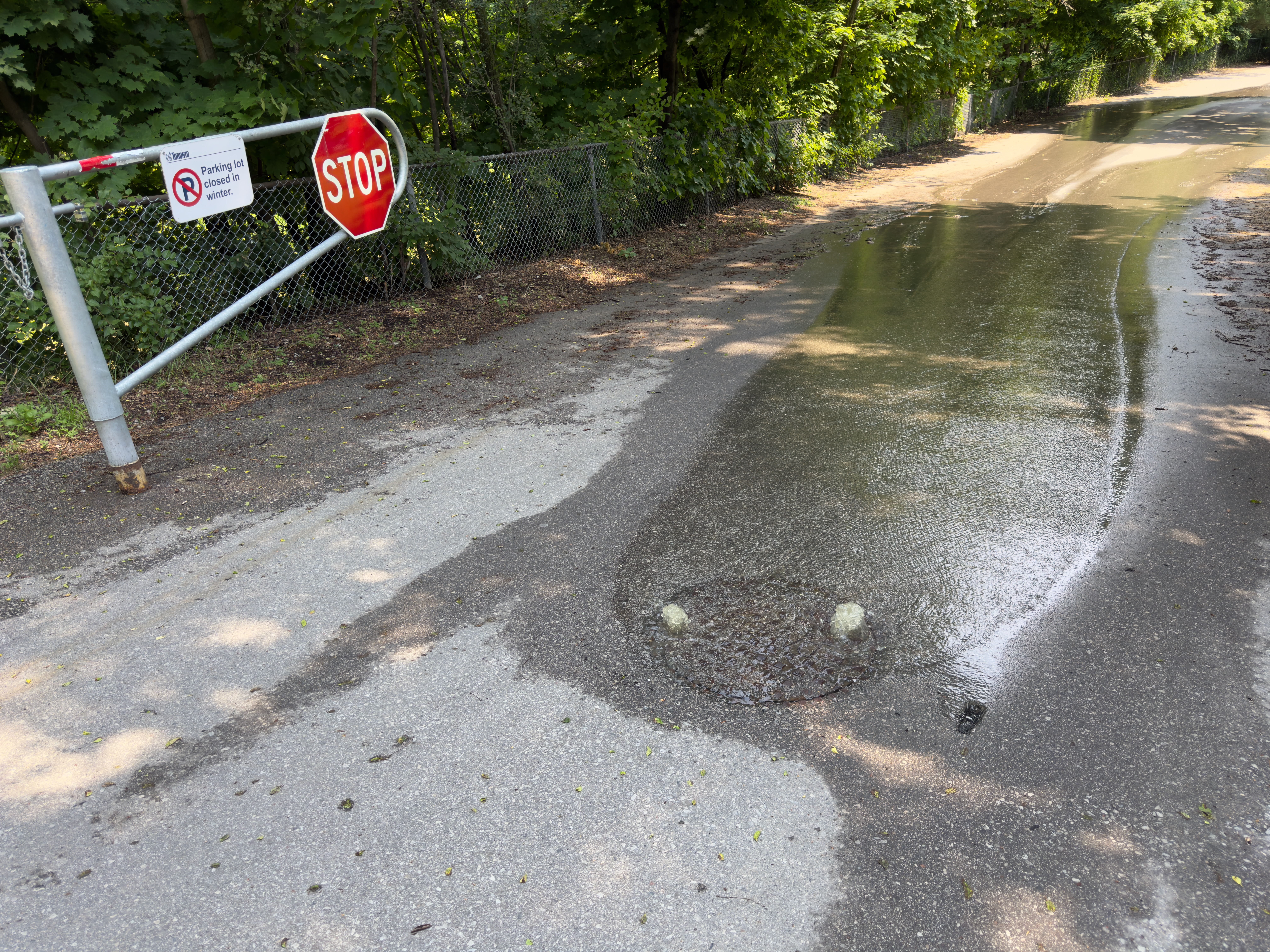
The neighbourhood around Raymore Park has been experiencing sewage backups thanks to a blocked sanitary sewer at the park entrance. Last month sewage was seen spilling out of a manhole cover and making its way into the Humber before crews could get on the job. This sewer has been blocked before, causing sewage to enter neighbourhood basements.

Raw sewage spilling from a manhole cover and making its way into the Humber. June 18, 2024.

A City work crew came out and discovered that the sewer was blocked on both sides of the river by tree roots and was crushed on the Weston side. After realizing that it was a big job, workers installed a temporary by-pass powered by a diesel pump. Sewage is now being piped over the pedestrian footbridge and into the sewage system.

Sewage piped over the bridge towards the main sewer on the Weston side. June 24, 2024.

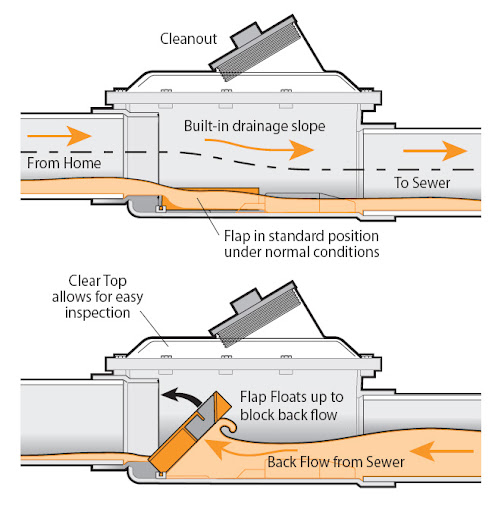
The job of clearing, repairing and relining the underground sewers is being put out to tender – a process that will take weeks if not months. Unfortunately, diesel pumps sometimes fail (twice in the last month) and these breakdowns have led to basement back-flow valves activating and in some cases, flooded basements – this is especially true during rain.
A backflow valve for basement installation. http://backwatervalve.com/

Until the sewer is cleared, repaired and relined, the bypass will carry neighbourhood sewage over to Weston. Let’s hope that the diesel pump will be carefully monitored so that local residents don’t have to deal with further sewage back ups and flooded basements.

Huge rainfall swells Humber.

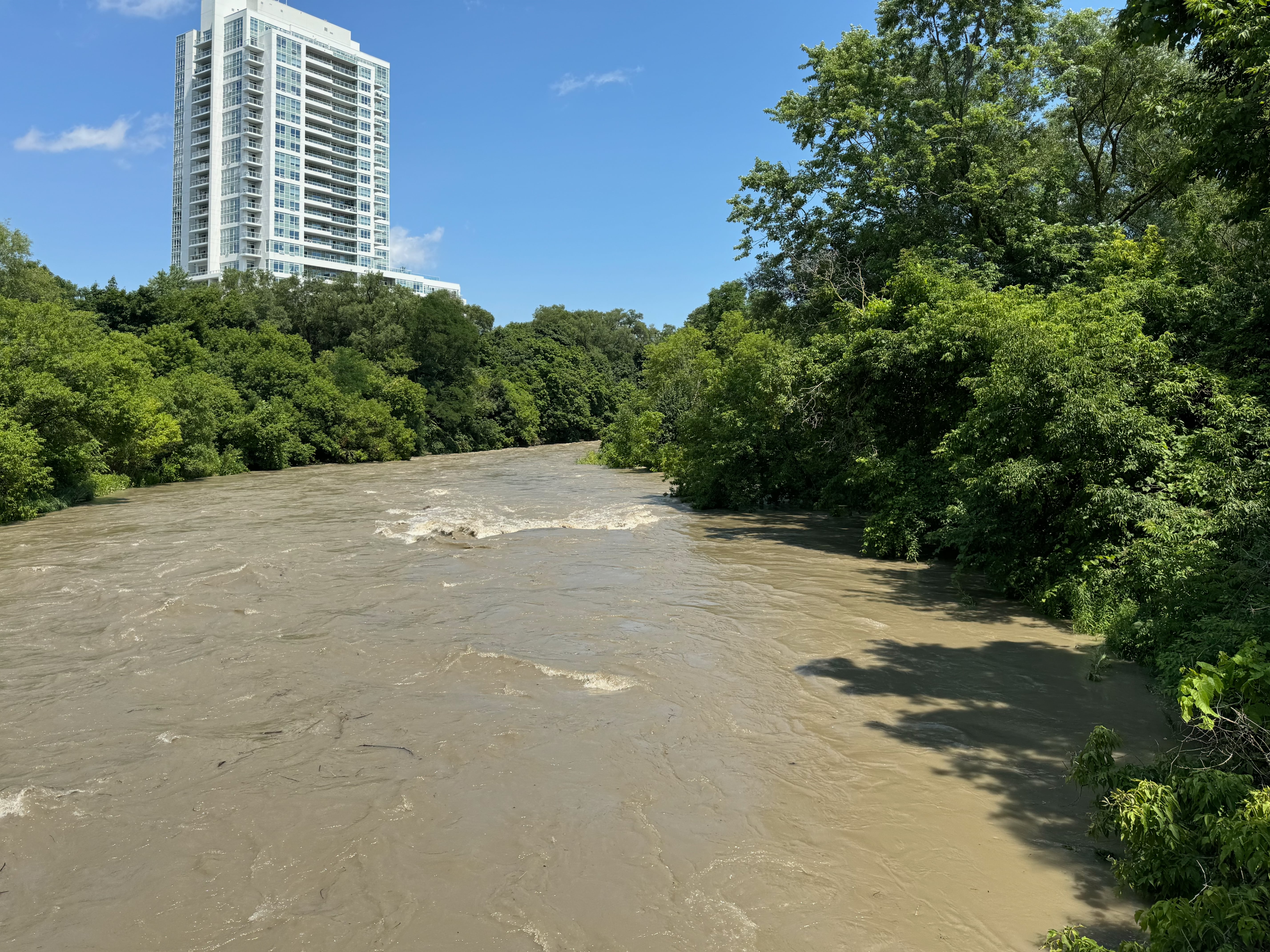
The Humber at rare levels.

July 16, 2024 was a rare but not unexpectedly rainy day. July often sees huge dumps of rain and Toronto received around 10cm in quite a short time. The Humber has a tell-tale depth gauge in the form of the old footbridge abutment which yesterday completely disappeared.

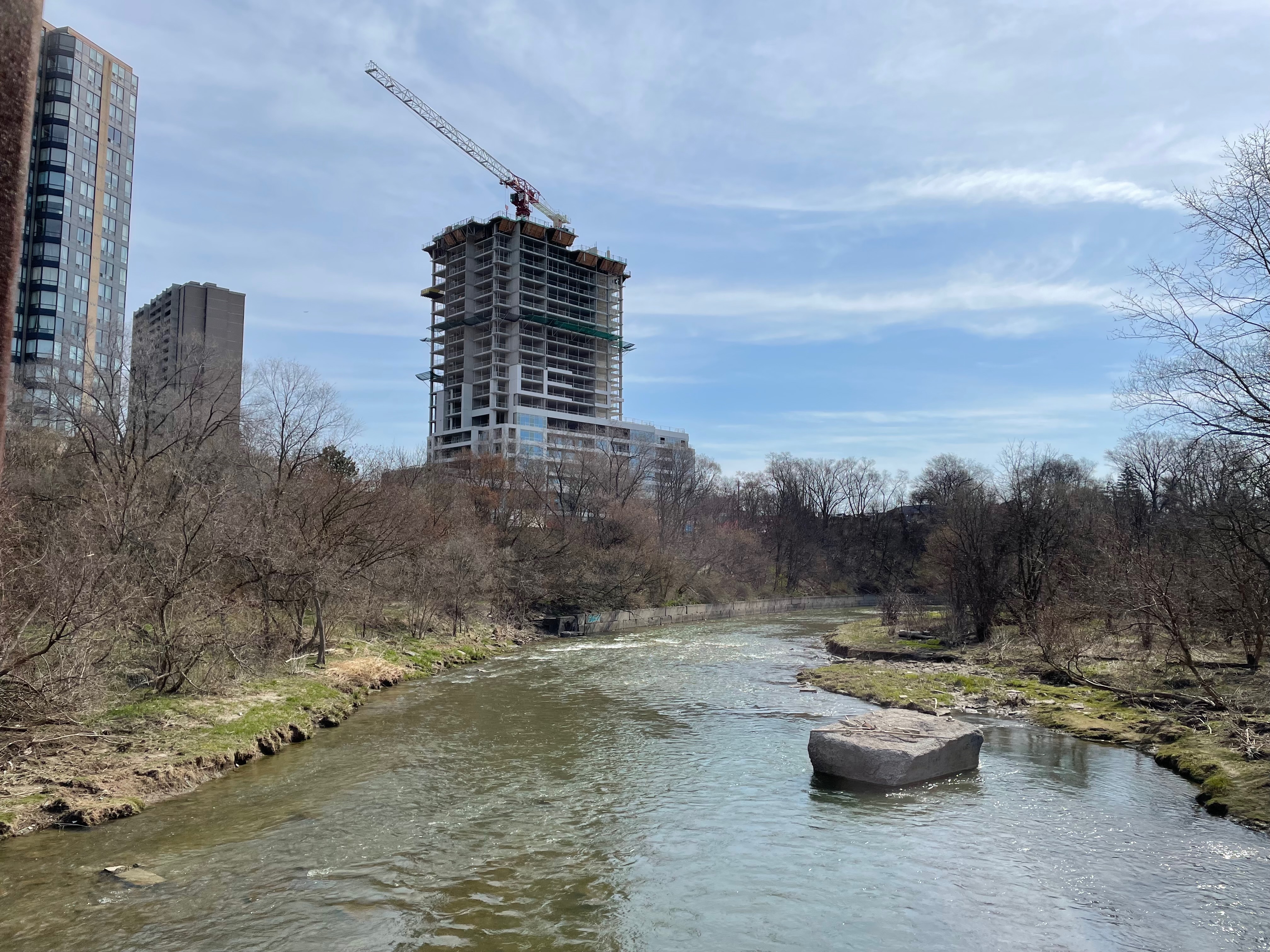
By way of comparison, here’s how it looked in April 2022.

The old footbridge abutment is clearly visible on most days. April 24, 2022.

As the city grows and more land is paved over, the ability of the river to hold huge volumes of runoff will be tested. Without green spaces and parkland to absorb runoff, the Humber would be much more of a threat during heavy rain or spring thaws.

September 2016 Construction Progress Report.

The finished product - at this end anyway.

The finished product – at this end anyway.

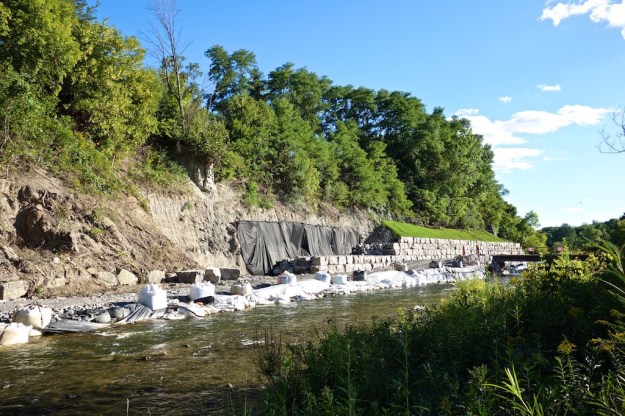
The finished appearance of the retaining wall is now evident at its southern end with a green vegetative planting just starting to sprout on the slope at the top of the wall. Regardless, there’s still a long way to go. It also looks as if the homeowner with riparian rights has now wisely decided to take advantage of the opportunity and so construction has begun further upstream. The original intent was to construct the wall along the full length and that now seems to be the plan.

dsc05907

A nice cross-section is visible from the northern end of the wall. (click to enlarge)

Astonishingly, even after all this effort, the work looks as if it’s only about 40% done and so there is a long, long way to go before this project can be signed off. The wall construction was originally scheduled for completion this past spring with brick removal from the access area and subsequent landscaping to take place this fall. Obviously, that ain’t gonna happen. My estimate at the current rate of construction is that they’ll be lucky to have the project completed and everything restored by the end of 2017. This seems to have been quite a miscalculation by the planners. The project was to cost a maximum of $250,000.

I’ll bet that marker was skated past months ago.

Signs of spring

Winter is finally over – the signs are everywhere but interestingly, native plants are some of the last to leaf and bloom, possibly as a protection from our continental climate’s treacherous ability to produce late snowfalls and frosts.

Imports feel no such constraint. Alongside the old path that follows the curve of the river, some old exotic plants remain from the days when people had homes by the water. Many of these remnants of domestication are unnoticed but somehow they have survived and stand as a mute testament to the victims of Hurricane Hazel in 1954.

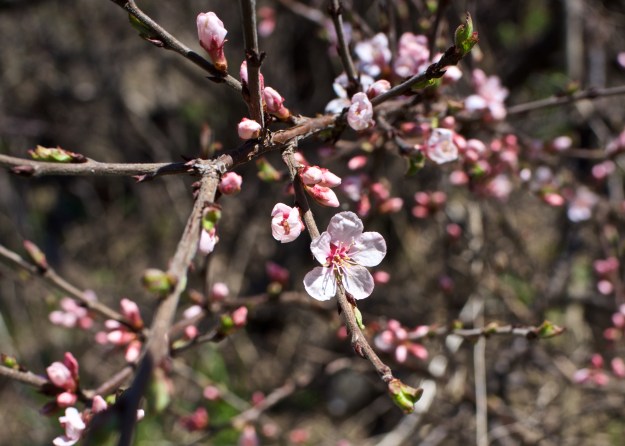
An exotic tiny blossom.

An exotic tiny blossom.

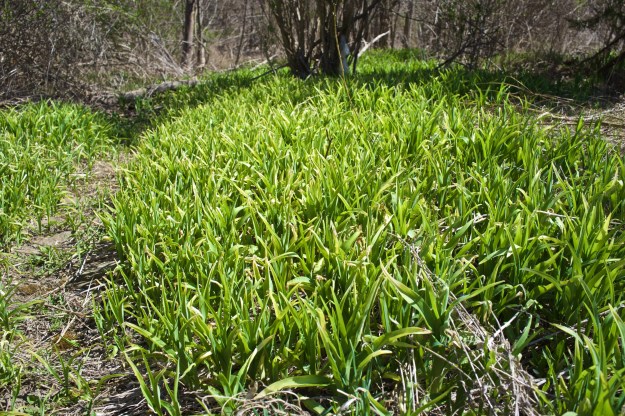
Day lilies carpet this fertile flood-prone corner of the park.

Day lilies carpet this fertile flood-prone corner of the park.

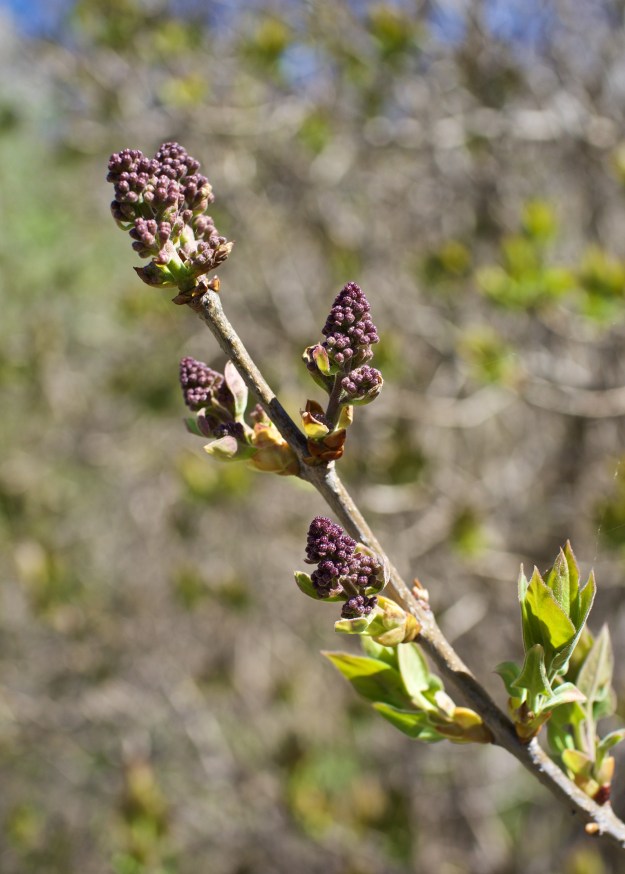
A lilac bush has begun to leaf and flower buds are set to bloom in a couple of weeks.

A lilac bush has begun to leaf and flower buds are set to bloom in a couple of weeks.

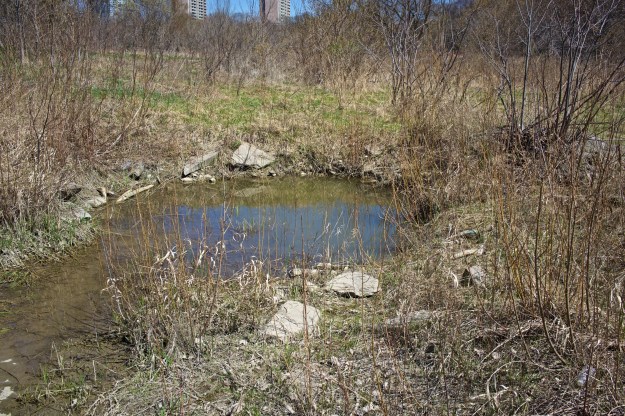
This pond was eroded out of the ground a few years ago as a result of an ice-jam temporarily diverting the river. It was promptly occupied by eastern American toads. No sign of the eggs or tadpoles yet.

This pond was carved out of the ground a few years ago as a result of an ice-jam temporarily diverting the river. It was promptly occupied by eastern American toads. No sign of this year’s eggs or tadpoles yet.

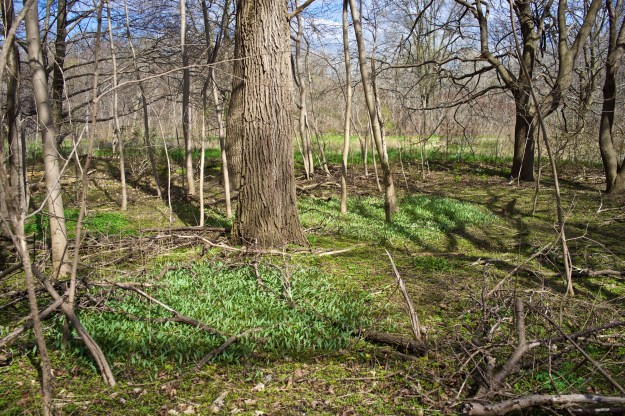
A carpet of toad lilies has sprung up in the woods south of the weir.

A carpet of toad lilies has sprung up in the woods south of the weir.

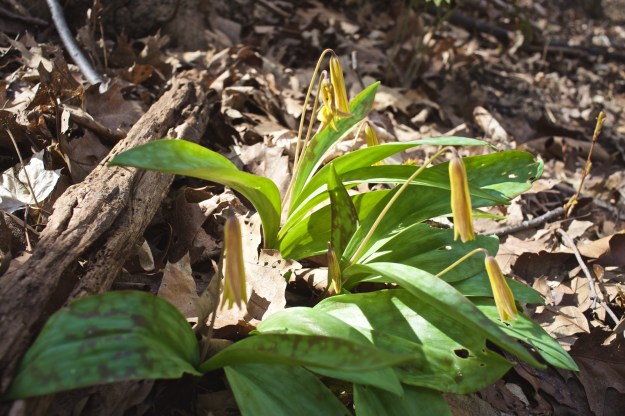
Toad lilies up close.

Toad lilies up close.

Toad lilies.

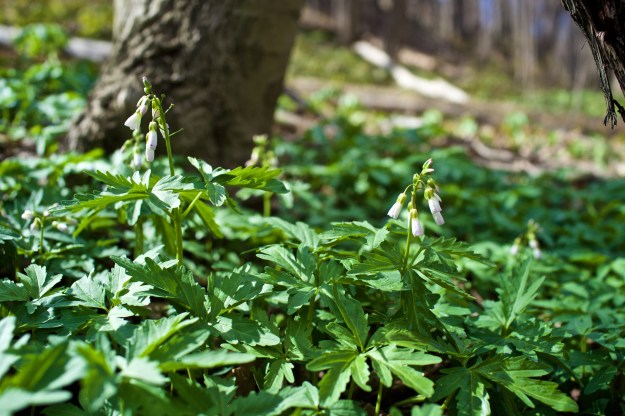
Cut leaved toothwort in the woods.

Retaining Wall Update April 12

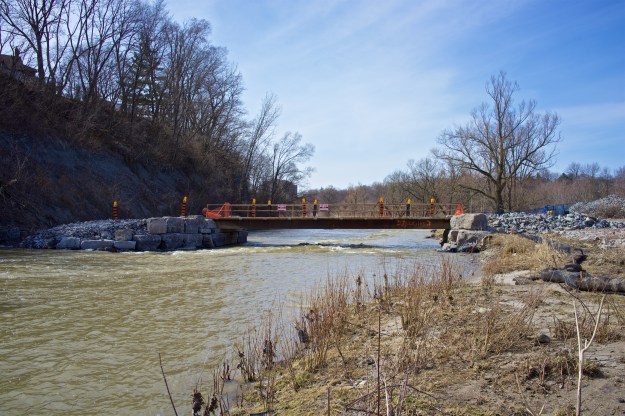
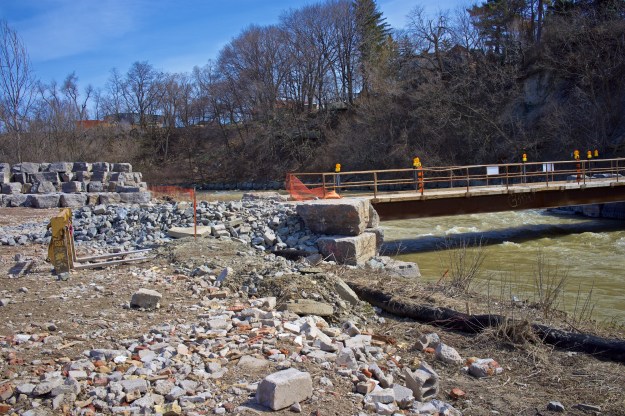
It’s truly astonishing seeing the scope of this work and the seemingly glacial pace at which it is trundling along. As of last weekend, not much has changed except that the new bridge has had its eastern abutment extended to the far bank.

The bridge with its extended abutment.

The bridge with its extended abutment.

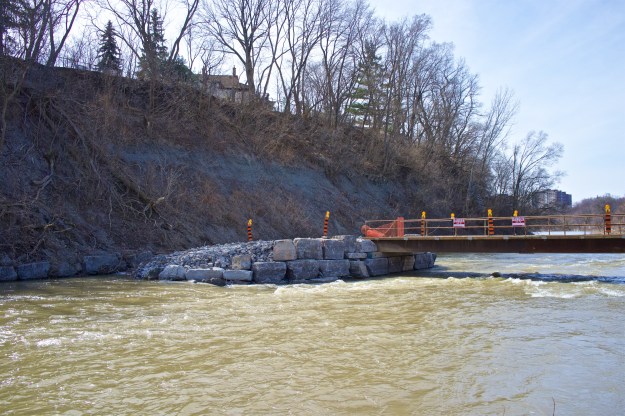
The result of the new abutment is to constrict the river at this point and warnings have been placed south of the bridge about the dangerous flow.

A close-up of the abutment.

A close-up of the abutment.

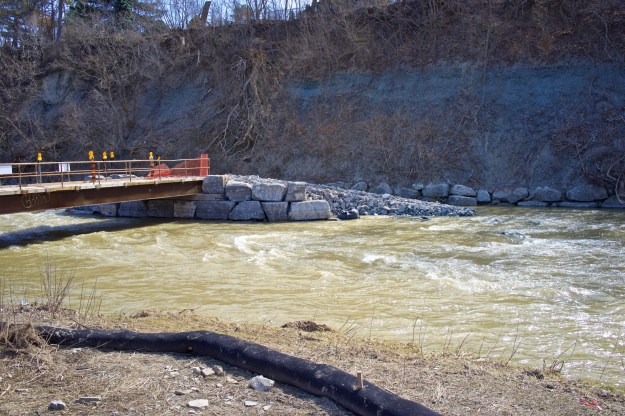
The extended abutment from downstream.

The extended abutment from downstream.

text

The faster flowing water downstream.


Off-Leash Area Update

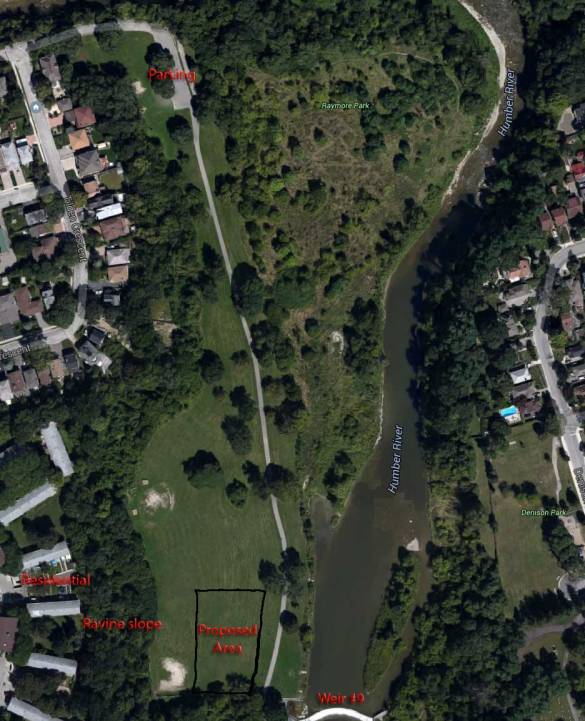
Raymore-Proposed-Leash-Free-Zone

The proposed area may have grown (probably northwards) by a small amount because of the addition of a separate small dog section. There was some discussion as to the nature of the surface of the area which apparently will be 4-6″ of pea gravel on top of a mesh filter which will help with drainage. As mentioned, plans are to divide the area into two parts for small and large dogs so there will be two gates and two paved pathways from the Pan-Am Trail for access. The small dog area would be for dogs 20 lbs and under. Regardless, all dogs should be under the owner’s control at all times. Dangerous dogs should not use the area. See Code of Conduct below.*

Fencing will be post and paddle, 1.5 m tall and made of northern pine. It will be reinforced with wire mesh 4-6″ deep to deter dogs that dig. Benches will be installed for owners.

There will be a delay in the opening of the area because of work currently ongoing on the retaining wall. This is taking longer than expected. There is only one entrance to the park and so the retaining wall and another job – an upgrade to the path will be done first; after that, sewer work will be ongoing. The reckoning is that the area will take about a month to set up and will be open by ‘Thanksgiving at the latest’.

One piece of good news is that TRCA has plans to plant trees along the north end of the area and between the area and the ravine slope. This will provide storm runoff relief and shade for the area (and perhaps some sound mitigation for nearby homes).

Hours of operation: 7 am – 9 pm but locals will be able to access the area at any time. The parking lot will continue to be locked at 9:30pm daily and re-open at 8:00am and will be closed for the Winter between November 1st and April 30.

There was a reminder to residents that the area will be self-policing and that they should supervise and pick up after their pets. There was confusion as to where to put dog waste – in the garbage or the recycling. This will be cleared up later (the location not the waste).

Sadly there is still no link on the City website to the plans or even the current state of off-leash parks.

*Code of Conduct for Off Leash Area

Municipal Code Chapter #608

  1. Comply with all signs and boundaries.
  2. Dog(s) must be on leash at all times except when in the designated off-leash area.
  3. All dog(s) must have a visible municipal license affixed to the dog(s).
  4. Dog(s) must remain in off-leash area so as not to trample or endanger plant material and other park resources.
  5. Dog(s) excluded from off-leash areas include:
    1. Pit Bulls or other dangerous animal
    2. Female dogs in heat
    3. Any dog(s) that has been issued a muzzle order by the Medical Officer of Health.
  6. Dogs shall not chase wildlife.
  7. Pick up after your dog(s) and place waste in receptacle or take home for disposal.
  8. Keep dogs in sight and under control at all times.
  9. Do not leave dog(s) unattended while in off-leash area.
  10. Repair holes dug by the dog(s) under your control.

Violation of Bylaws are punishable by fines.

Retaining Wall Update: Blocks Arrive

Screen Shot 2016-02-22 at 9.48.53 AM

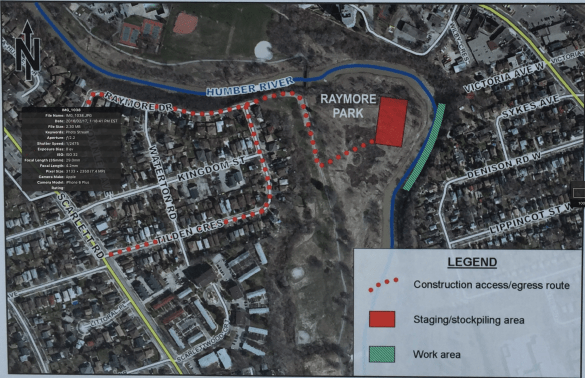
The official diagram showing the working area of the project.

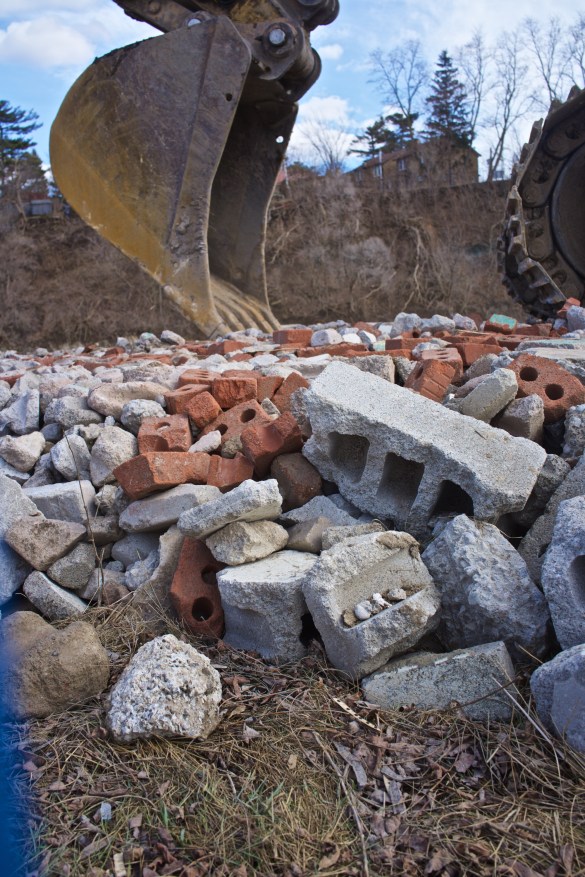
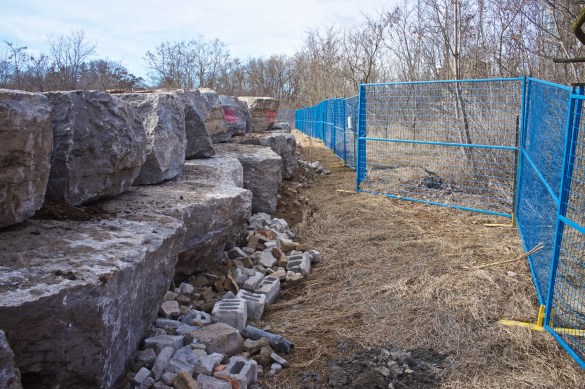
Truck after truck of old brick rubble came trundling into the park last week to consolidate the staging / stockpiling area. All of this material will eventually have to be scraped up and carted off again; probably late next month. No doubt this will have added substantially to the cost. Meanwhile, big blocks that will form the new retaining wall have arrived.

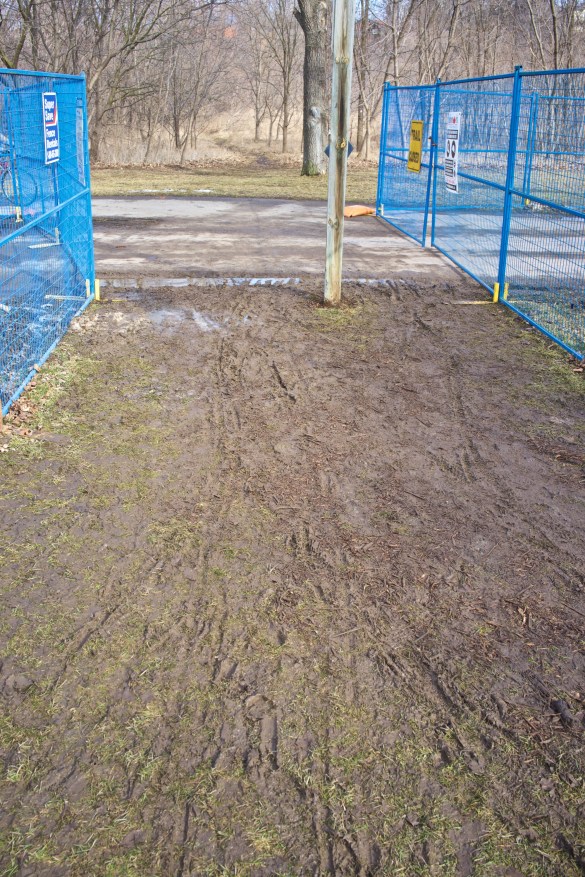
Mild weather has brought new problems, this time for pedestrians and cyclists; mud. This mud is unavoidable for anyone wishing to travel past the construction. It might be helpful if the construction crew – ever vigilant for pedestrians (wishing to stay clean) straying through the paved area – could spread some wood chips to make life easier and cleaner for people.

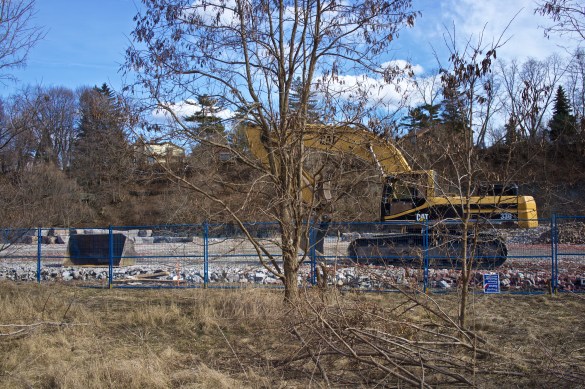
Large machinery resting on the base.

Large machinery resting on the base.


A close-up of the base.

A close-up of the base.


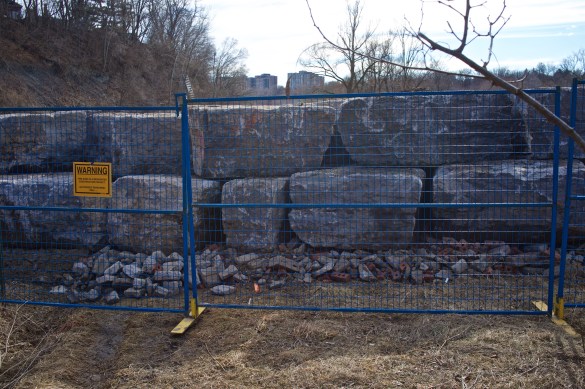
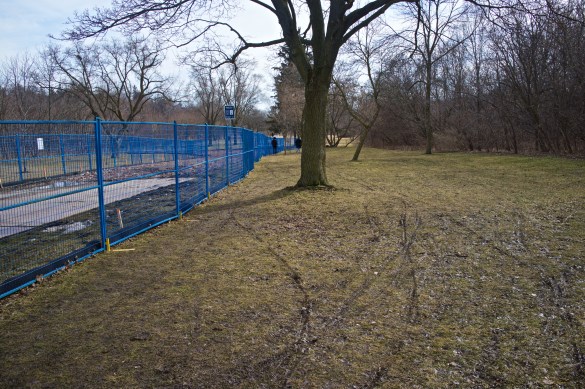
Blocks for the retaining wall are waiting to be installed. The fence is about 6' high.

Blocks for the retaining wall are ready to be installed. The fence is about 6′ high.


The blocks are natural stone.

The blocks are natural stone and should last a few years!


This is the treacherous route for people moving past the construction.

This is the slippery quagmire for pedestrians and cyclists. Wood chips will help greatly here.


Cyclists have obviously made their mark.

Cyclists are making their mark.

Update: Wood chips were quickly applied to the quagmire making things easier for the pedestrians who must pass through.