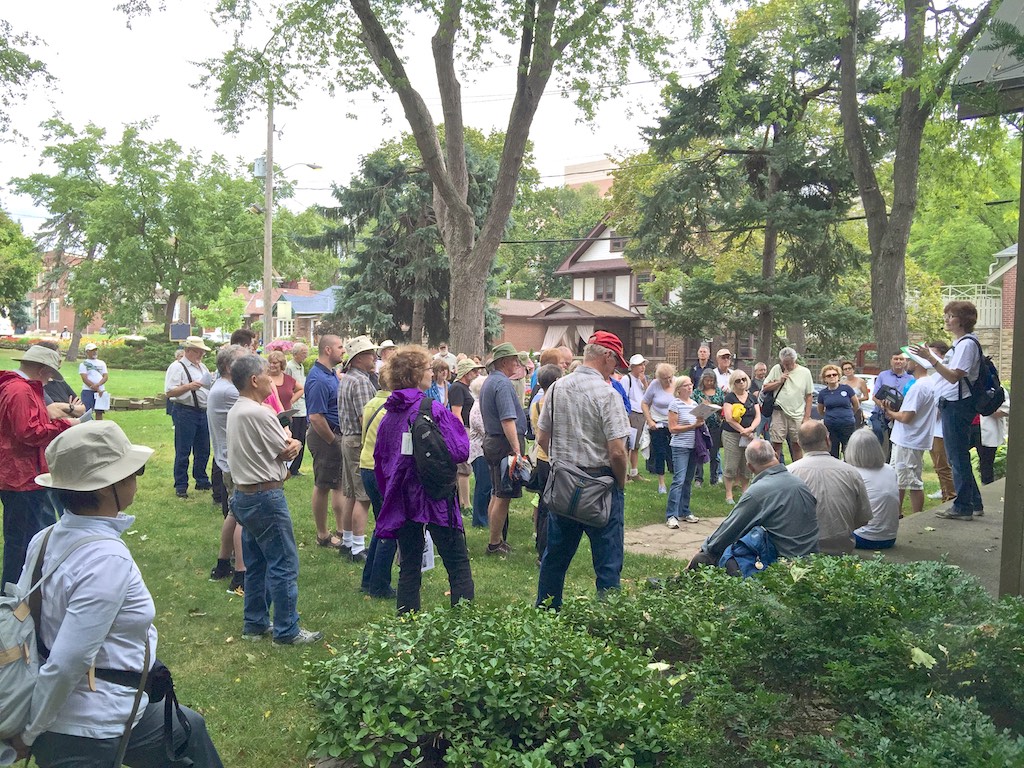
Weston Historical Society’s Cherri Hurst (far right) talks at the first stop on the tour.
Close to 70 people attended last Saturday’s Hurricane Hazel Revisited walk. The guided tour stopped at many of the significant locations that played a part in the October 1954 tragedy that changed the face of Toronto. The walk was well received thanks to an excellent script that was a collaboration between Weston Historical Society members, Cherri Hurst and Mary-Louise Ashbourne.
I had the privilege of assisting in this Heritage Toronto walk and the level of interest among attendees was impressive. Hazel’s legacy is our precious park ravine and system; a place to enjoy nature as well as a haven for plant and animal wildlife.
Thanks to Jill for coming all the way from Burlington and adding a personal touch via her father’s incredible memories of being personally involved during the storm.
The rain held off until we began walking to the renovated St Matthias Church – now the Canadian headquarters for Sukyo Mahikari. We were shoehorned into the beautifully restored small church, dripping wet and were given a bonus presentation on the renovation of the church which played a part during Hazel’s aftermath.
Have you ever wondered about the people who lived in Weston during the time of Hurricane Hazel? Weston’s Historical Society is leading a walk, ‘Hurricane Hazel Revisited‘ that focuses on the storm’s devastating impact on the people and surrounding area. Participants will walk along the river, past some of the most significant locations and look at traces of what remains and the changes forced by Hazel that have occurred since 1954. The tour begins on Little Avenue this Saturday at 1:30 follows the river down to Raymore Drive and ends at the former Matthias church at Scarlett and Kingdom.
Little Avenue Memorial Park
Meet on Little Avenue in the Memorial Park at 1:30
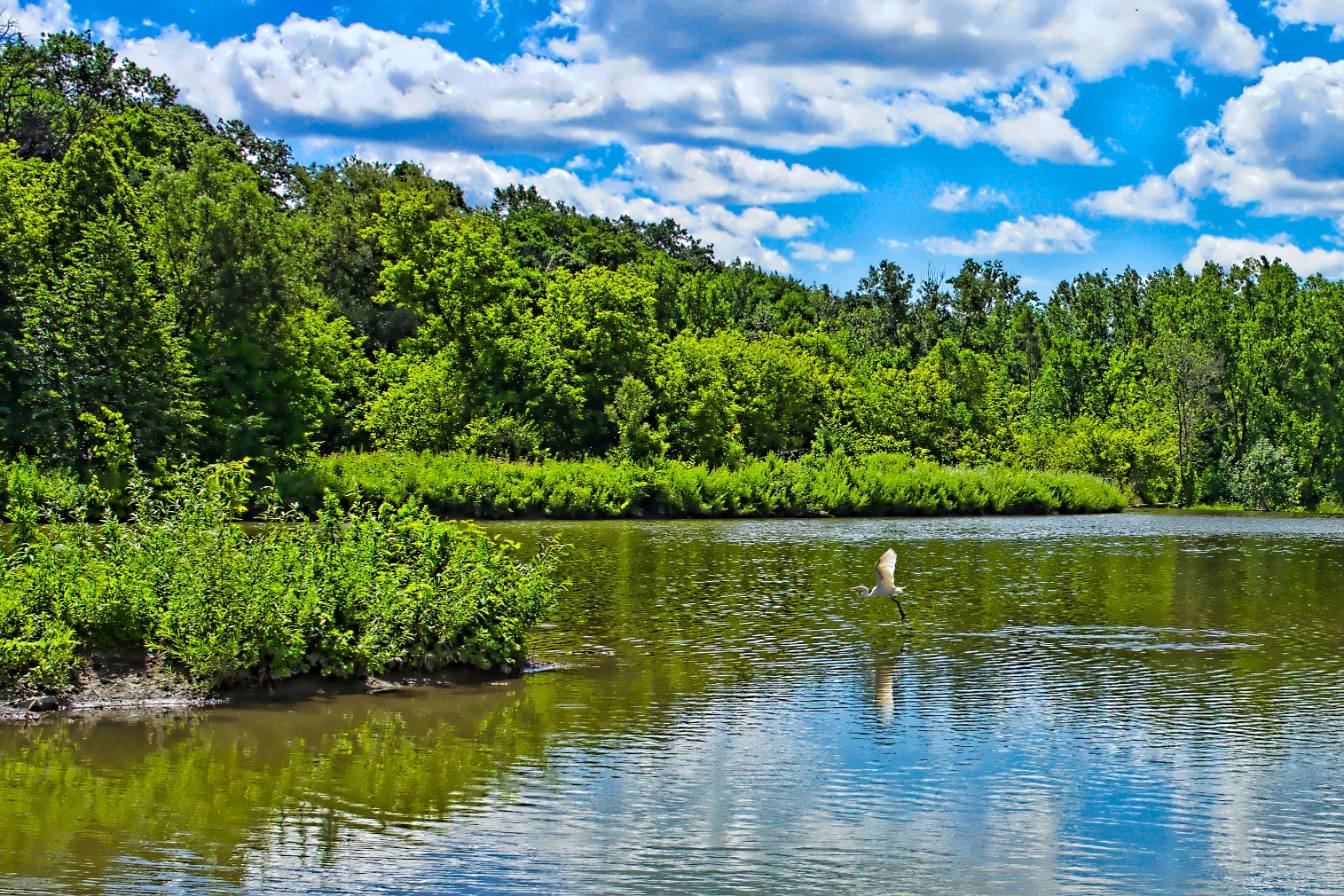
Raymore Park has an astonishing variety of wildlife. Great Egrets are occasionally seen in the park and this one was seen taking off last month after wading through shallow waters ahead of the weir. They were nearly hunted to extinction in the 19th Century for their plumage which was used to decorate ladies’ hats. Once a purely migratory bird in southern Ontario, It is estimated that as many as a thousand breeding pairs make their home in Canada. Great Egrets are related to herons and have a similar profile. The first time I saw one in Raymore Park I thought it was an Ibis as they look so similar. The Ibis has a range much further south and is also a relative.
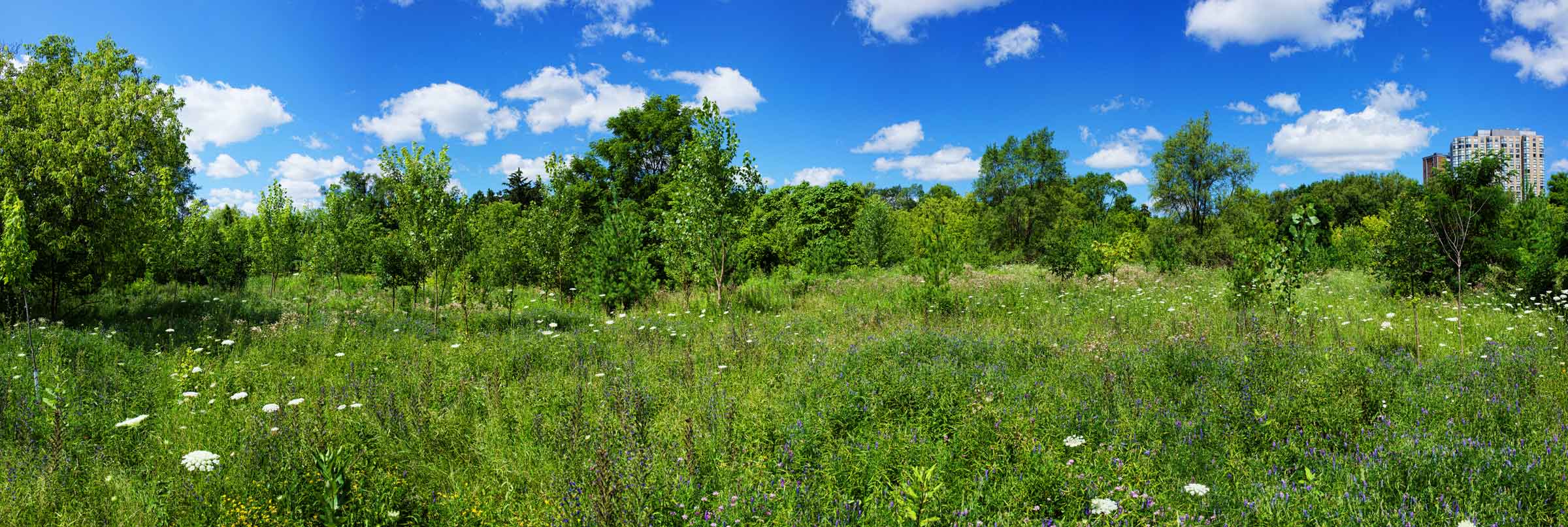
Seven years ago, land between the parking lot and the Humber was cleared of mainly scrub and non-native trees. A variety of native trees was planted and they are thinning out, thanks to general mortality as well as growing taller. The poplars seem to be doing best but the look has changed from fresh planting to more of a mature nursery. Here is a panorama taken recently of the area and a link to a photo of the area two years ago.
Two baseball diamonds have occupied the middle of the park for years and have been virtually unused for almost a decade. In that time they have been regularly mowed, the infield regularly graded and a few years ago, the batters’ cages were replaced and bleachers renovated. Because of the lack of use over the years, I suggested that the park manager consider planting some native trees and extending the growing canopy that already exists to the south. This would create a wildlife corridor extending the length of the park. His response was that plans were in place for a cricket or soccer field.
Toronto is committed to increasing its tree cover from the current 28% to 40% over the next decade. It is widely recognized that flooding events are ameliorated by tree cover. As recently as July 8th 2013, a rain event caused considerable flooding throughout Toronto because the sheer volume of water overwhelmed the sewer system. Trees and the ground beneath them are natural sponges that absorb water and release it slowly. In addition to providing cover for deer and other animals, tree cover tempers the local climate making it cooler in summer and warmer in winter.
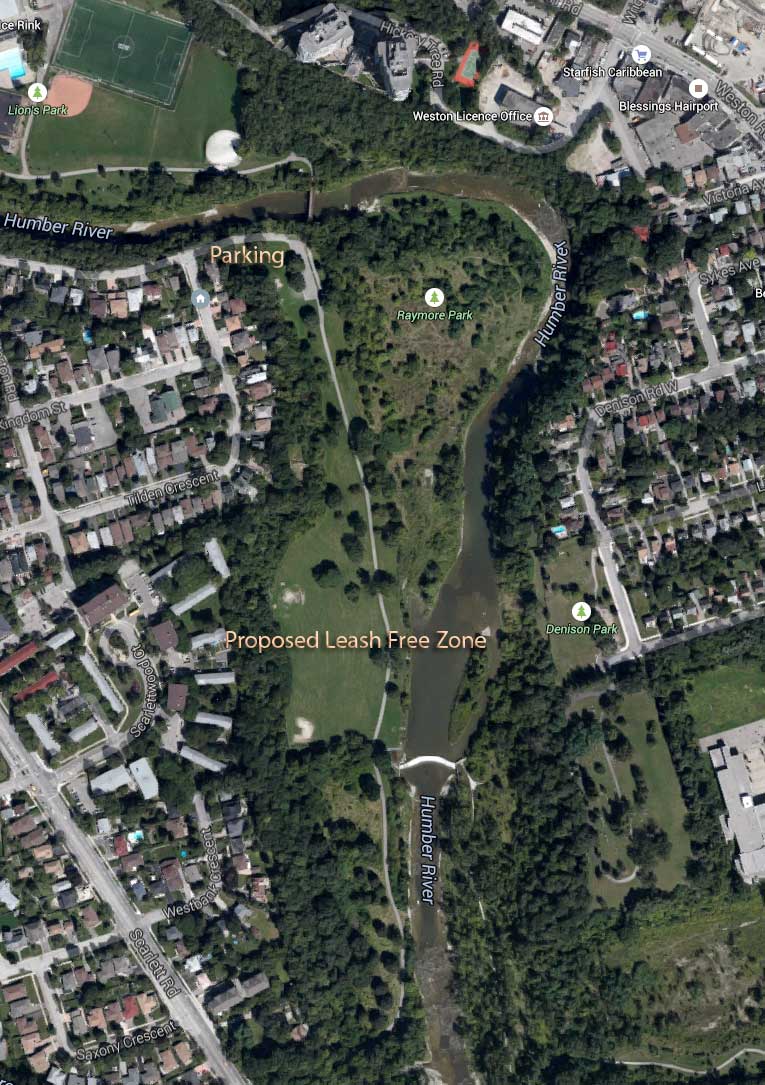
Now instead of trees, there is a proposal to establish a leash free zone for dogs in that location.
Aerial view of Raymore Park. (click to enlarge)
The ramifications of this proposal are huge.
The quiet nature of the park will be completely changed.
Wildlife (deer, waterfowl, foxes, coyotes, turtles, beaver etc.) will be adversely affected.
A considerable increase in car traffic into the park along with many more dogs.
Supervision will be difficult because of the distance from the parking lot to the proposed zone.
More dogs will be set loose as owners make their way to the zone.
The park is surrounded by homes; noise will be an issue for residents on both sides of the river.
An increase in motorized traffic along the Pan Am Path to empty garbage bins and provide enforcement.
Commercial dog walkers will be tempted to use the zone.
Raymore is a neighbourhood park in a quiet residential area; neighbourhood traffic levels will increase greatly.
As you can probably guess, I’m not in favour of the proposal. Councillor Rob Ford City Staff has have arranged a meeting to discuss the issue September 22, 2015 at 6:30 – 8:30pm in Hilltop Middle School’s Main Gym (35 Trehorne Drive). This City site outlines the process for allowing or denying an off leash zone.
Points of interest in the application process are:
The zone must also be approved by the Toronto and Regional Conservation Authority as Raymore Park is TRCA property
The zone would be fenced as it is adjacent to a tree planting area, a natural shoreline and not far from a playground
The number of licensed dogs in the area is taken into consideration
A shortage of off-leash zones in the area is not one of the criteria
Quote: “New off-leash areas will be considered in conjunction with capital redevelopment of existing parks or new park development against the policy criteria.”
In the meantime, the word needs to get out about this threat to the relatively tranquil and natural environment of Raymore Park. Please contact Councillor Ford to let him know what you think of this proposal.
Post Script: Dan Jacobs from Rob Ford’s Office contacted me with the following email:
Thank you for your e-mail.
A point of clarification – Councillor Ford was not involved in setting up this meeting, nor was he behind the proposal in the first place. This has been initiated by City Staff.
Our office will be present at this meeting to make sure we hear directly from those affected by this proposal – there is no staff report that can substitute for input from the members of the community itself.
It would be greatly appreciated if you could amend or add to your blog post to reflect the above information.
Thank you in advance, and I look forward to meeting you on September 22nd.
So much for my reading skills! The info was in Rob’s newsletter and I put two and two together to get five.
Apologies to Councillor Ford and thanks to Dan Jacobs for the correction.
Faithful readers may have noticed an abrupt decline in output since December 2013. The problem started on July 8, of that year – a date that has etched itself onto my memory (believe me that’s hard at my age). On that fateful dark and stormy day, the rain came down for hours apparently creating a new one-day rainfall record. Comparisons to Hurricane Hazel were aired in the media but the difference between the two events is put into perspective here. Our latest big storm while significant for its intensity, was relatively tame when compared to Hazel in 1954.
July 9 2013 – water levels beginning to subside.
Anyway, I digress. At the height of the storm, our power went out and after a while, I trotted down to the basement to dig out a radio to find out what was happening. One’s subconscious is an amazing thing – it monitors thoughts and sensations without judgement and leaves it to the conscious brain to make sense of it. While descending the stairs and trying to remember where the radio was; gently nudging my brain were the following sensations: darkness, the sound of rain outside, running water inside(!), a musty smell(!) – none of which registered until I hit the bottom of the stairs and I stepped into several centimetres of flowing water and sewage. Gritting my teeth and squelching through the dark with a flashlight, several floor drains were found to be the source, gushing sewage with considerable force. Luckily, our basement is at ground level at the back so I was able to open a door and allow the smelly effluent an ungraceful exit.
Needless to say, the volume of rain had swamped the combined sanitary and storm sewer system resulting in several flooded basements in our neighbourhood and in neighbourhoods across the city. The sheer number of people affected overwhelmed insurance companies along with mitigation and construction contractors. It took us two days to get someone out to begin the clean-up process. Adjusters were brought in from Texas – they proved to be useless and eventually (after a great deal of arm-twisting) it took a Canadian adjuster to approve a fair settlement which we received in October. All the basement flooring had to be removed along with drywall to a height of about 3 feet. In addition, we decided to go the extra mile and renovate the rest of the house. We packed everything into boxes as if we were moving and stored the boxes in the garage and bathrooms. Work commenced in December and was completed by the end of February 2014. While the work was under way, we rented a cottage on Lake Erie near the charming town of Dunnville.
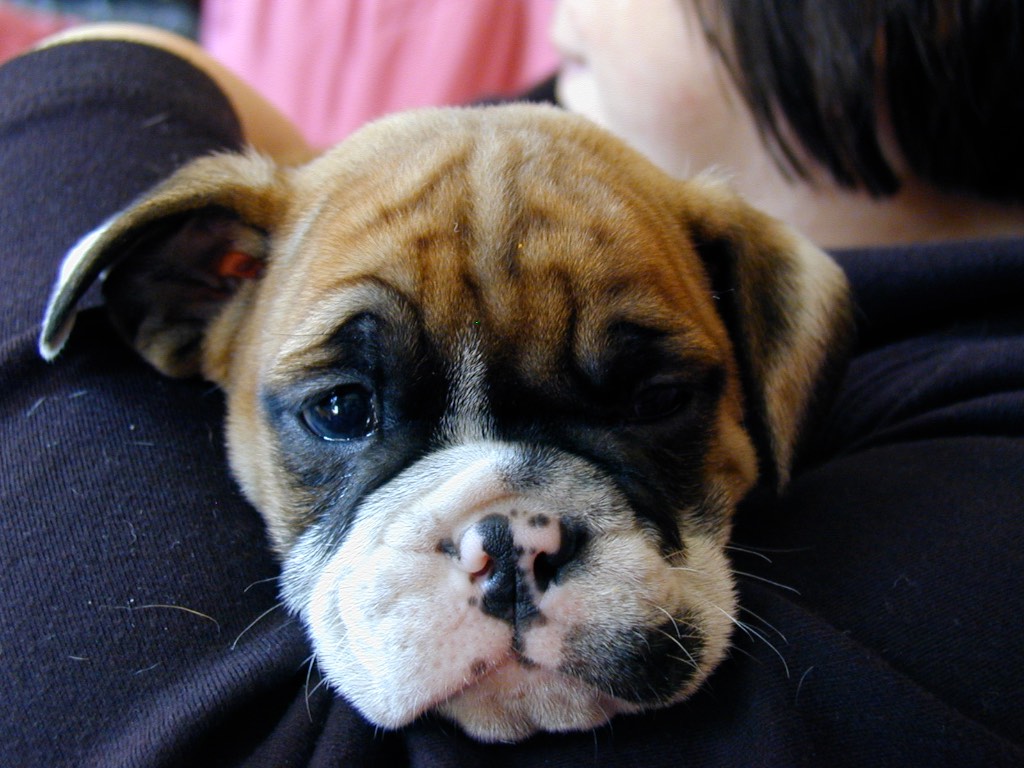
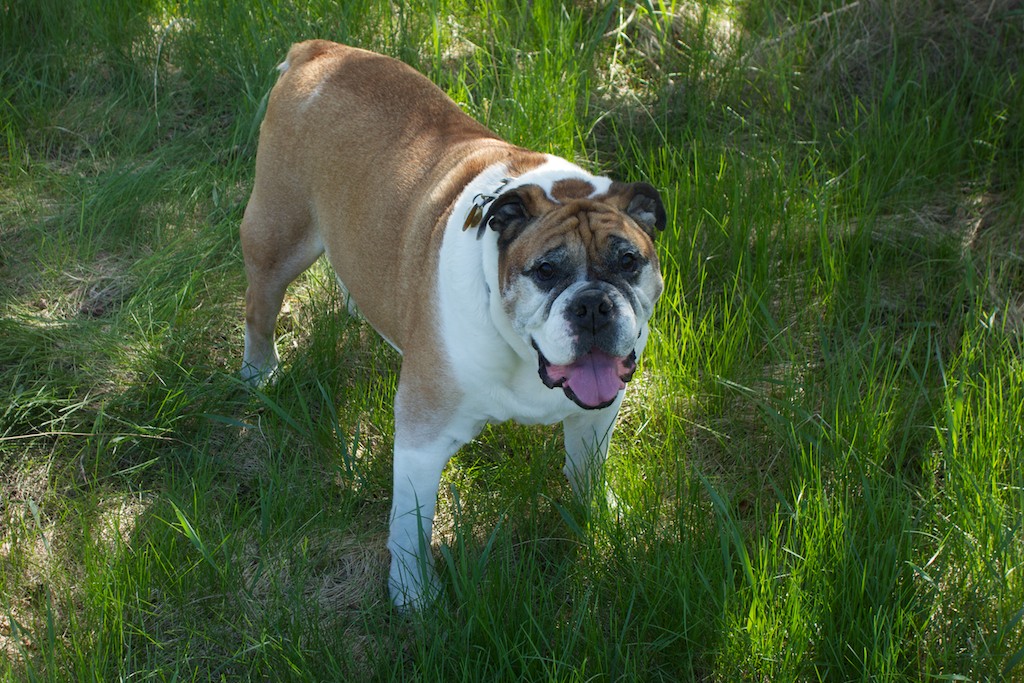
Our frail and elderly bulldog Mugsey managed to injure himself on the first day at the cottage and required nursing and emergency vet visits (think All Creatures Great and Small where they’re quite comfortable treating horses and cattle). He never really recovered and after an operation to remove some tumours in March, the vet discovered that he had spondylosis and a mass by his neck that seemed to be paralyzing him gradually. by June, he was unable to walk more than a few steps and his stomach had become bloated with gas. My wife and I made the horrible decision to put him down on June 16 as it became harder to blunt his pain and other than food and treats, he was unable to be Mugsey.
Mugsey on the day we brought him home in April 2003
We had lived with Mugsey for over 11 years. He was an incredible, intelligent and (usually) happy boy who lived for his daily hour-long walks in the park. He provided moral support and comfort to my wife through her prolonged illness and when word got out that his life was ending, some of his greatest fans came to bid him a fond farewell. Gorging himself on previously forbidden treats he was petted and caressed one last time before his final drive to the vet. Even though he was in terrible shape and in pain despite lots of Gabapentin, he knew by gestures (he had become totally deaf in the previous year) that it was time for one last car ride. He tottered unsteadily to his feet and waited for his lifejacket to be fastened. This device with its carrying handles at the top had helped us many times to get his 80lb bulk up and down steps and into the car.
There are moments of crystal clarity when events are seared into the memory. Walking from the car to the vet’s office that last time is one of those. The late afternoon sun shone brightly and people passed us, getting on with their lives, oblivious to the final minutes of Mugsey’s life. In my head was the unsettling thought, ‘I’m going to kill my pet’, yet the world didn’t know or seem to care. He sniffed the usual spots along the way and once inside, plonked himself on a blanket in the vet’s office (as he had done many times for laser treatments) and lay quietly on his side keeping an eye on me to make sure that I was still there with him. The act of betrayal pressed heavily on me as I lay beside him and second-guessed our decision. Bravely, he didn’t flinch as the vet needed a couple of tries to find a vein in his back leg that would carry the fatal injection. I kissed his head and gave him one last hug goodbye and he let out an enormous sigh as tranquillizer was released into his bloodstream. At that moment it seemed as if he could now stop holding it all together and drop the burden of pain and discomfort he had endured for so long. He became deeply unconscious and on the vet’s persistent advice, I left, as the final injection, while painless can produce a reaction in the form of movements that are distressing to owners. The walk back to the empty car without him was one of profound sadness, guilt and relief.
The house seemed empty for months afterwards. Even now, I catch myself thinking that he’s on the couch in the basement ready to snooze while we watch TV.
So anyway, this cathartic little posting is why it’s been quiet lately and I hope to begin walks in the park anew without our boy. We still miss him horribly. It won”t be the same without him.
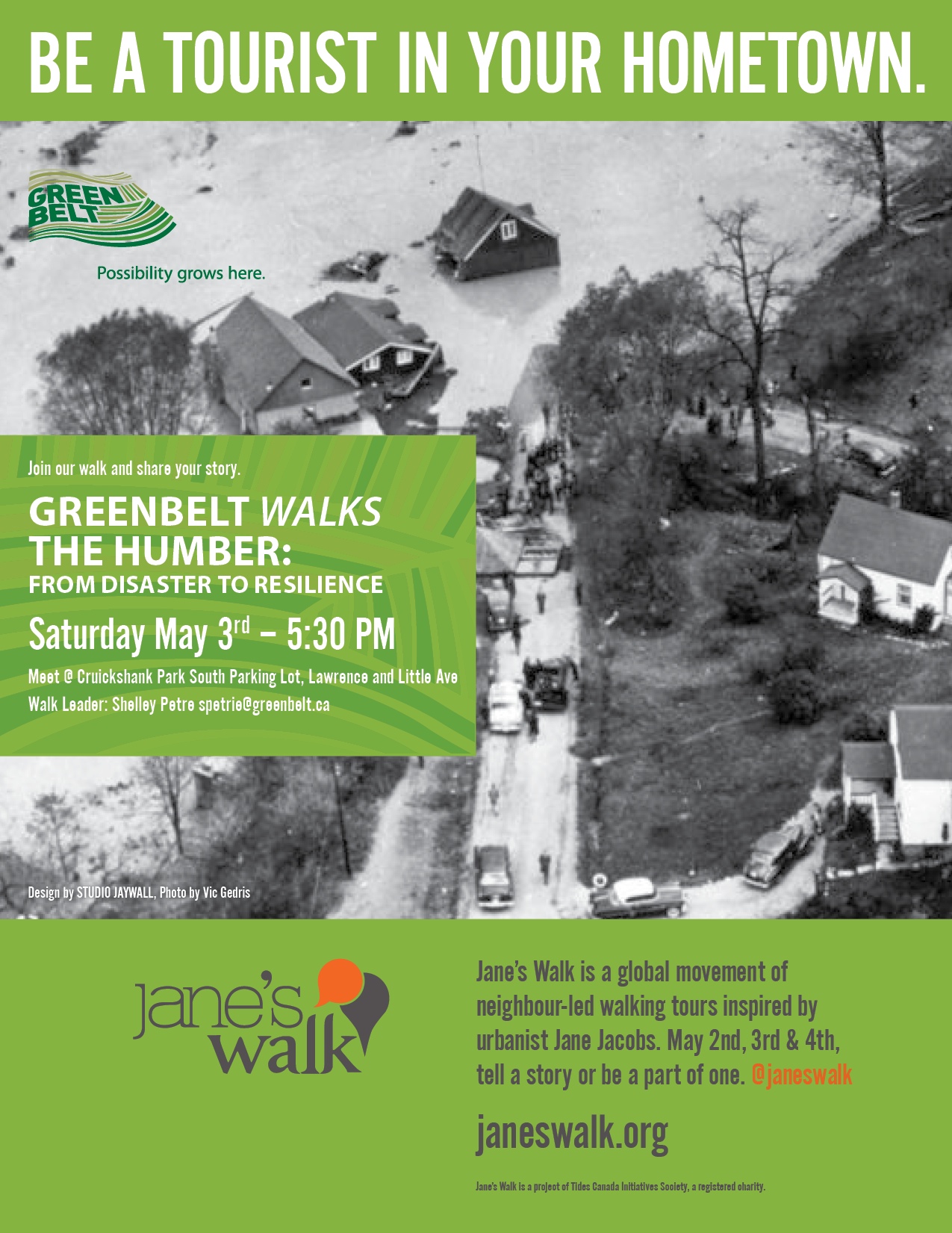
On Saturday, May 3rd, a ‘Jane’s Walk’ will feature the Humber between Lions Park and the weir in Raymore Park. The emphasis will be on Hurricane Hazel and its effects on the environment both natural and human. Some of the stops along the way will be:
Stop 1: Lawrence Avenue Bridge
The effects of Hurricane Hazel and its deluge of water on the bridge and surroundings.
Stop 2: Lion’s Park / Weston Fairground
Stop 3: Raymore Foot Bridge
The history of the footbridge that once existed at this point and its current successor.
Stop 4: Raymore Drive (across bridge)
The ground where 36 people lost their lives; the role of the old bridge. View traces of the settlement that was destroyed.
Stop 5: Raymore Park
The aftermath of Hazel and the organization set up to acquire and manage flood plain land.
Stop 6: Raymore Park dam
The fish ladder and migrating trout. The future of weirs along the Humber.
Stop 7: Chapman Valley Park / Humber Creek
The flooding that occurred at the top of this creek on July 8 2013, and the impact development has had on rivers across the city
Stop 8:
Urban river valleys, the Greenbelt, and the upcoming staff report and vote in city council to add the Humber, Don, and Etobicoke Creek to the Greenbelt.
Option 1: Retrace our steps along the Humber path,
Option 2: walk through the streets, past the wooden church at Scarlett and Kingdom, down Raymore Drive, crossing back over Raymore bridge and ending back up at Lion’s Park.
Walk Leaders:
Mary Louise Ashbourne (Weston Historical Society)
Gaspar Horvath (TRCA)
Roy Murray (Humber Watershed Alliance)
Shelley Petrie (Friends of the Greenbelt)
Michael Cook (Lost Rivers)
Meeting point: Car park at Lawrence Avenue and Little Avenue (Cruickshank Park) at 5:30pm.
A knock on a door sealed the fate of two families on the rainy night of October 15, 1954. They lived on Raymore Drive in an idyllic neighbourhood by the shore of the Humber River. That night, radio stations had warned of a dangerous hurricane making its way north that would dump more heavy rain onto an already saturated ground.
Autumn in Ontario is a time of transition. The province occasionally finds itself in the path of extra-tropical hurricanes that are usually shadows of their former selves by the time their energy supply of tropical air has been cut off. This hurricane, named Hazel, was different. It had wreaked havoc in many areas of the United States. Instead of becoming a rain event, Hazel managed to re-energize itself by finding and merging with a cold low pressure area and using that to squeeze out more wind and moisture.
As the evening progressed, the storm parked itself over the city and the already swollen Humber River began to rise higher than residents had ever seen it. In wintertime, ice jams would bring water and inconvenience to the doorsteps of a few homes at the lower end of Raymore Drive but this time was different as the higher water level ceased to be an annoyance and started to become a threat. The roaring water surged wildly with no sign of levelling off.
As water lapped over thresholds into homes near by the river, one family thought it wise to ask neighbours on higher ground if they could bring over furniture threatened by the rising waters. This was the fatal knock. While the two families focussed on moving furniture to the higher house, their single-minded dedication to the task may have prevented them from acting quickly when events took a sudden turn for the worse.
What neither family could see and what would end up costing the lives of 35 residents of the neighbourhood was an unpredictable turn of events. Straddling the river was a footbridge. It was then, as its replacement is today, a convenient short cut from Raymore Drive to the bustling town of Weston, a centre of commerce for miles around.
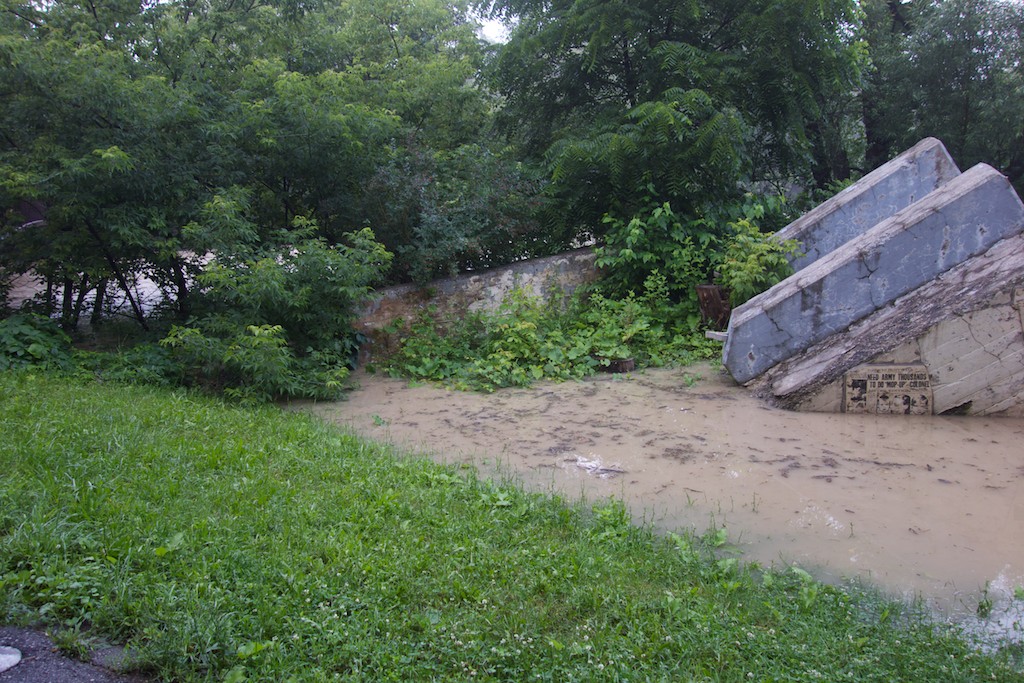
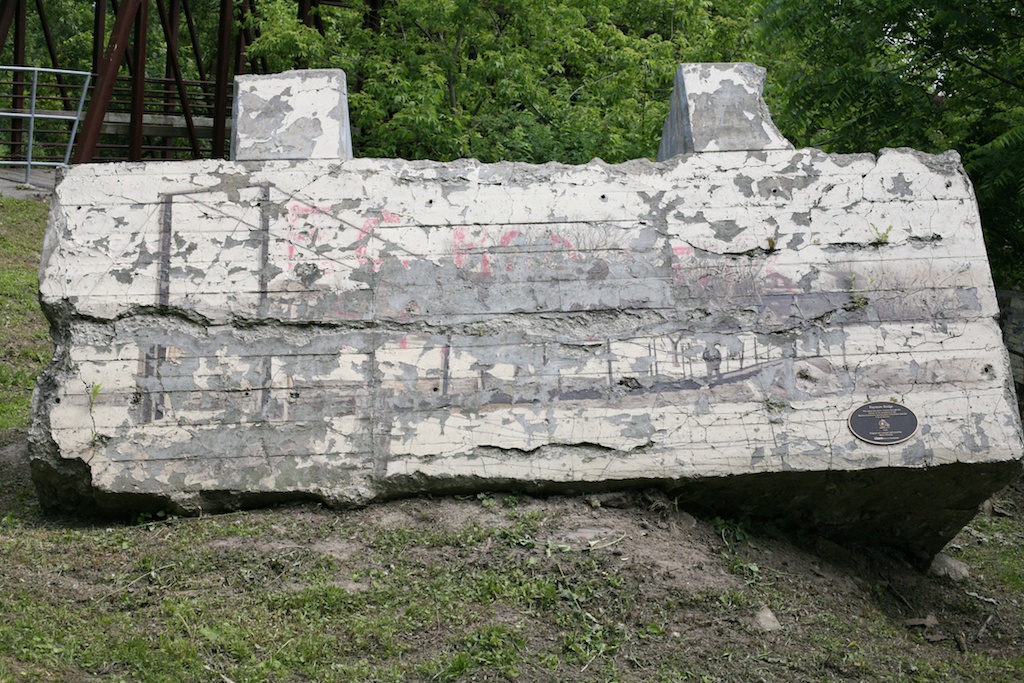
As the water continued to rise, the western abutment of the footbridge was dragged off its perch into the river a few metres downstream where it anchored itself in the position it occupies today. The structure of the bridge held and in effect, re-positioned itself diagonally across the river forming a barrier which, thanks to the debris washing downstream quickly became a diversionary dam. Suddenly and without warning, the river was steered directly into the path of the homes at the end of Raymore Drive engulfing our two families and taking a total of 35 lives at this location.
To this day, the western abutment remains in the river, standing as a grim witness to that terrible night. The eastern end of the bridge is also in place and as mentioned previously, was decorated with a (now badly peeled) commemorative mural in 2002. Raymore Park itself contains no memorial to the people who lost their lives that day. Perhaps this would be a worthy project.
Looking upstream, the western abutment can be seen below and to the left of the bridge.
Readers are invited to add their own memories or anecdotes of Hurricane Hazel.
This year is the 60th anniversary of Hurricane Hazel. The night of October 15th, 1954 saw a storm that hugely affected many parts of Toronto and Southern Ontario. The epicentre of the tragedy was of course Raymore Drive where 35 residents died. In order to avoid such tragedies in the future, the Toronto and Region Conservation Authority was formed. This body was charged with setting aside flood-prone lands and creating the parks system that is a major feature of today’s Toronto.
To commemorate the anniversary, I’ll try and produce the occasional article on the topic until October. The first one will appear later this week.
The eastern abutment of the old footbridge connecting Weston to Raymore Drive. Artist Mario Noviello painted this commemorative work in 2002 but sadly the weather has not been kind to his creation showing the original suspension bridge. The western abutment remains in the river where it was dragged during Hazel’s fury.
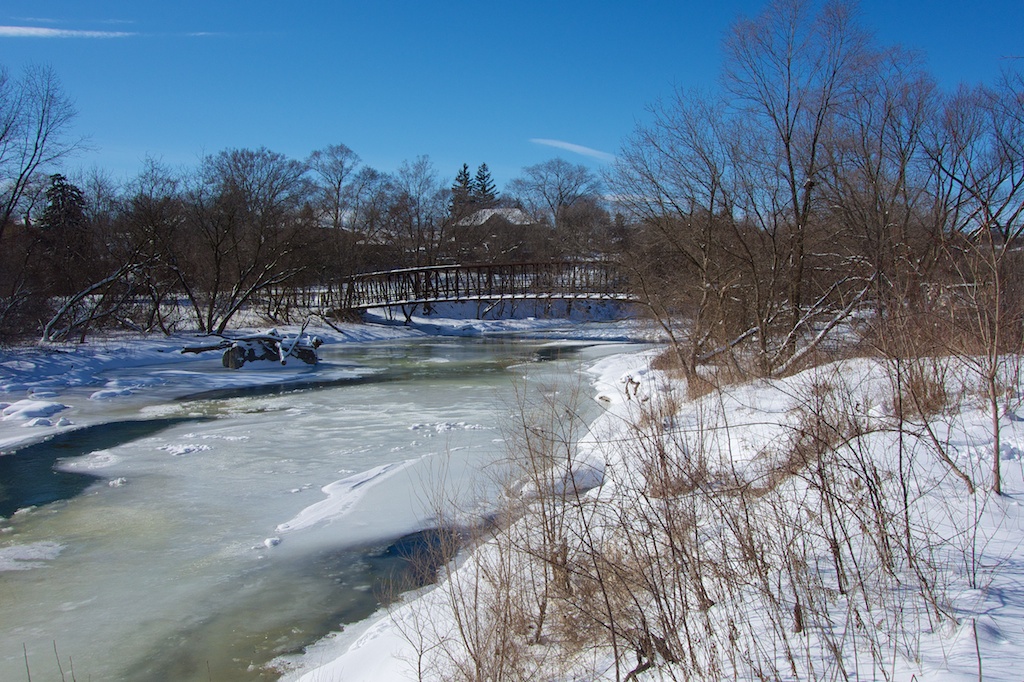
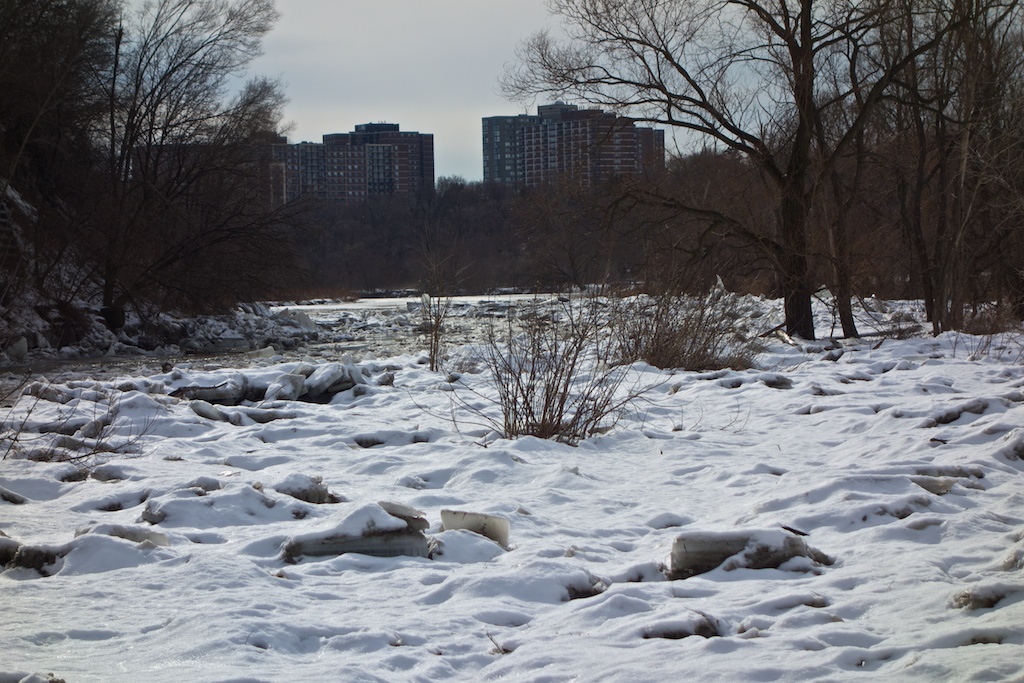
During most recent winters, there has been a battle between heat and cold, freeze and thaw. One of the features of a Raymore Park winter thaw is the flooding of the wild area across from the parking lot. An increased river flow usually caused by rain, raises river levels and cracks the ice cover. The ice then progressively forms a moving dam and flood which moves gently downstream. In a couple of decades of observing the before and after, I have never seen the process in motion. This January, after the recent thaw, the ice stalled before the river widens above the weir and no doubt will produce some spectacular flooding and subsequent erosion when the next strong rain event occurs.
Ice littering the banks of the Humber, January 2014.
Considering the cold weather prior to the thaw, the ice is surprisingly thin. The approaching ‘PolarVortex II’ will no doubt consolidate the present ice dam.










 Friends of Raymore Park