Meteorological winter is here as of December 1 and the sun has almost reached its lowest point in the sky. Even though we’re nearly 4 million km closer to the sun than we were in June, the low angle in the sky and short daylight hours ensure a limited amount of heat. There is an El Niño event occurring this year; rainfall amounts are down and temperatures have been considerably above average so far. Because the way the earth accelerates at this point on its way around the sun we have reached our earliest sunset time of 4:41pm while mornings will continue to darken until the end of the month.
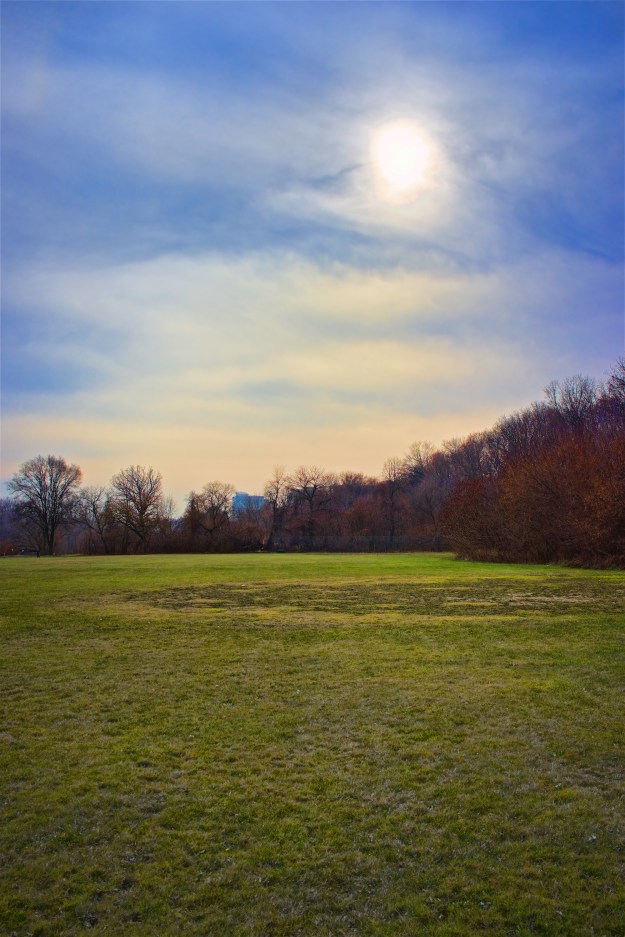
Looking south towards the location of the proposed dog park. At celestial noon (12:09pm), the sun was 23.8° above the horizon. On December 22nd, it will appear to be only 23° above the horizon and then begin to recover until June 21 when it will peak at 69.8°.
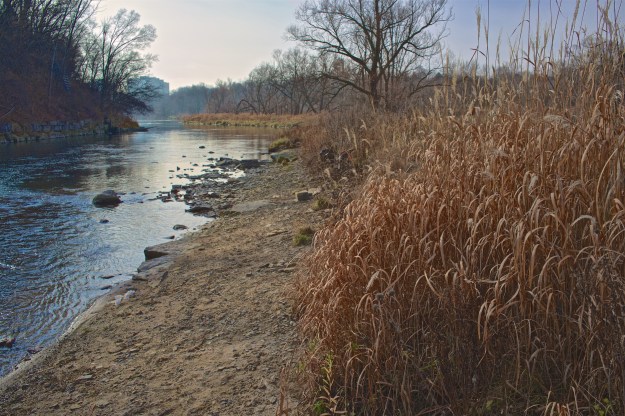
Not a trace of ice by the river.
As a result of the mild weather there are some plants that have not yet gone into dormancy and they are a probable indication of what global warming will bring to Toronto’s climate if temperatures continue to rise.
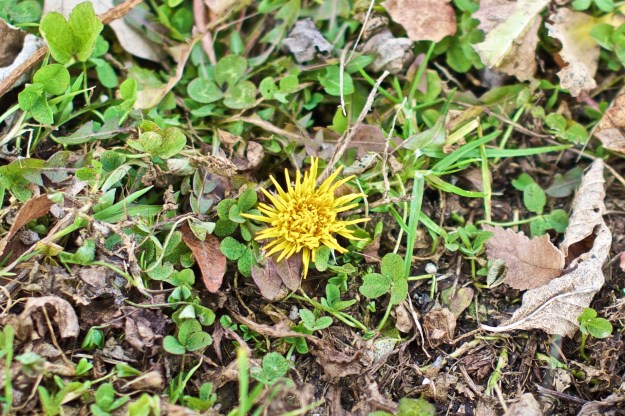
A dandelion in flower.
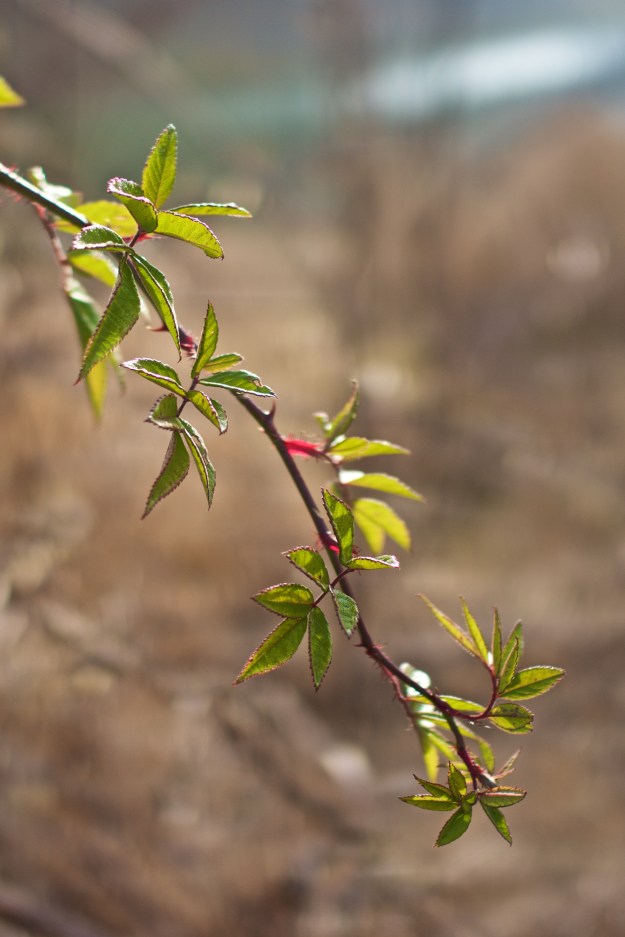
A wild rose has retained its leaves.
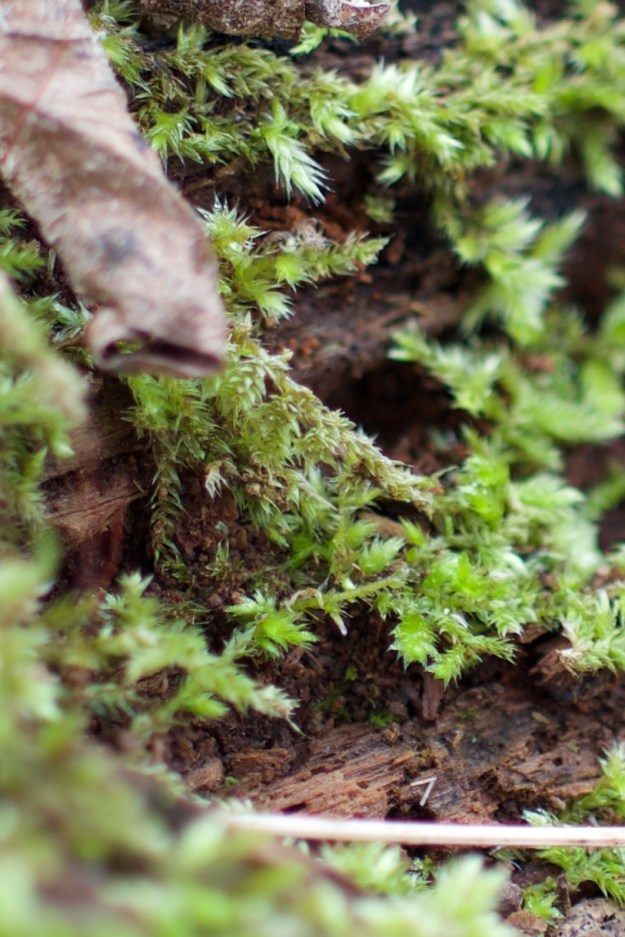
Moss feeds on an old tree stump.
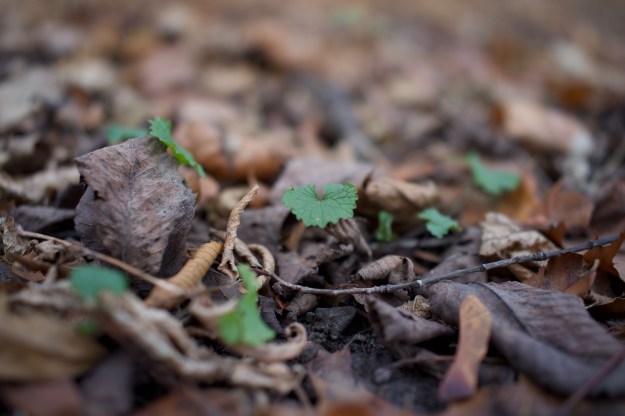
Garlic mustard lurks in the undergrowth.
The downside of such mild weather is that in wooded areas, and especially if warming affects Canada’s boreal forest, leaves on the ground slowly decompose when in a normal winter they would be compressed by snow and their carbon content preserved. This decomposition releases carbon dioxide, reducing the natural carbon sink effect of the boreal forest.
On a lighter note, although it’s quite common in Toronto for winter to begin in earnest after Christmas, this winter there is a feeling that we may be getting off lightly.
After the last two winters, let’s hope so.
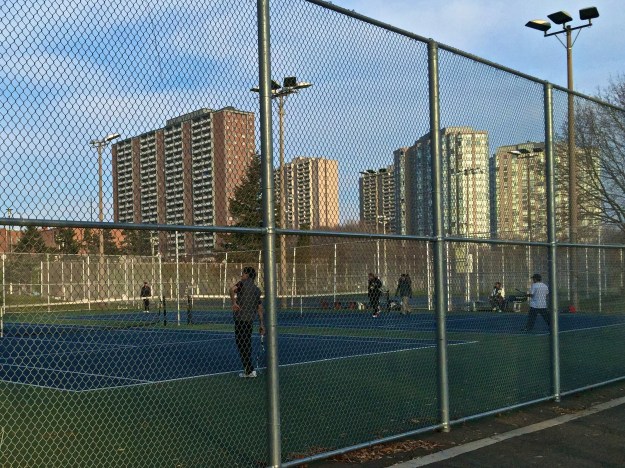
Tennis players enjoying a mild December in neighbouring Lions Park.
Faithful readers may have noticed an abrupt decline in output since December 2013. The problem started on July 8, of that year – a date that has etched itself onto my memory (believe me that’s hard at my age). On that fateful dark and stormy day, the rain came down for hours apparently creating a new one-day rainfall record. Comparisons to Hurricane Hazel were aired in the media but the difference between the two events is put into perspective here. Our latest big storm while significant for its intensity, was relatively tame when compared to Hazel in 1954.
July 9 2013 – water levels beginning to subside.
Anyway, I digress. At the height of the storm, our power went out and after a while, I trotted down to the basement to dig out a radio to find out what was happening. One’s subconscious is an amazing thing – it monitors thoughts and sensations without judgement and leaves it to the conscious brain to make sense of it. While descending the stairs and trying to remember where the radio was; gently nudging my brain were the following sensations: darkness, the sound of rain outside, running water inside(!), a musty smell(!) – none of which registered until I hit the bottom of the stairs and I stepped into several centimetres of flowing water and sewage. Gritting my teeth and squelching through the dark with a flashlight, several floor drains were found to be the source, gushing sewage with considerable force. Luckily, our basement is at ground level at the back so I was able to open a door and allow the smelly effluent an ungraceful exit.
Needless to say, the volume of rain had swamped the combined sanitary and storm sewer system resulting in several flooded basements in our neighbourhood and in neighbourhoods across the city. The sheer number of people affected overwhelmed insurance companies along with mitigation and construction contractors. It took us two days to get someone out to begin the clean-up process. Adjusters were brought in from Texas – they proved to be useless and eventually (after a great deal of arm-twisting) it took a Canadian adjuster to approve a fair settlement which we received in October. All the basement flooring had to be removed along with drywall to a height of about 3 feet. In addition, we decided to go the extra mile and renovate the rest of the house. We packed everything into boxes as if we were moving and stored the boxes in the garage and bathrooms. Work commenced in December and was completed by the end of February 2014. While the work was under way, we rented a cottage on Lake Erie near the charming town of Dunnville.
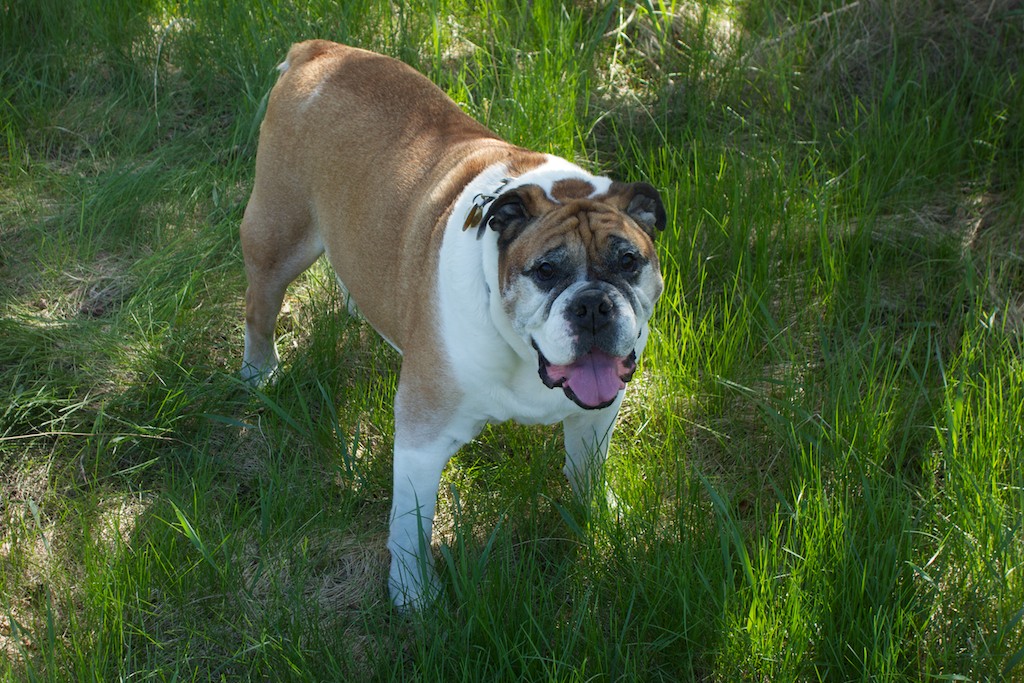
Our frail and elderly bulldog Mugsey managed to injure himself on the first day at the cottage and required nursing and emergency vet visits (think All Creatures Great and Small where they’re quite comfortable treating horses and cattle). He never really recovered and after an operation to remove some tumours in March, the vet discovered that he had spondylosis and a mass by his neck that seemed to be paralyzing him gradually. by June, he was unable to walk more than a few steps and his stomach had become bloated with gas. My wife and I made the horrible decision to put him down on June 16 as it became harder to blunt his pain and other than food and treats, he was unable to be Mugsey.
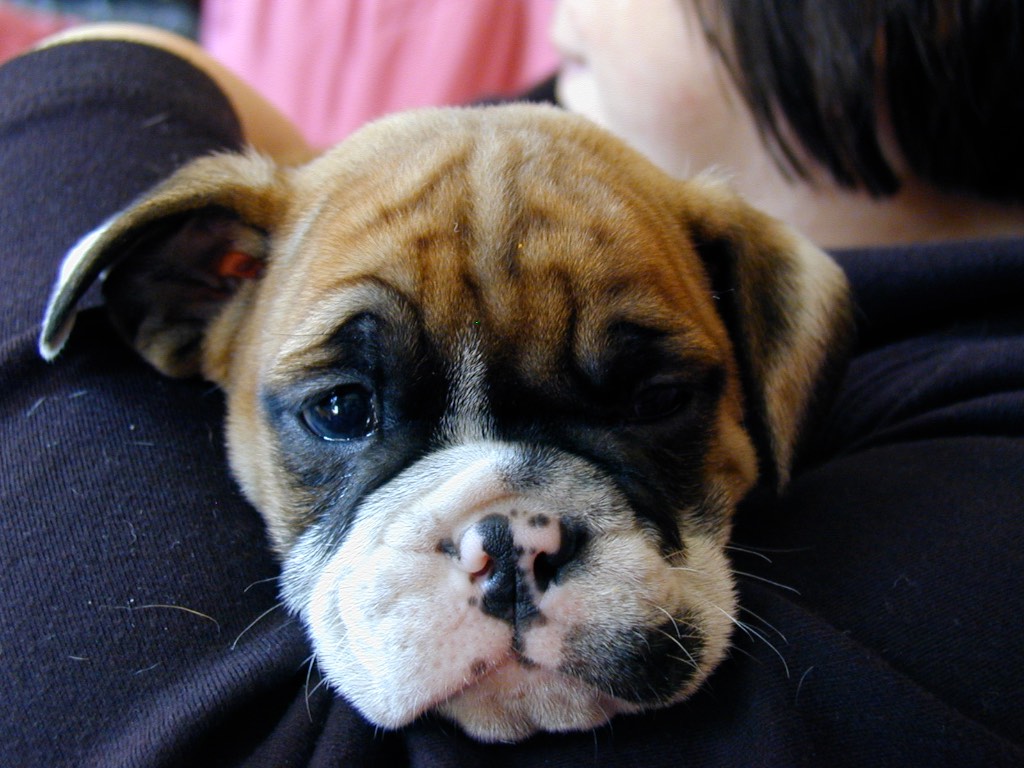
Mugsey on the day we brought him home in April 2003
We had lived with Mugsey for over 11 years. He was an incredible, intelligent and (usually) happy boy who lived for his daily hour-long walks in the park. He provided moral support and comfort to my wife through her prolonged illness and when word got out that his life was ending, some of his greatest fans came to bid him a fond farewell. Gorging himself on previously forbidden treats he was petted and caressed one last time before his final drive to the vet. Even though he was in terrible shape and in pain despite lots of Gabapentin, he knew by gestures (he had become totally deaf in the previous year) that it was time for one last car ride. He tottered unsteadily to his feet and waited for his lifejacket to be fastened. This device with its carrying handles at the top had helped us many times to get his 80lb bulk up and down steps and into the car.
There are moments of crystal clarity when events are seared into the memory. Walking from the car to the vet’s office that last time is one of those. The late afternoon sun shone brightly and people passed us, getting on with their lives, oblivious to the final minutes of Mugsey’s life. In my head was the unsettling thought, ‘I’m going to kill my pet’, yet the world didn’t know or seem to care. He sniffed the usual spots along the way and once inside, plonked himself on a blanket in the vet’s office (as he had done many times for laser treatments) and lay quietly on his side keeping an eye on me to make sure that I was still there with him. The act of betrayal pressed heavily on me as I lay beside him and second-guessed our decision. Bravely, he didn’t flinch as the vet needed a couple of tries to find a vein in his back leg that would carry the fatal injection. I kissed his head and gave him one last hug goodbye and he let out an enormous sigh as tranquillizer was released into his bloodstream. At that moment it seemed as if he could now stop holding it all together and drop the burden of pain and discomfort he had endured for so long. He became deeply unconscious and on the vet’s persistent advice, I left, as the final injection, while painless can produce a reaction in the form of movements that are distressing to owners. The walk back to the empty car without him was one of profound sadness, guilt and relief.
The house seemed empty for months afterwards. Even now, I catch myself thinking that he’s on the couch in the basement ready to snooze while we watch TV.
So anyway, this cathartic little posting is why it’s been quiet lately and I hope to begin walks in the park anew without our boy. We still miss him horribly. It won”t be the same without him.
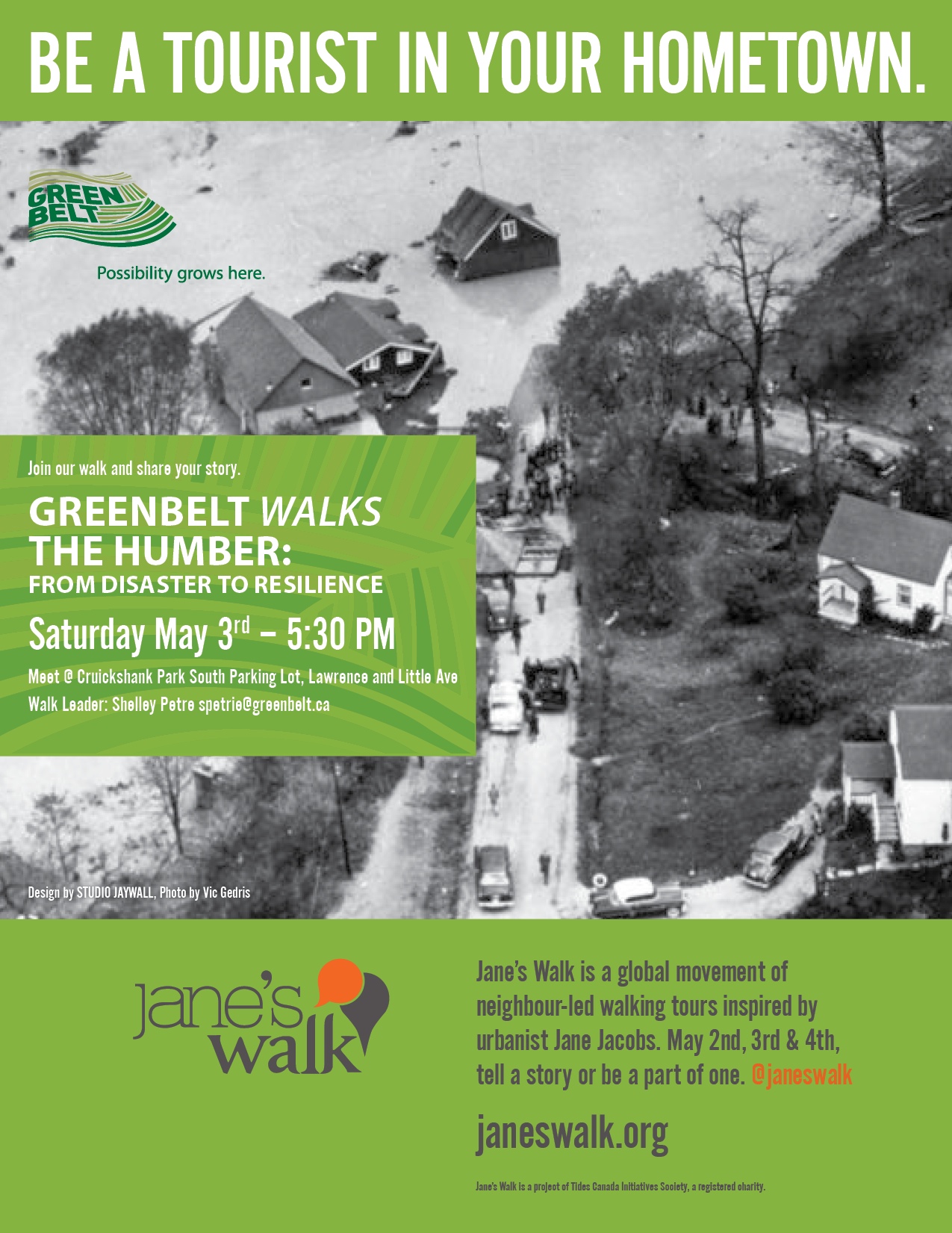
On Saturday, May 3rd, a ‘Jane’s Walk’ will feature the Humber between Lions Park and the weir in Raymore Park. The emphasis will be on Hurricane Hazel and its effects on the environment both natural and human. Some of the stops along the way will be:
Stop 1: Lawrence Avenue Bridge
The effects of Hurricane Hazel and its deluge of water on the bridge and surroundings.
Stop 2: Lion’s Park / Weston Fairground
Stop 3: Raymore Foot Bridge
The history of the footbridge that once existed at this point and its current successor.
Stop 4: Raymore Drive (across bridge)
The ground where 36 people lost their lives; the role of the old bridge. View traces of the settlement that was destroyed.
Stop 5: Raymore Park
The aftermath of Hazel and the organization set up to acquire and manage flood plain land.
Stop 6: Raymore Park dam
The fish ladder and migrating trout. The future of weirs along the Humber.
Stop 7: Chapman Valley Park / Humber Creek
The flooding that occurred at the top of this creek on July 8 2013, and the impact development has had on rivers across the city
Stop 8:
Urban river valleys, the Greenbelt, and the upcoming staff report and vote in city council to add the Humber, Don, and Etobicoke Creek to the Greenbelt.
Option 1: Retrace our steps along the Humber path,
Option 2: walk through the streets, past the wooden church at Scarlett and Kingdom, down Raymore Drive, crossing back over Raymore bridge and ending back up at Lion’s Park.
Walk Leaders:
Mary Louise Ashbourne (Weston Historical Society)
Gaspar Horvath (TRCA)
Roy Murray (Humber Watershed Alliance)
Shelley Petrie (Friends of the Greenbelt)
Michael Cook (Lost Rivers)
Meeting point: Car park at Lawrence Avenue and Little Avenue (Cruickshank Park) at 5:30pm.
This year is the 60th anniversary of Hurricane Hazel. The night of October 15th, 1954 saw a storm that hugely affected many parts of Toronto and Southern Ontario. The epicentre of the tragedy was of course Raymore Drive where 35 residents died. In order to avoid such tragedies in the future, the Toronto and Region Conservation Authority was formed. This body was charged with setting aside flood-prone lands and creating the parks system that is a major feature of today’s Toronto.
To commemorate the anniversary, I’ll try and produce the occasional article on the topic until October. The first one will appear later this week.
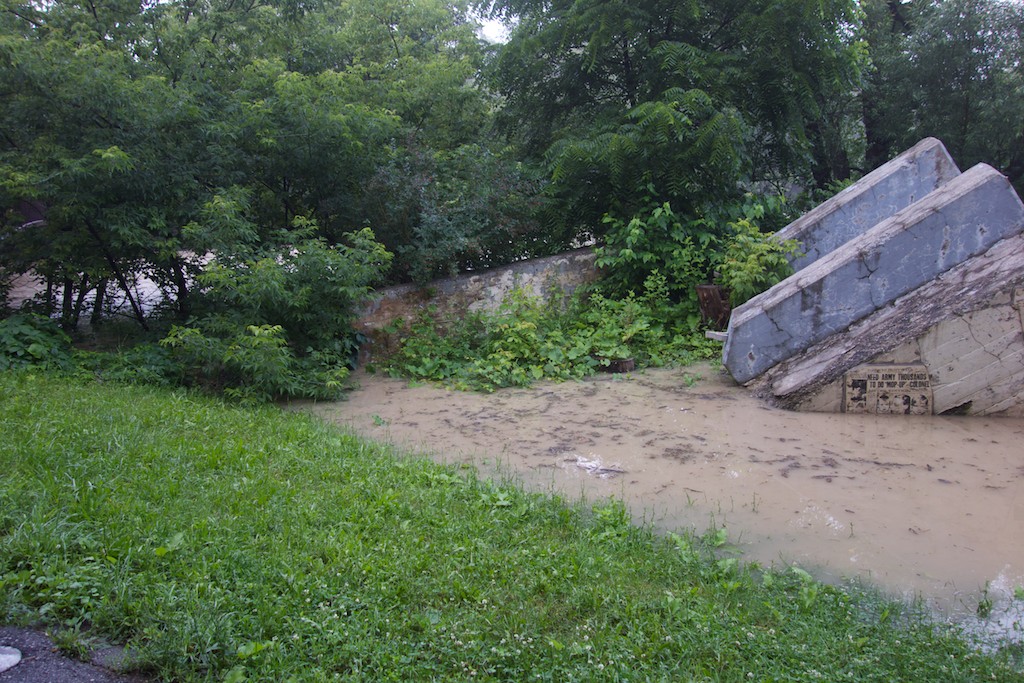
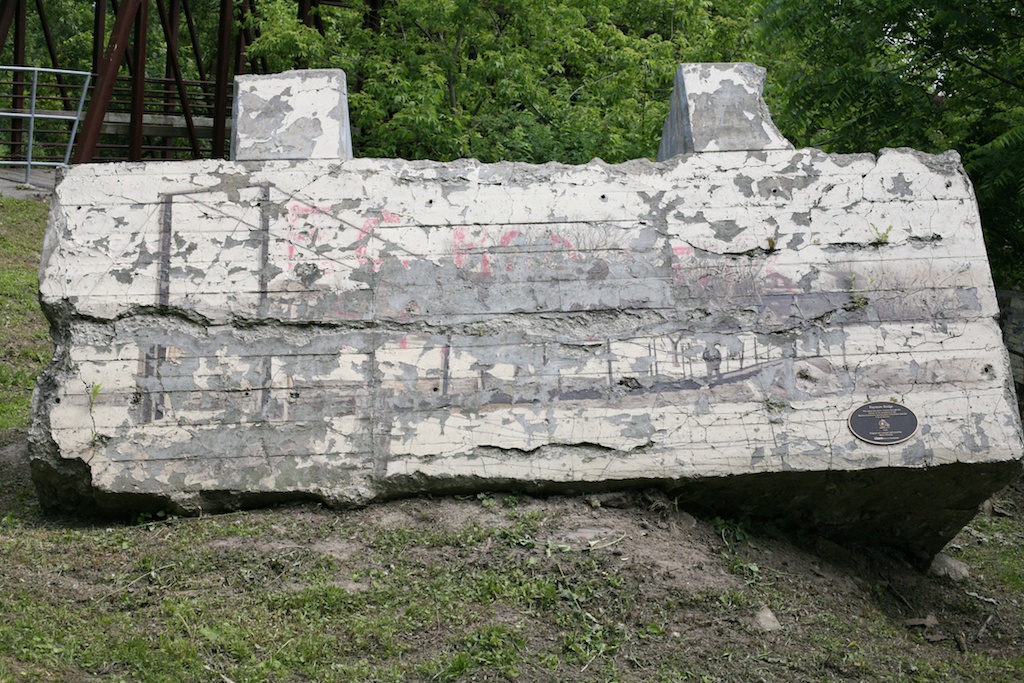
The eastern abutment of the old footbridge connecting Weston to Raymore Drive. Artist Mario Noviello painted this commemorative work in 2002 but sadly the weather has not been kind to his creation showing the original suspension bridge. The western abutment remains in the river where it was dragged during Hazel’s fury.
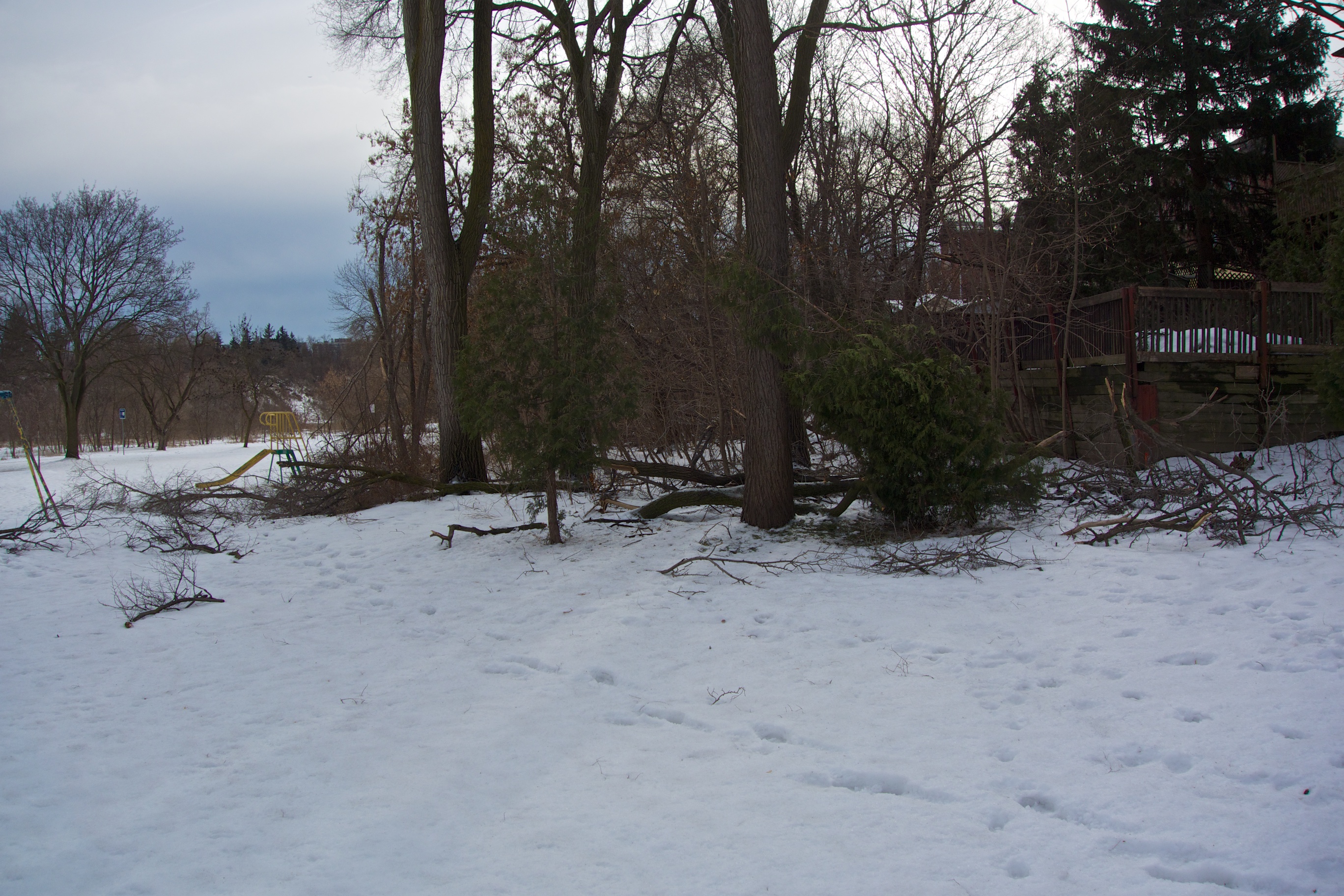
Last month’s ice storm inflicted little damage on the park. Most of the recently planted trees in the park suffered no damage while some of the older ones lost dead wood. Siberian elms at the entrance to the park seem to have suffered the most damage and as ‘Guest’ pointed out, these along with Norway maples are not natives and aren’t in their natural environment. Surprisingly, the park wasn’t planted with a lot of trees after its creation in the 1950s. If that had been done, Raymore Park would be a mature forest by now and helping to reduce flooding along the Humber. On the other hand, the trees chosen for planting may have been non-natives or even species under threat such as elm or ash.
Looking south – Siberian elms have dropped many branches near the park entrance.
Siberian elms are a particularly damaging tree in Ontario because they are so prolific and also because they are partly resistant to the Dutch elm beetle allowing it to remain a threat. No doubt the park will be low on the list for clean-up of the debris (which is not entirely a bad thing).
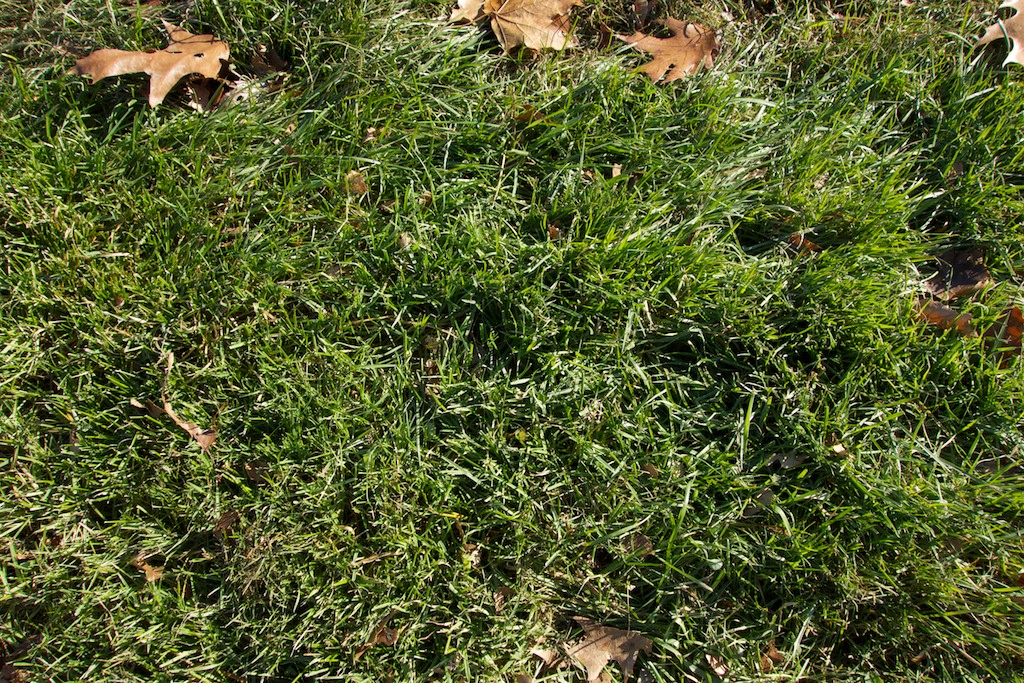
Who knew that all you have to do to maintain a spectacular lawn is cut and aerate it. The occasional re-seeding helps too.
This grass in Raymore Park hasn’t been treated with weed killer or insecticides in this century and is cut relatively infrequently (with a mulching mower) and aerated annually. In spite of that (or perhaps because of it) there are no bare patches, few weeds and no animal diggings for grubs. When a weed killer ban was proposed around 1999, there was a huge outcry from those who thought that weeds would replace grass in Toronto’s parks. Somehow, the chemical lawn brigade’s fears were as justified as those around computers and the Millennium.
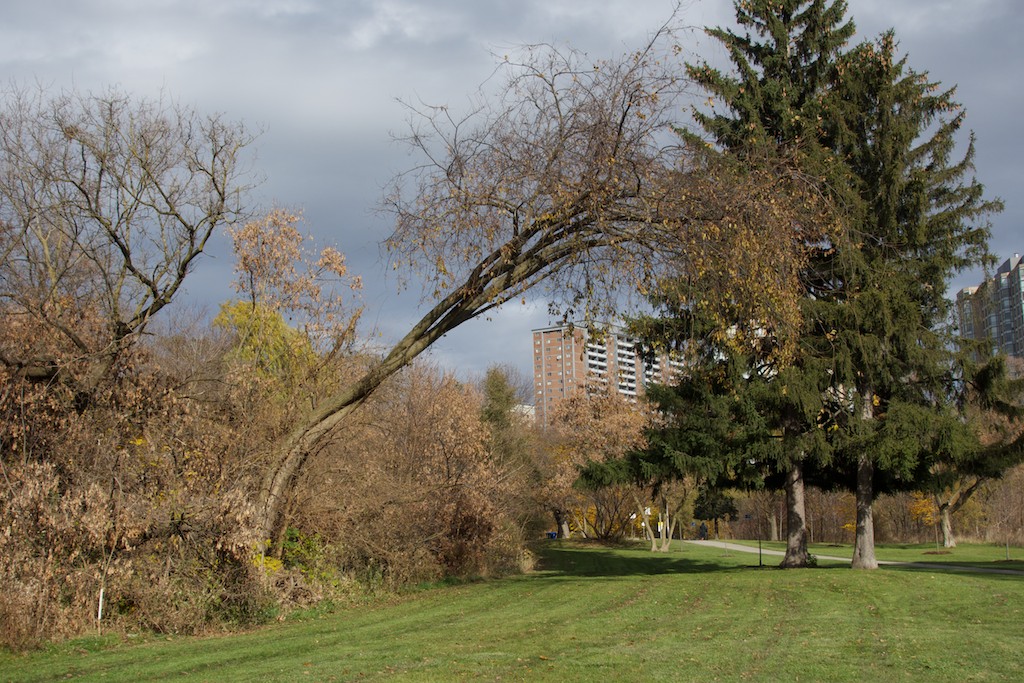
There is a tree that leans at a jaunty angle and I confess to walking at a brisker pace when underneath it. I have the impression that the lean is increasing so perhaps this winter will be its last.
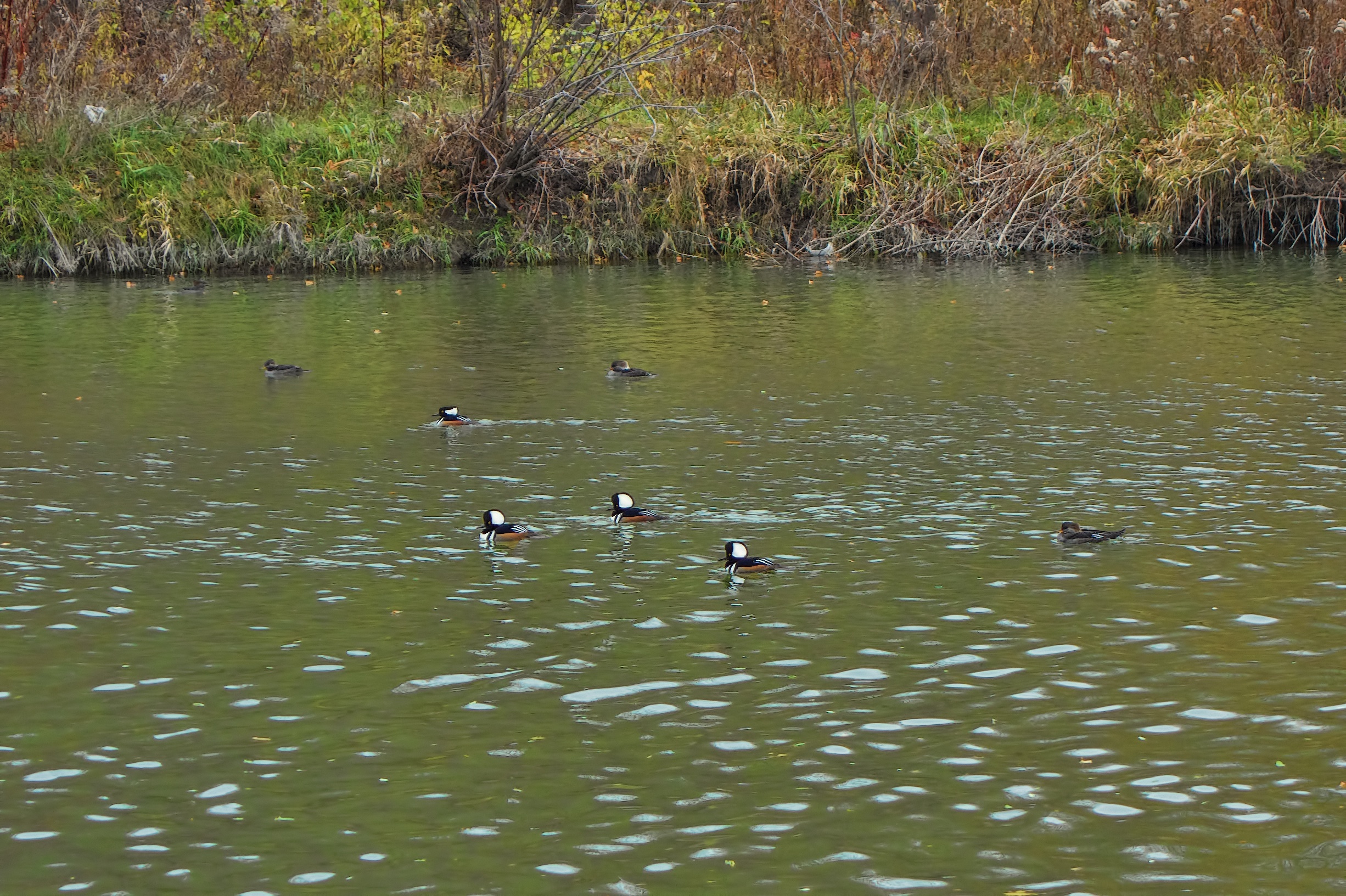
Lastly this group of Hooded Mergansers have returned to the Humber to add an exotic air. They are quite shy but don’t seem to mind hanging around with the resident mallards.
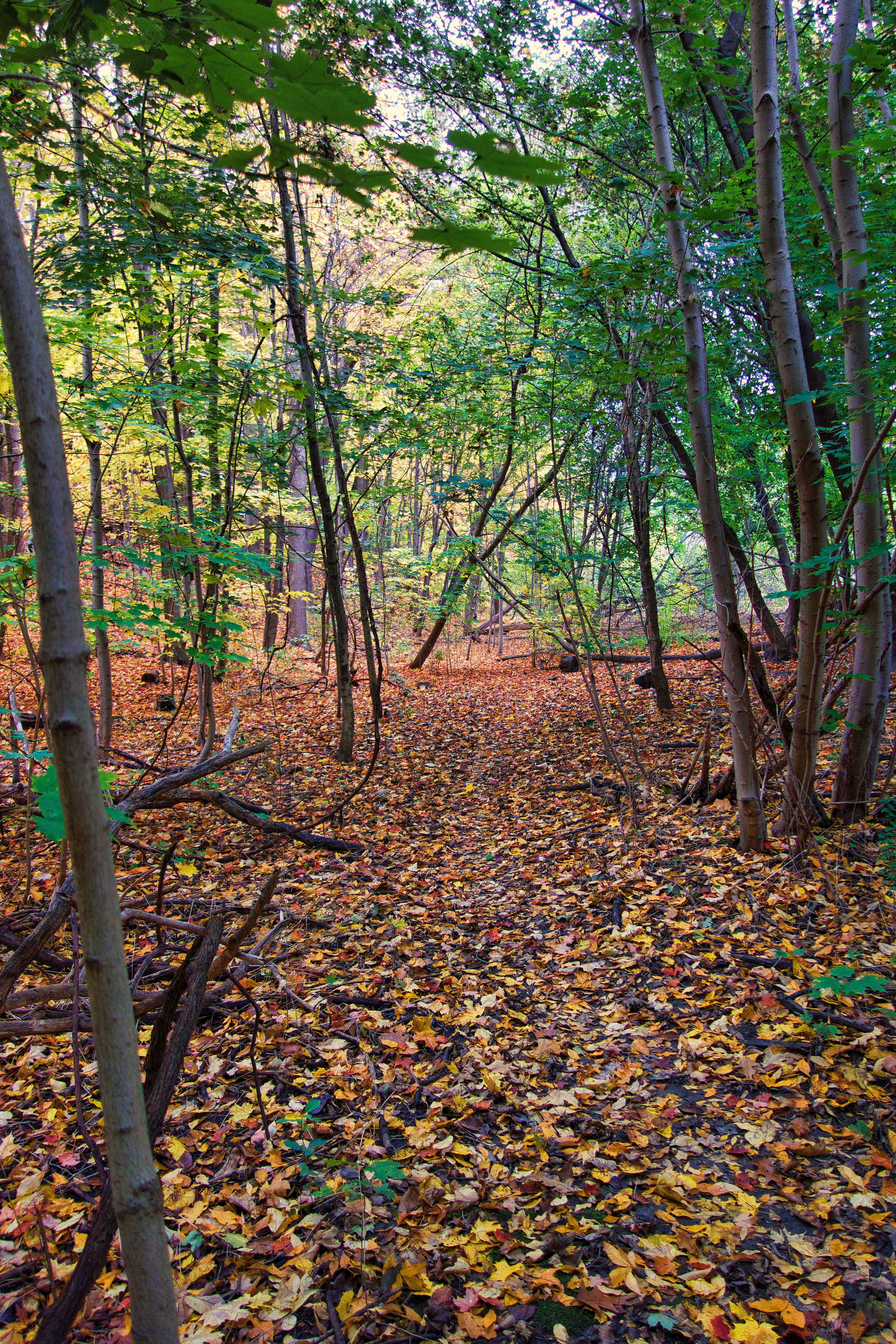
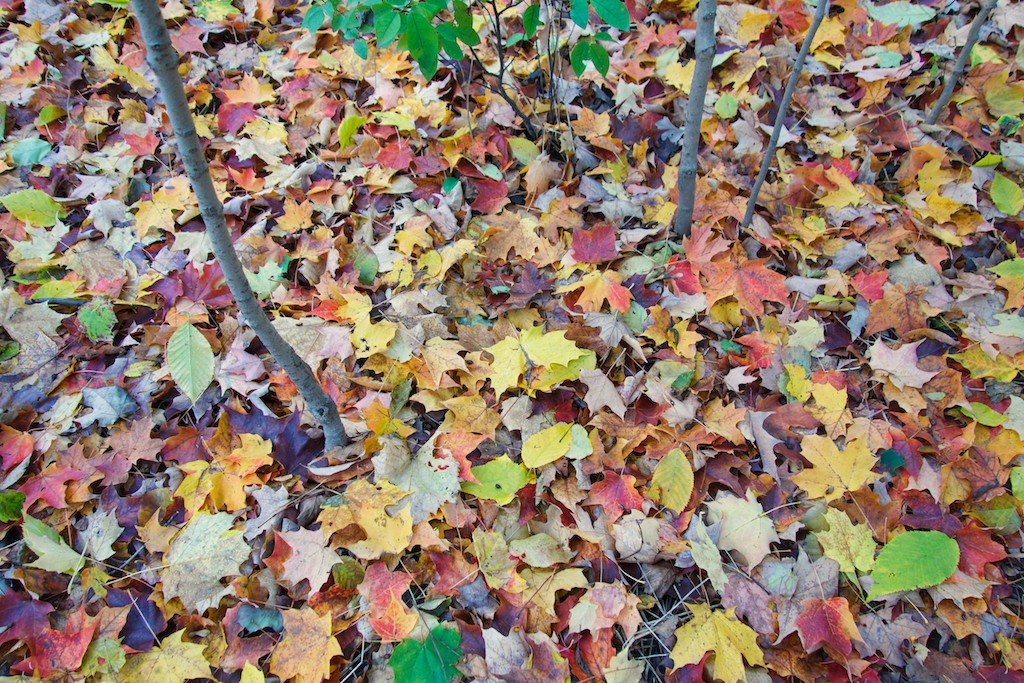
Autumn is well under way and the wooded area at the southern end of the park is undergoing a transformation. Many leaves are off the trees, changing the canopy dramatically and the increased light on the freshly fallen leaves has created a brightly coloured carpet.
A carpet of colour.
This part of the park always reminds me of the nave of a great cathedral. Sadly, many of the trees in the woods are Norway maples which produce little colour and need a frost to dislodge them.
The fresh colours of early autumn.
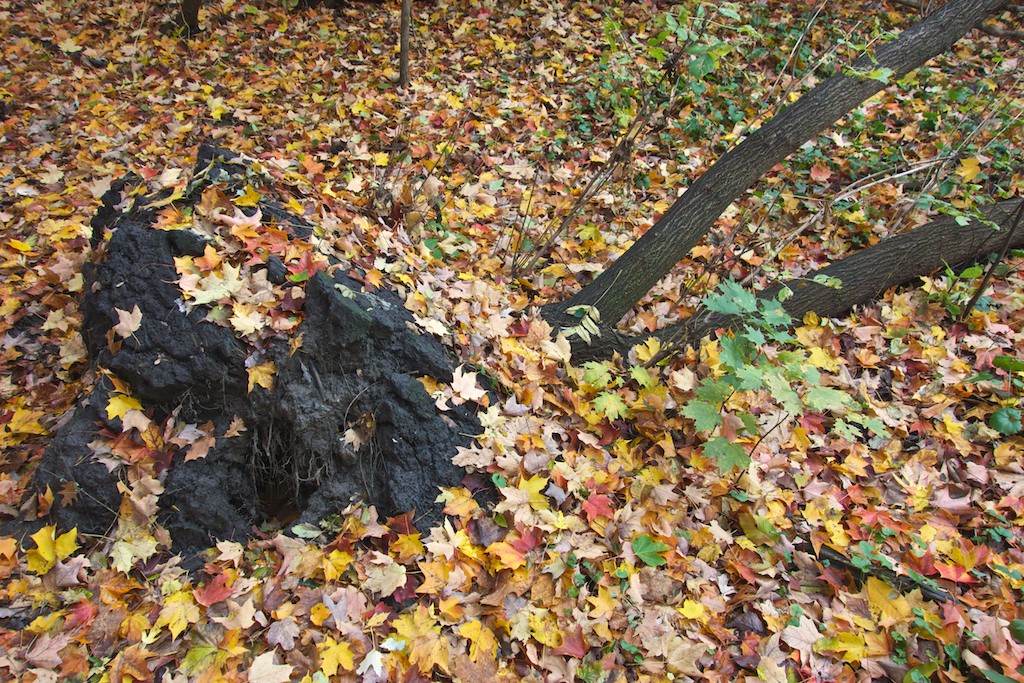
If there was ever any doubt as to the ability of trees in a park to act as a carbon sink, the soil in the woods provides ample evidence. The site was once a rubbish tip but has been wooded for a few decades. In that time, annual cascades of leaves have fallen and decomposed in place, leaving much of their carbon behind to form a deep and rich loam. This summer, a few trees were downed by strong winds and the uprooted trees reveal a soil that is incredibly black and rich in carbon.
Dark black loam, rich in nutrients and especially carbon.
It is estimated that Canada’s boreal forests (yes, even Raymore Park’s tiny woods) store up to 80% of the carbon they pull out of the air. This is because our cool climate drastically slows carbon’s oxidation back into the atmosphere. On the other hand, a mature tropical forest sequesters very little carbon. But wait, there’s more; boreal forests moderate a region’s climate by warming winter air (more sunlight is absorbed by trees than by snow). In summer, leaf transpiration keeps temperatures down so trees in our part of the world are definitely a great resource.
Toronto has a front yard tree planting program that allows residents to receive a native tree in the city-owned portion of their front yard for free. A selection of species is available and they’ll even do the planting. This is in an effort to raise the canopy cover of our city from around 27% to 40%. A laudable goal that will improve life for all residents and help with reducing flooding and the escalating carbon dioxide levels in the atmosphere.
In the last 20 years, thanks to old age and disease, there has been a steady reduction in the number of mature trees in Raymore Park. Quite a number of these trees are invasive non-natives such as Siberian elm and Norway maple. While many hundreds of native saplings have been mass planted in the wild areas, no mature boulevard trees have been planted to line the pathway.
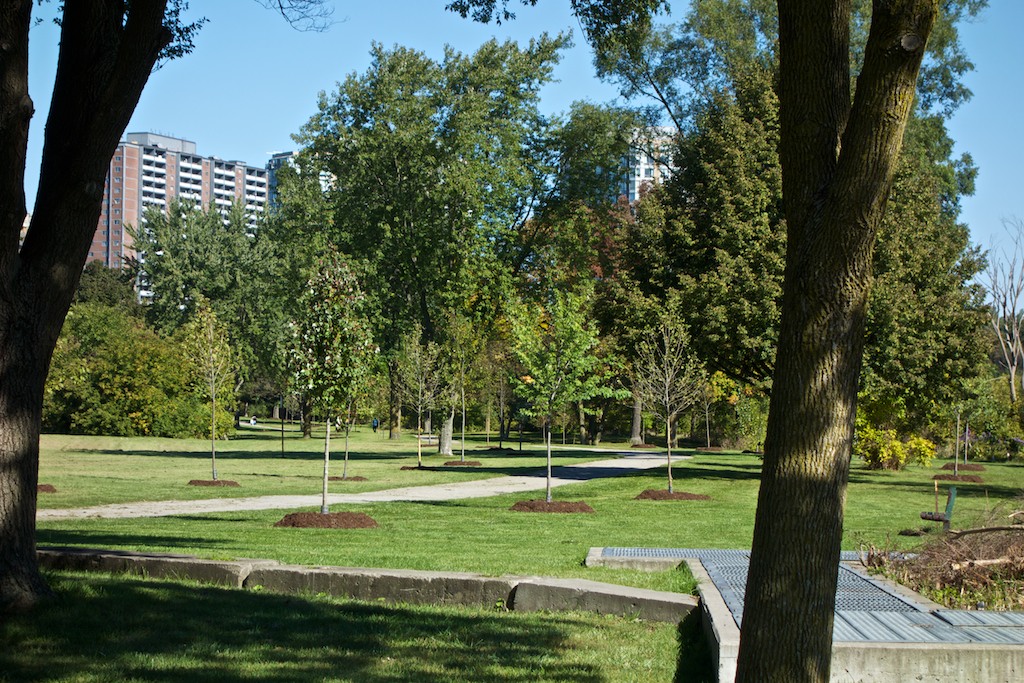
On Monday September 23rd, 43 trees were planted along the entrance and pathway as far down as the weir. This will make a big difference in years to come as the path is quite exposed in both winter and summer. I only have one slight quibble with the choice of trees; quite a number are black walnut and the park has no shortage of those already. There are quite a few water-loving weeping willows where the path comes near the river and some maples too.
A couple of Toronto Forestry workers were inspecting the trees yesterday and they told me that for the most part the trees were planted to the correct specifications by the contractor. A few have been planted too high and will need to be adjusted and some look a little straggly, but for the most part it has been a successful planting.
This is the perfect time of year to plant trees as the ground is still warm and autumn rains will ensure lots of moisture for roots to grow.
Two hundred years ago, Atlantic salmon along with many other varieties of fish were plentiful in the Humber. Gradually, settlers built dams and toxic waste from sewers, factories and pulp mills was dumped into the river. The combination killed just about everything in the water and Atlantic salmon were extirpated from the Humber as a result. In 1959, the opening of the St Lawrence Seaway saw the accidental introduction of the parasitic sea lamprey which killed the rest. An ambitious program lasting several years aims to restore a self-sustaining wild Atlantic salmon population to the Humber. Each spring until 2015, salmon fry are being released all along the Humber. Most weirs along the river have been adjusted to be too high for lamprey but low enough for migrating fish.
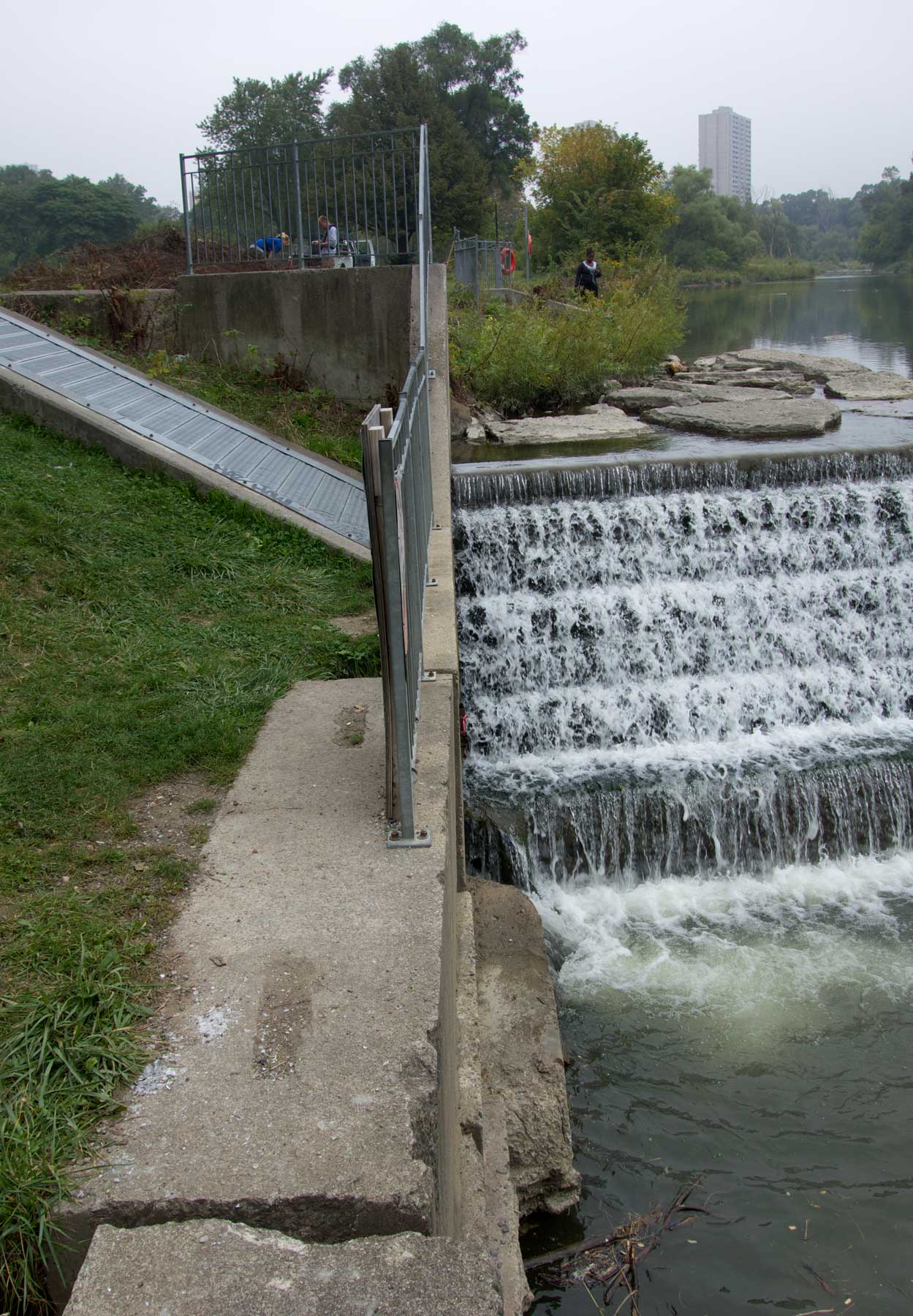
In Raymore Park, the 3 metre weir remains an insurmountable barrier to all aquatic life and to work around that, a denil fishway, (better known as a fish ladder) was built around 13 years ago.
The fish ladder entrance is on the left just below the weir.
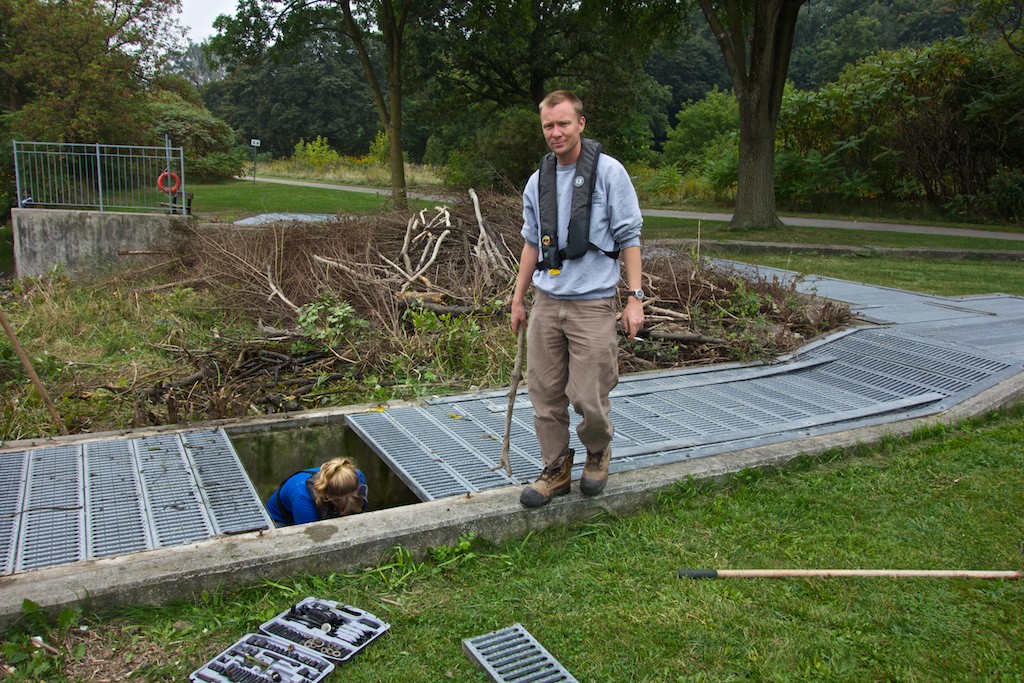
The fishway provides a gentler current and slope so that large fish can make their way up the ‘ladder’ with rest stops along the way. Unfortunately, beavers stuff the fishway with wooden debris in the hopes of creating a dam. Needless to say, the blockages need to be cleared several times a year so that fish can migrate to their spawning grounds.
On Friday, two workers were clearing the way for the salmon and told me that when water levels rise (as they did on Saturday), these large Lake Ontario fish will be able to access and use the ladder. From there they will swim upstream to their birthplace, spawn and return to the lake – assuming they can run the gauntlet of people out to get them.
Toronto and Region Conservation Authority workers clear the top of the fishway.
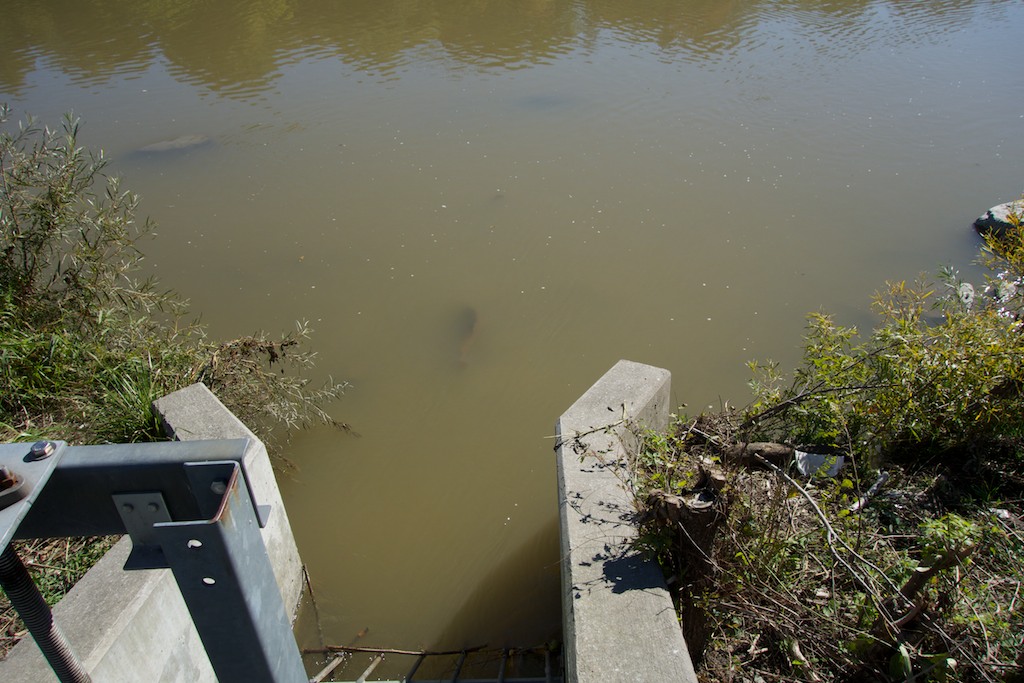
Since the ladder was built I have watched in vain for a fish to appear at the exit. Today, (Tuesday September 24th) I had a premonition and with the camera ready, just like that, a fish emerged. The water was a little murky and I was a little late but here’s the evidence; the ladder works.
The salmon (middle top of photo) continues its journey up the river.
For its part, the TRCA is studying the further removal of obstacles to fish migration along the Humber and the weir in Raymore Park is the highest. Lowering and notching of the weir will allow the fish to leap upstream the old-fashioned and low-tech way. This will end the high maintenance costs of the fishway and finally allow the beavers to block it to their hearts’ content.
Last night the first ground frost hit Raymore Park. This occurs when the temperature doesn’t go below zero but there is a touch of white on the grass. Hopefully the first air frost is some time away but there are unmistakeable signs of fall, even though most leaves are still green. One sign that is hard to miss is the fruit that seems to be everywhere. From crab apples to acorns, seeds for the next generation are ready to be distributed.
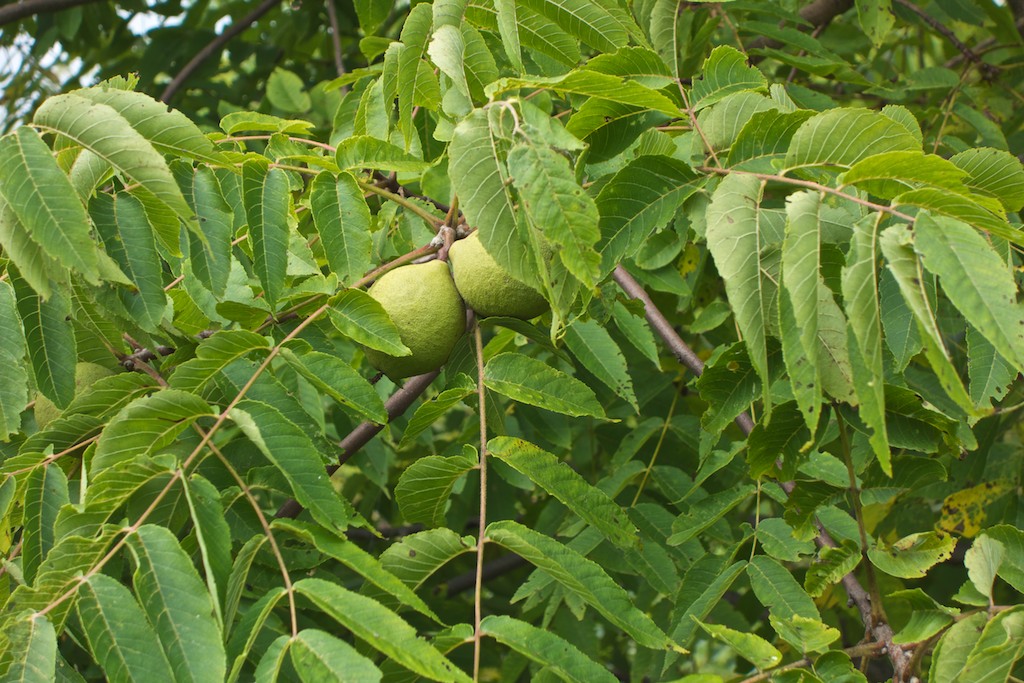
These exotic looking fruit are black walnuts.
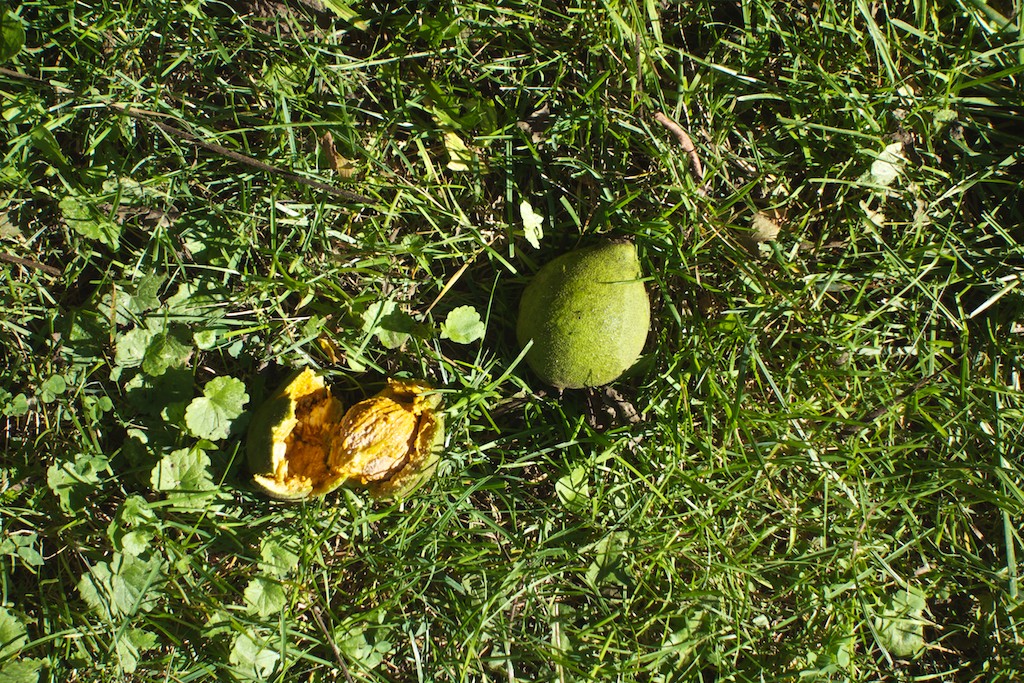
Black walnut trees are very common in Toronto and provide food for squirrels and the occasional curious human. They are native to Toronto but thrive in cold spots such as Quebec City because they avoid frost damage by leafing late in spring. The walnuts themselves are surrounded by a fleshy outer skin and then an incredibly hard shell.
The walnut on the left was run over by a car revealing the unbroken inner shell.
Unlike Persian (aka English) walnuts that have been cultivated for millennia, black walnuts are pretty much as nature designed them and as a result are smaller and incrementally more difficult to harvest. Anyone who has attempted to extract a black walnut can only appreciate the skill and determination of squirrels. The trees dispense a natural herbicide called juglone which kills competing plants unlucky enough to be nearby. The toxicity is not isolated to plants; horses should be kept well away from black walnuts. Attempting to extract the nut from the flesh will leave hands turned dark orange by the chemical. The wood is much prized as a veneer.
Thanks to absent-minded squirrels, Raymore Park is a black walnut nursery with more and more planted every year. They grow quickly and can live on average 200 years. As time goes on, walnut trees will increasingly influence the variety of flora and fauna in the park.










 Friends of Raymore Park