Category Archives: Park management

Humber Bank Stabilization Update

All last week, trucks rumbled into Raymore Park delivering old bricks and concrete blocks (clean fill).

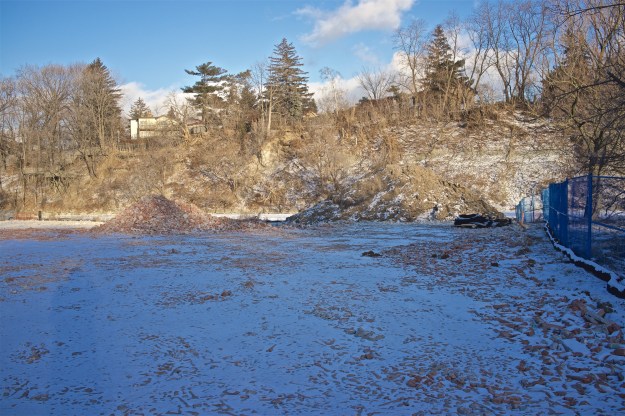
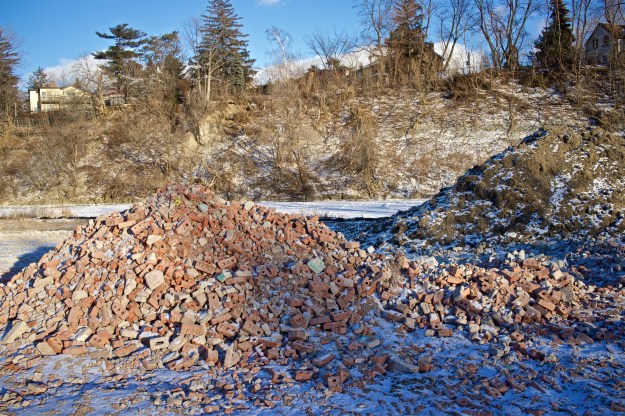
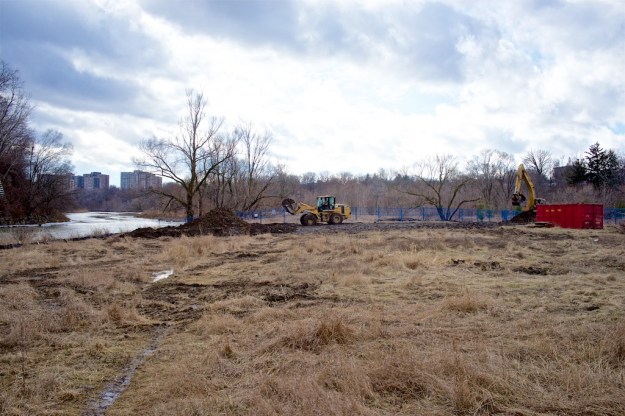
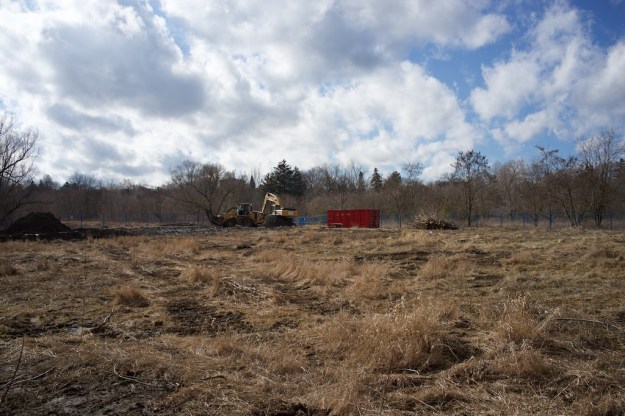
I braved the bitter cold this afternoon to find out what was going on. Rather than building a stable roadway along which trucks can approach the river, the whole of the fenced off land is being laid with about 40cm of clean fill to create a working area that stretches to the river’s edge from which the retaining wall can be constructed.

Topsoil scraped from the area can be seen (right) and brick rubble ready to be spread over the remainder of the land is on the left. To get an idea of the scale of  this endeavour, there’s a person standing by the orange fencing (far left).

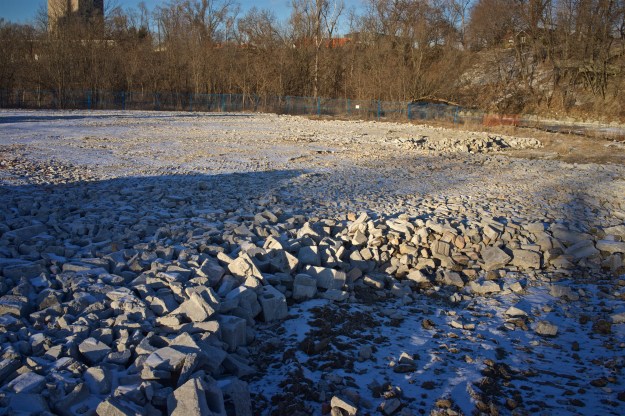
The depth and size of the rubble layer can also be seen here.

Apparently the plan is for the rubble to be carted away again and the topsoil replaced after the job is completed.

Bricks waiting to be spread over the park surface.

A closer look at the brick rubble and (eventually) the old topsoil waiting to be spread over the park surface.

One permanent change that may have been made; the old basement depressions from homes swept away during Hurricane Hazel are probably gone.

Work begins on Humber bank stabilization and sewer rehabilitation.

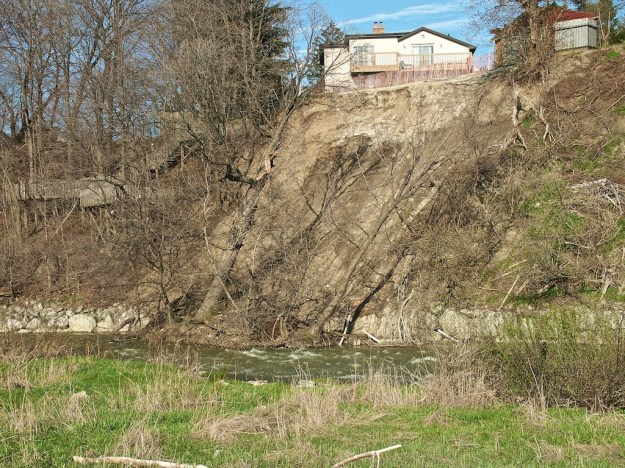
More than a decade ago, the owner of a house on Sykes Avenue in Weston suddenly lost several feet off the back end of their property. The house overlooks a sharp curve of the Humber River as it turns to the south. During April rains in 2004, the rear of the property abruptly vanished along with several mature trees and other vegetation. Luckily nobody was standing near the edge.

Shortly after the landslide in April 2004.

Shortly after the landslide in April 2004.

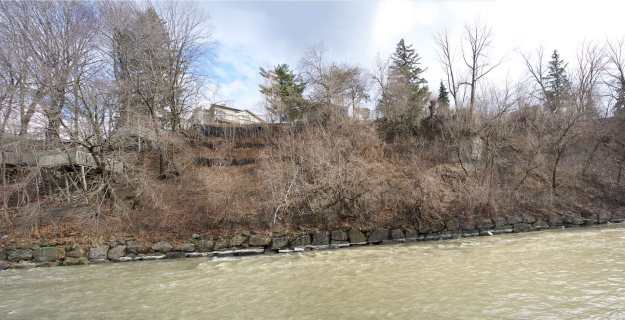
Panorama view of the bank as it looks today.

A panorama view of the bank as it looks today. Note the current retaining wall and the precarious position of the tree on the right.

That summer, the fallen trees actually went into leaf and remained in place for most of the season but were eventually washed down the Humber. What caused the erosion? Who knows; it probably didn’t help that each autumn, the owner at the time drained the pool over the top and into the river. The likely explanation is that the slope was simply too steep to withstand the shearing forces and nature adjusted the angle. TRCA is responsible for erosion control and has a handy guide for those ‘living on the edge’. It must have been painful to update the property deeds to reflect the new reality. After this event, the owner put in some vegetation and other stabilization measures but by then the rot had started and moved downstream taking chunks of other back yards into the river.

A retaining wall of sorts is already in place, built in 1981 and it has been high enough to provide ‘toe protection’ for most flood events. Unfortunately it wasn’t tall enough to cope with major events such as the storm of July 2013.

After extensive study, TRCA has decided that in order to stabilize this stretch of the Humber, a 6.5 metre tall ‘replacement armourstone wall’ and stabilization measures need to be put in place on 170 metres of the east bank before more land disappears downstream.

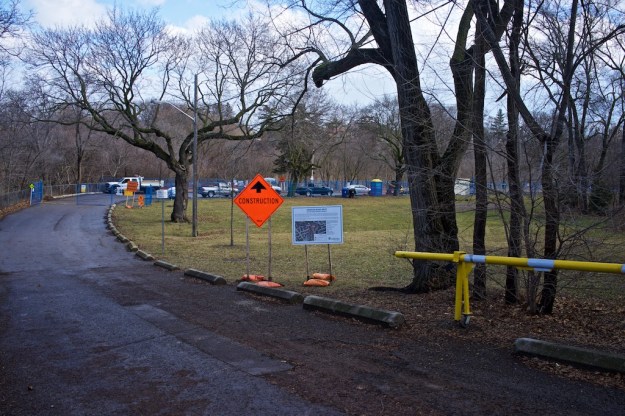
Raymore Park entrance.

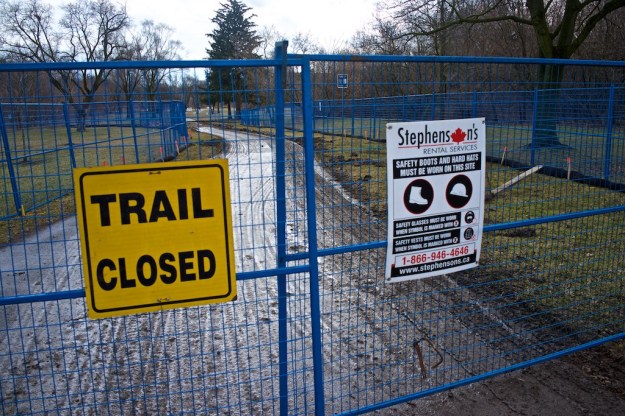
Raymore Park entrance. Notice that the pathway and direct footbridge access is blocked to pedestrians. This could have been avoided by fencing off a narrow gap on the left.

Looking south from the parking lot.

Looking south from the parking lot. The trail resumes further down.

Since construction from the top of the east side is impossible, the plan is to access the wall through Raymore Park.

Unfortunately the solid winter ground from the bike path to the river expected by the construction crew has failed to materialize (so far) and a steady stream of trucks has been offloading fill onto the site in order to construct a stable road down to the river.

Sadly dozens of native trees that were planted several years ago have been removed from a surprisingly large area. Presumably these will be replaced but this will delay the expected native canopy planned for this section of the park.

The new road under construction leading to the river. Notice the clearance of all trees and shrubs.

The new road under construction leading to the river. Notice the clearance of all trees and shrubs.

Another view showing the extent of the clearance.

Another view showing the extent of the clearance.

In the meantime, pedestrians are having a messy time getting access to the footbridge from Raymore Drive, the continuation of the path further down the park and there are questions regarding the replacement of trees and shrubs lost when the land was cleared.

According to the leaflet delivered to homes in the area, the work is scheduled to be completed by the end of March and restoration of the land will take place in the fall. Projected cost: up to a maximum of $250,000.

At the same time, more sewer rehabilitation work is ongoing along the Humber that will necessitate further tree clearance along the path of the sewer line between now and the end of March and this will extend along the river between Raymore Drive to well past Eglinton. The City of Toronto has more information here.

Later this spring will begin the construction (if given final approval) of the proposed leash free zone (Many dog owners seem to have declared Raymore Park leash free already). This will bring even more heavy equipment through the park. A final meeting is scheduled for February 25th at 6:30pm in Westmount Junior School, 95 Chapman Rd. Councillor Rob Ford will be in attendance.

Raymore Park Leash Free Zone Likely

In spite of the fact that Raymore Park was rejected as a candidate for leash free zone consideration as recently as June 2014, organizers of the recently held residents’ meeting seemed to confirm that the zone is a done deal. Apparently ‘someone’ applied last June, and the City must consider the site. Oddly the city’s reasons against a leash free zone in Raymore were the same as those for rejecting adjacent Lions Park, namely, ‘TRCA, ravine,  natural heritage’. The document may be accessed here.

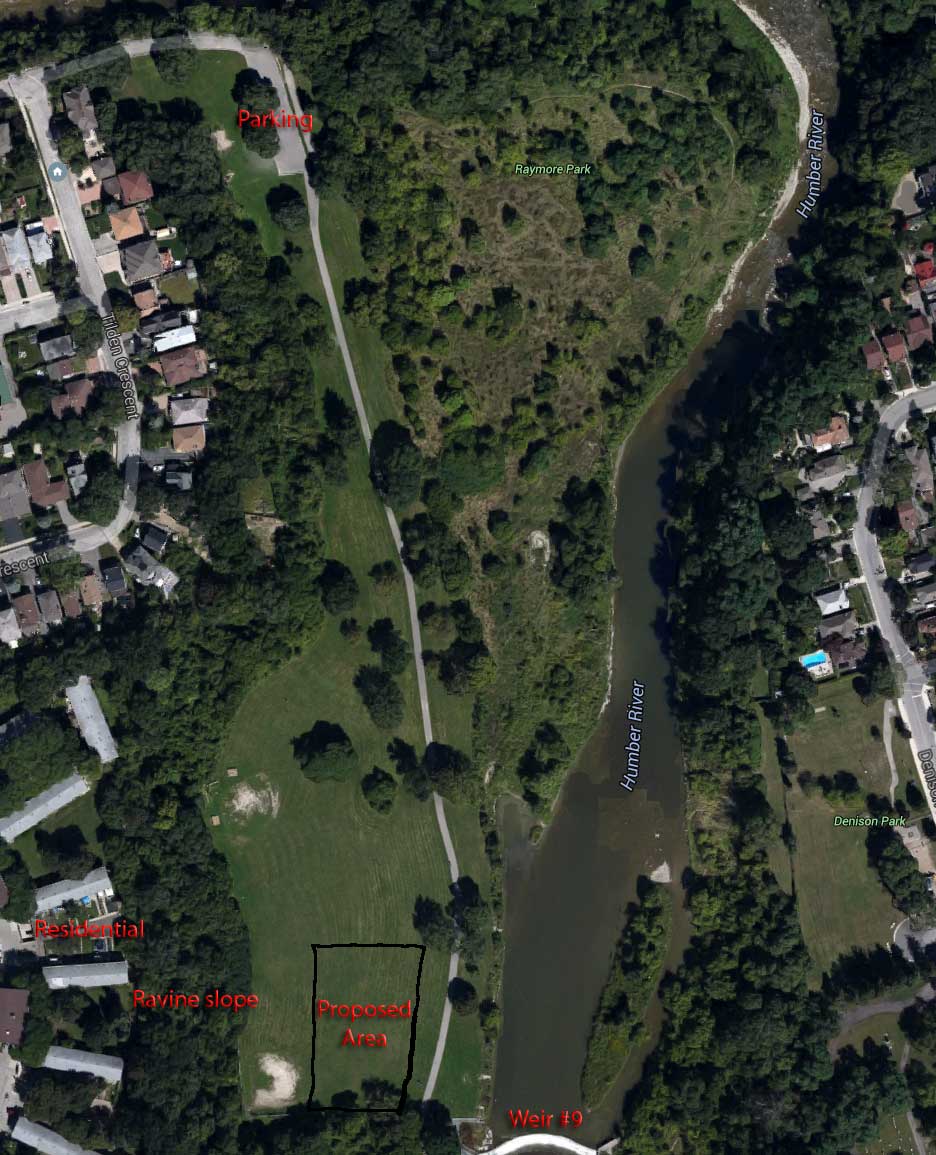
The meeting was attended by about 25 people and the proposed zone was illustrated – I have outlined an approximation as the organizers distributed no hard copy:

Raymore-Proposed-Leash-Free-Zone

Raymore Park showing the proposed off-leash zone. Google Earth.

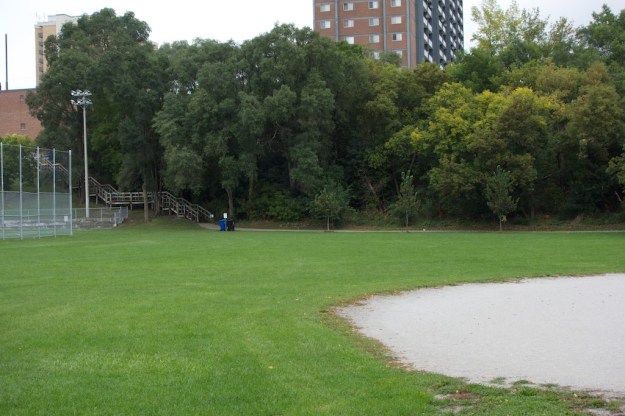
The site as it looks now (September 2015)

The site as it looks now (September 2015).

The zone will be about 450 metres from the parking lot yet only about 100 m from nearby residences (the fact they are TCH homes may have eased concerns). The baseball diamonds will remain in place as removing them would involve park owners, TRCA and it’s ‘too much hassle’ according to the meeting organizer. The zone will occupy ¾ of an acre down at the southern baseball diamond in a rectangle following the river about 15 feet from the far side of the path. It will be fenced with pine wood rail fences so at least it won’t look too bad. Its northernmost tip will be about half-way up the open field (perhaps a little further than what I have drawn). I did suggest planting trees to the north of the zone which would hopefully dampen the sound somewhat. The organizers’  positive response to this suggestion may have been a way of easing my concerns; we’ll see. Trees to the south will provide shade. Water and lighting will not be supplied as the location is too remote and the budget small. Supervision by city staff will be minimal thanks to budget restraints and may I cynically suggest, the long walk from the parking lot.

When I suggested that the majority of people using the zone will be with unlicensed dogs, the response was a bit of a metaphorical shrug. From what I gather, nobody will be checking for dog licenses – even in the early days of this thing. Professional dog walkers will be allowed to use the zone.

The proposed opening hours are 7:00 a.m. to 9:00 p.m. year-round (even though the park gates are locked from November until April). This will create parking issues along Raymore Drive and Tilden Crescent. Organizers then talked about keeping the gates open year-round which some in the crowd thought was unlikely as even the ploughs get stuck occasionally.

The zone will be installed by spring of next year.

The organizers claim that traffic and noise levels won’t increase by much but they don’t like getting complaints about the zones it will be up to residents to phone 311 if people are abusing the area or being noisy.

There will be one more meeting to discuss the plans based on community input.

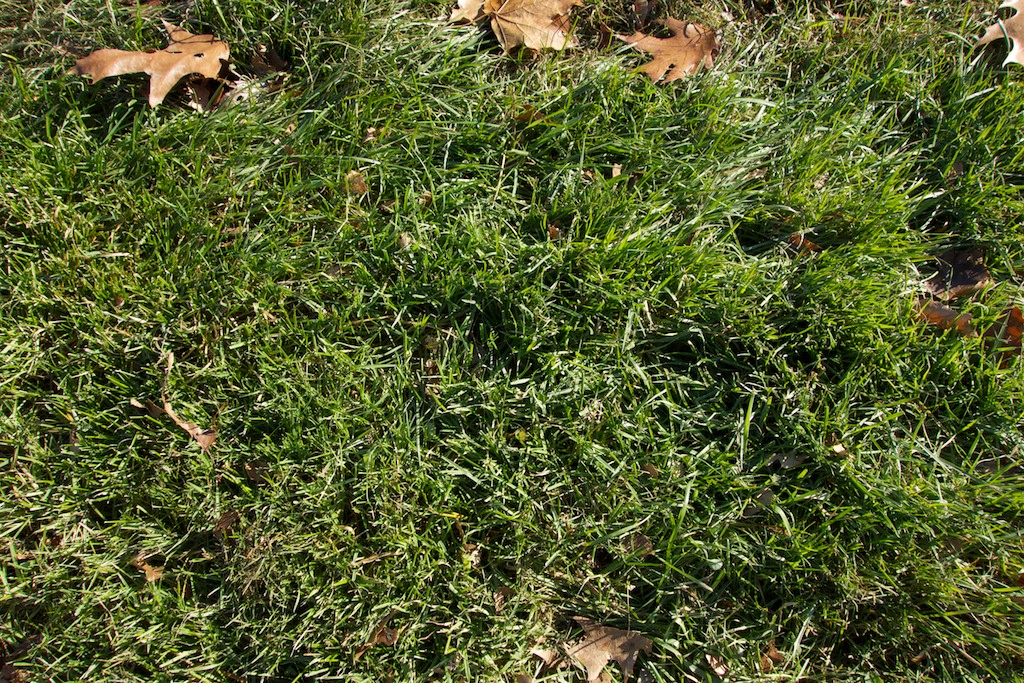
Lawn gods don’t ask for much.

Who knew that all you have to do to maintain a spectacular lawn is cut and aerate it. The occasional re-seeding helps too.

DSC03787

This grass in Raymore Park hasn’t been treated with weed killer or insecticides in this century and is cut relatively infrequently (with a mulching mower) and aerated annually. In spite of that (or perhaps because of it) there are no bare patches, few weeds and no animal diggings for grubs. When a weed killer ban was proposed around 1999, there was a huge outcry from those who thought that weeds would replace grass in Toronto’s parks. Somehow, the chemical lawn brigade’s fears were as justified as those around computers and the Millennium.

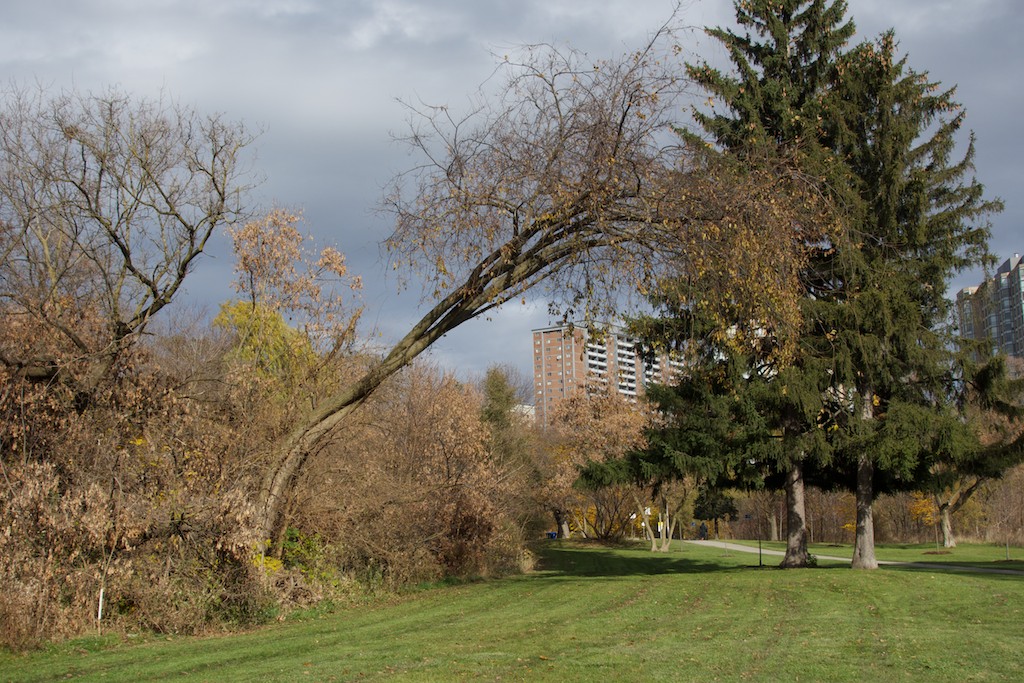
There is a tree that leans at a jaunty angle and I confess to walking at a brisker pace when underneath it. I have the impression that the lean is increasing so perhaps this winter will be its last.

DSC03748


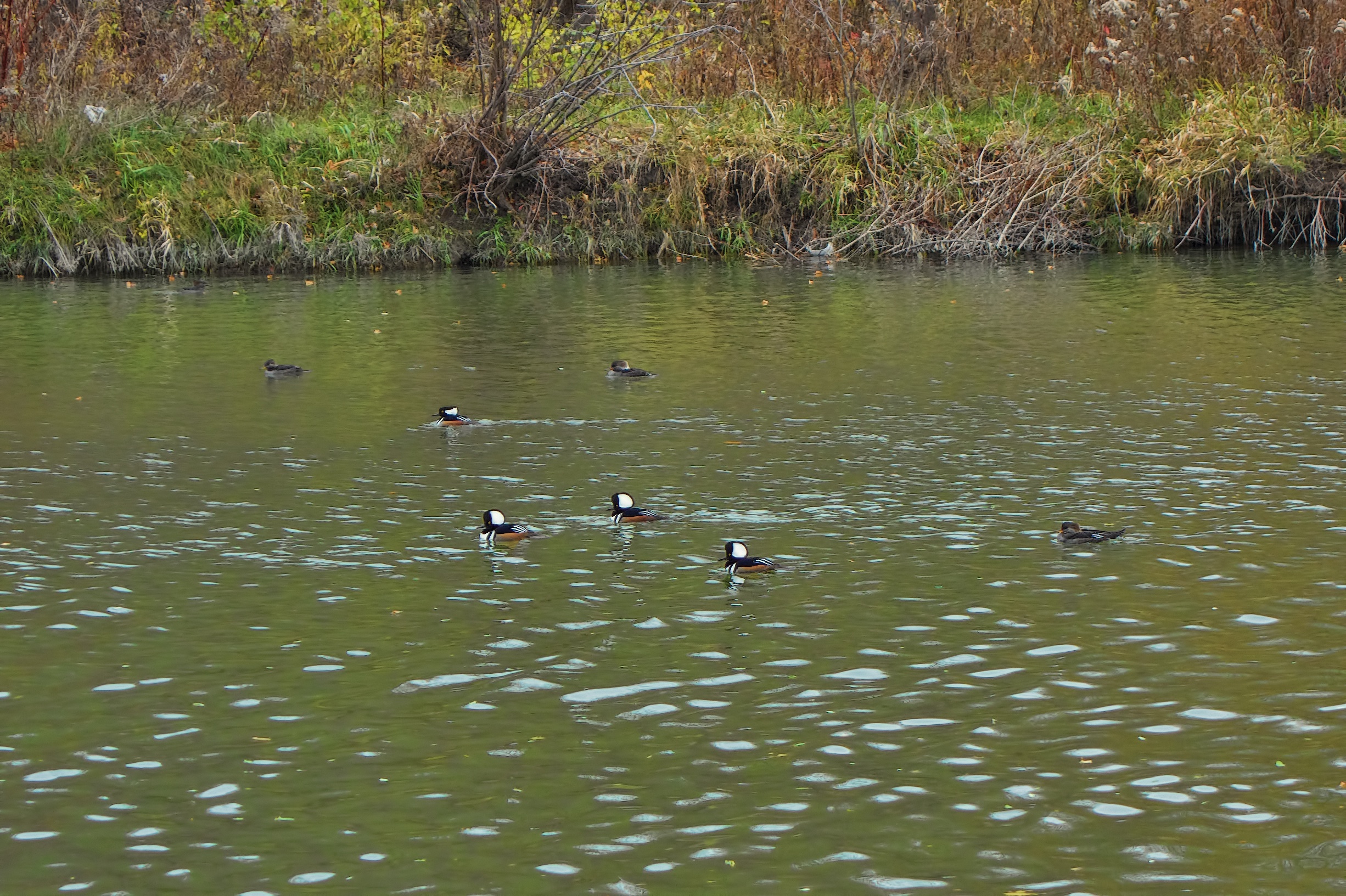
Lastly this group of Hooded Mergansers have returned to the Humber to add an exotic air. They are quite shy but don’t seem to mind hanging around with the resident mallards.

DSC03765

It’s that time…

Let it snow.

Let it snow.

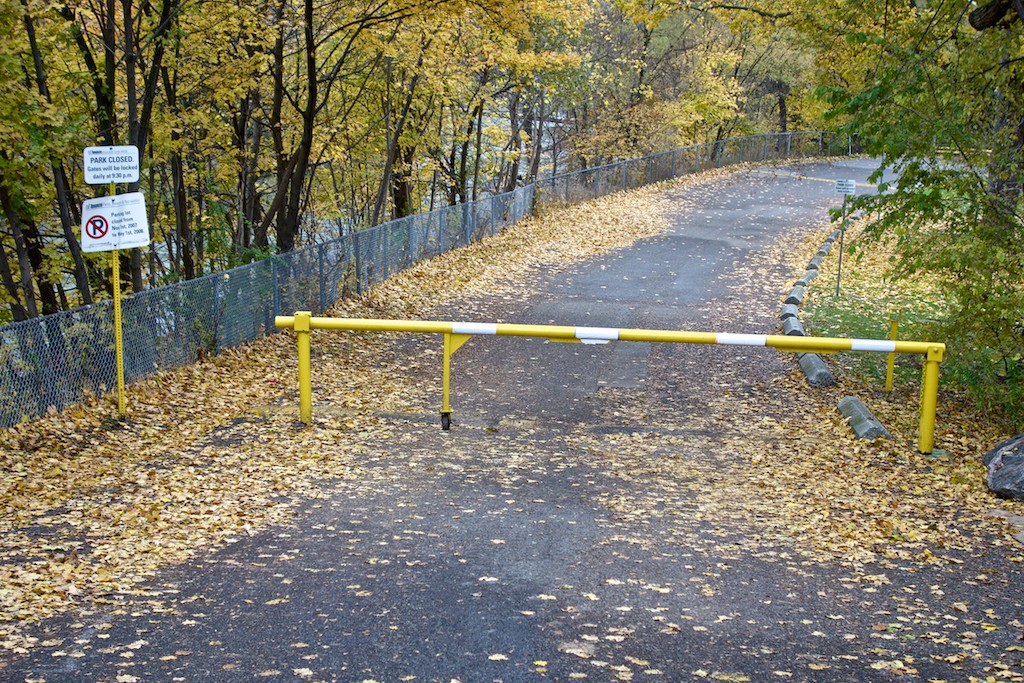
For the past few years, Raymore Park has closed its gate at the beginning of November and it stays that way until the end of March. This is because snow can occur at any time between these dates and many people are unable to drive back up a steep snowy hill to exit the park. This cuts down on quite a large number of visitors as the effort to park on Tilden Crescent and walk down to the park seems to deter most people.

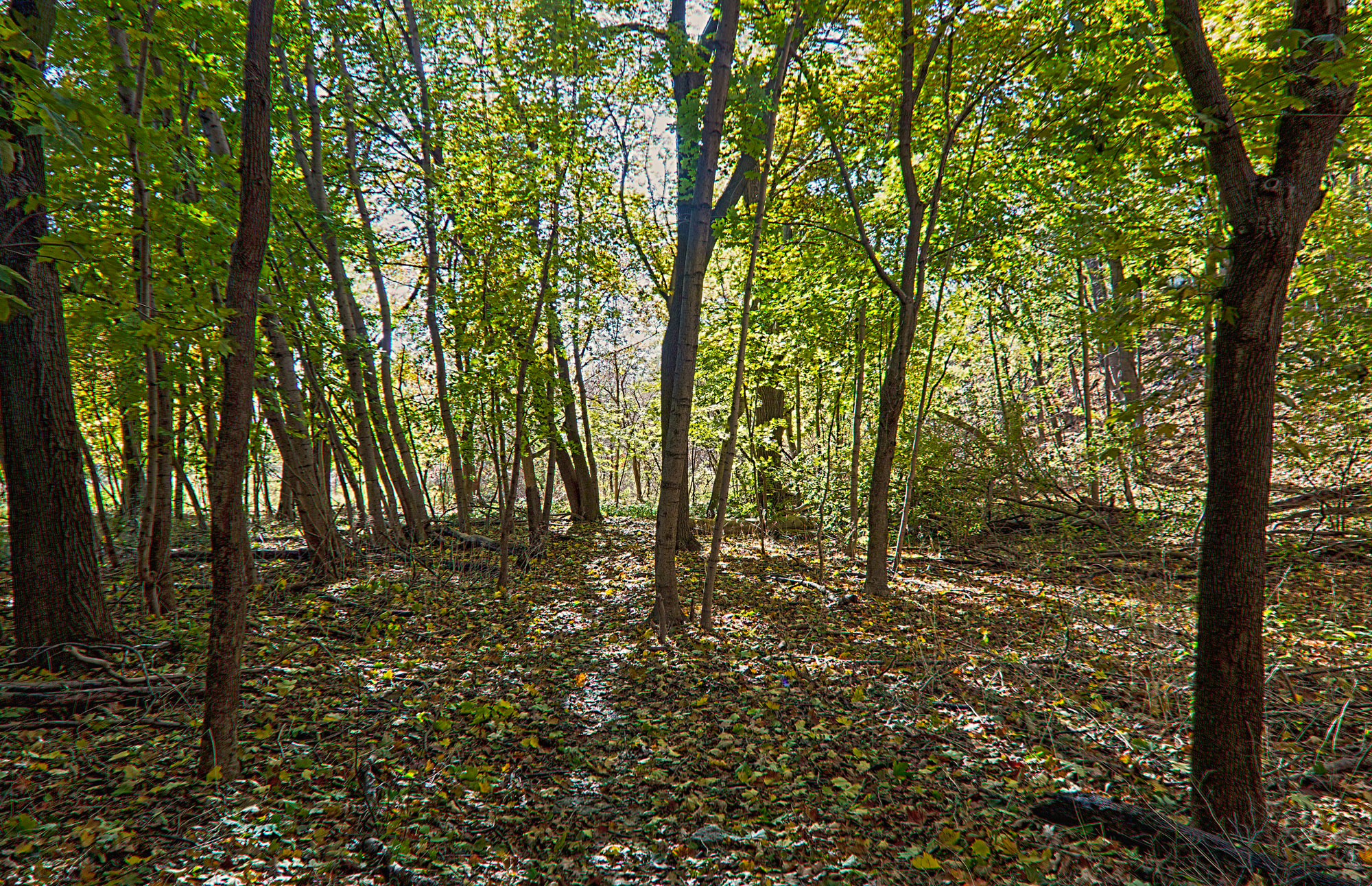
Light still is creating fascinating scenes in the woods. Here’s an attempt to capture what the eye sees using an HDR shot based on two images, one capturing highlights, the other, shadows then merged in Photoshop.

Woods-HDR

It’s your park too; get involved!

The Toronto Parks System is huge, occupying 12% of the city and consisting of hundreds of parks of varying size. Some are tiny little parkettes measured in square metres while others are measured in hectares. While it would be wonderful to have park staff available on site to solve problems at each location, sadly, this is not possible.  At one time, contacting a park supervisor was a laborious process. Now thanks to 311, it’s a lot easier.

So what can an ordinary resident do if they see a problem in their local park?

In my experience, Toronto’s  311 system, has made contact with park supervisors a lot easier. Operators will either forward your call to the voice mailbox of a supervisor or they will write up a work order themselves.

Here is an example of a situation I recently tackled in Lions Park, which is the one next to Raymore.

The problem:

Litter is the enemy of parks. It’s a hazard to wildlife and it puts off visitors. When litter levels reach a certain point, ordinary visitors and sightseers begin to drop away. Litter that stays on the ground actually attracts more, as people are less inhibited when the place is already a mess. It’s tough to fight human nature.

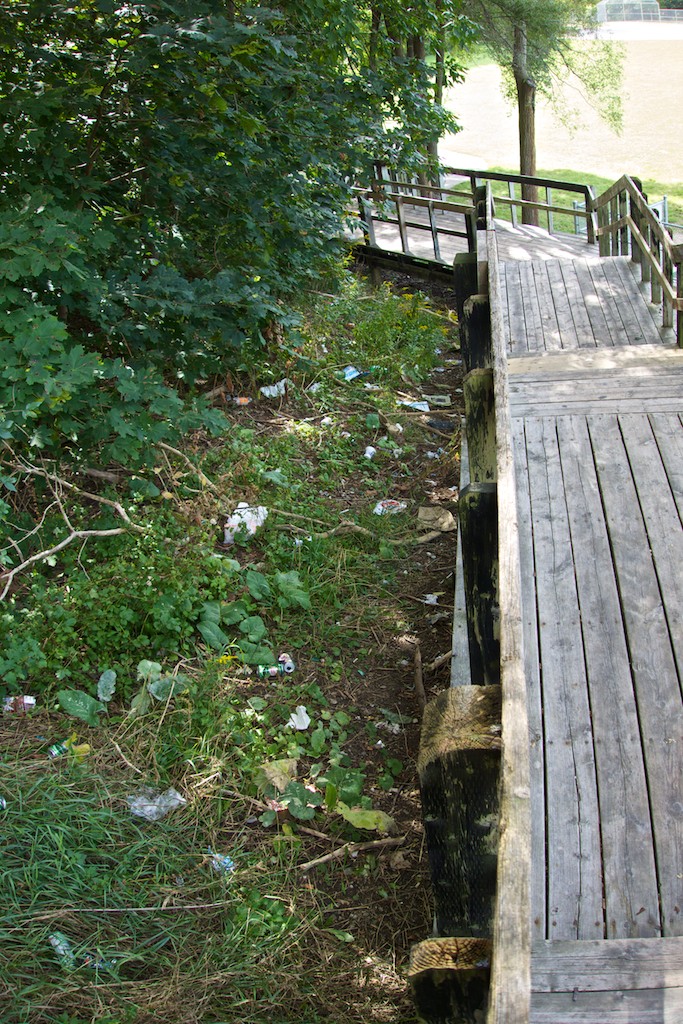
Lions Park contains a sports complex which includes a FIFA standard soccer field. Quite often, secondary soccer games spring up and for goalposts, garbage and recycling bins were easily commandeered from various positions around the park. After the game, the bins either stayed or ended up around the main field leaving vast areas without bins. Garbage became even more of a problem. In addition, the location of the bins was problematic as the photos will illustrate.
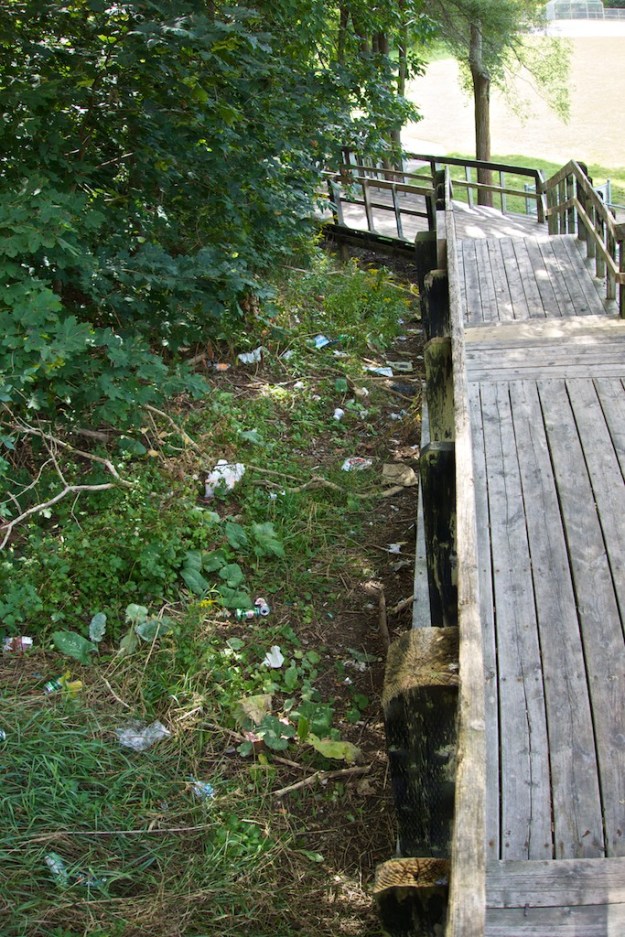
These stairs generate a large amount of garbage.

These stairs generate a large amount of garbage – no bins in sight.
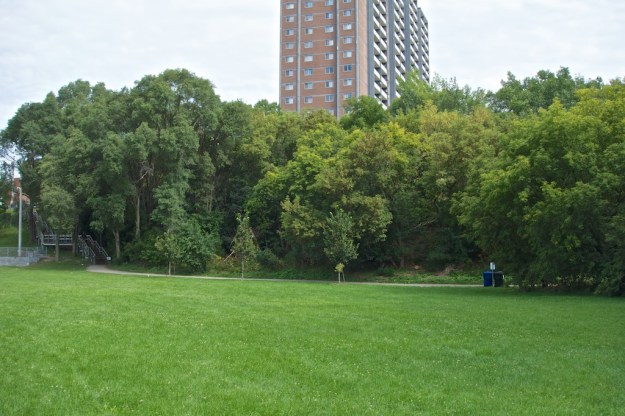
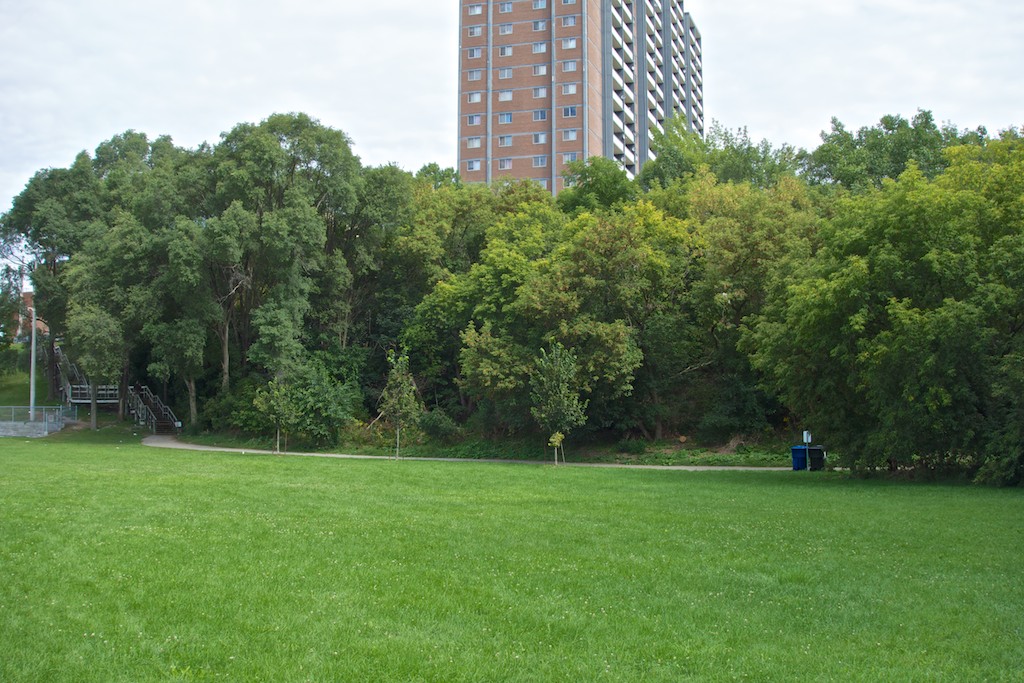
Bins are located far from the stairs.

Bins (on right of picture) are located far from the stairs.

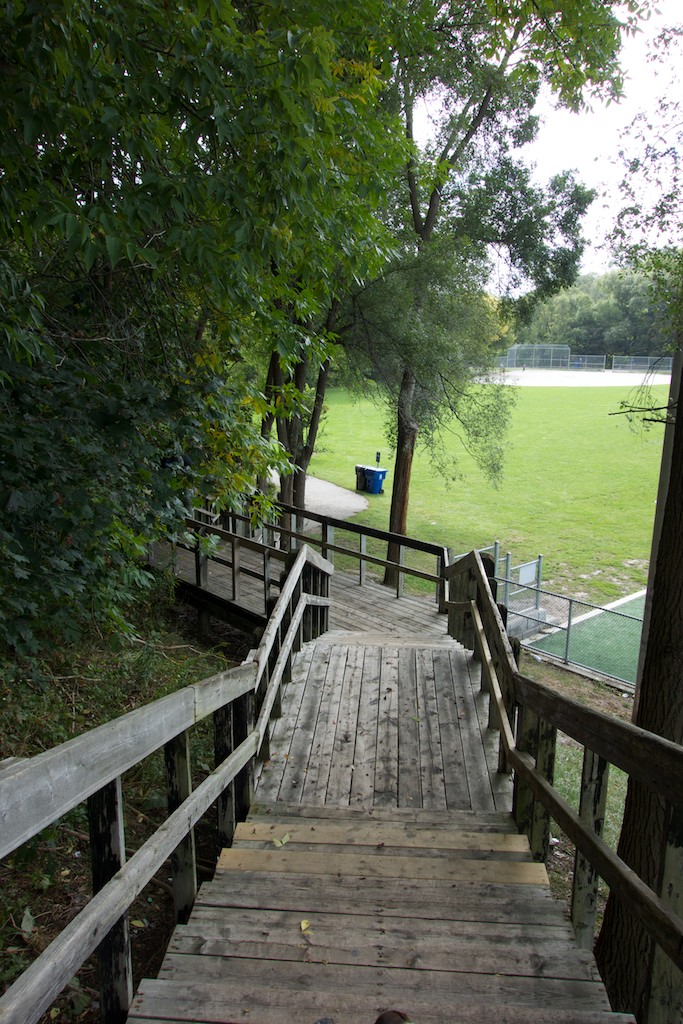
The stairs are often used as bleachers as they are above the soccer field. They also act as a hang-out spot. While it’s impractical to place bins on the stairs, no bins were visible making disposal inconvenient.
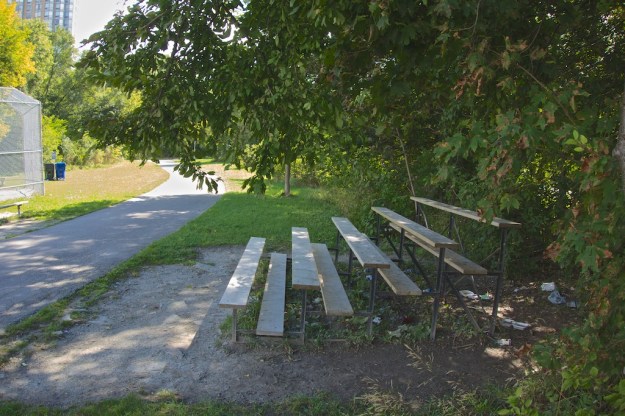
Bleachers - another big source of litter.

Bleachers – another big source of litter and bins too far away.

Bleachers generate large amounts of garbage. These back onto the delicate ecosystem of the Humber while the nearest bins were too far away.

With a problem outlined and a strategy for improvement in my head, I phoned 311. Unfortunately it was not possible to leave a message for the Park Supervisor as her phone mailbox was constantly full.

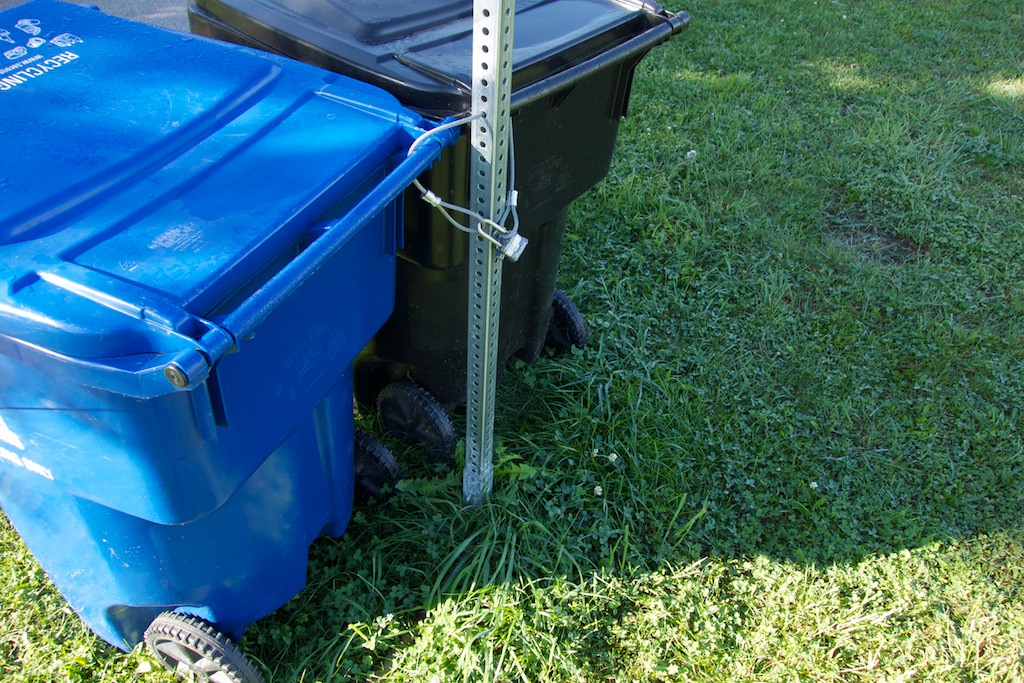
With the supervisor unavailable, I again called 311 and action was promised. Sure enough, stakes were hammered into the ground and as is standard practice, bins wired to them. Unfortunately, there was nothing to stop anyone disconnecting the wires and removing the bins. Within a couple of days, the bins had returned to being goalposts. To make matters worse, bins had been located poorly.

Eventually, the park supervisor got back to me after I placed a call to 311 and her boss. She explained that bin placement was not decided by Toronto Parks. The people who remove the waste now decide locations. A call made to Solid Waste Management soon got me in touch with Carson Freeman who agreed to come out and meet me on site. We discussed the issues and decided on a course of action which was carried out.

To cut a long story short, within a relatively short period of time, action was taken. Bins were placed in better locations and padlocked into place. The Parks supervisor sent a crew to clean up the garbage by the stairs and a new start was made.
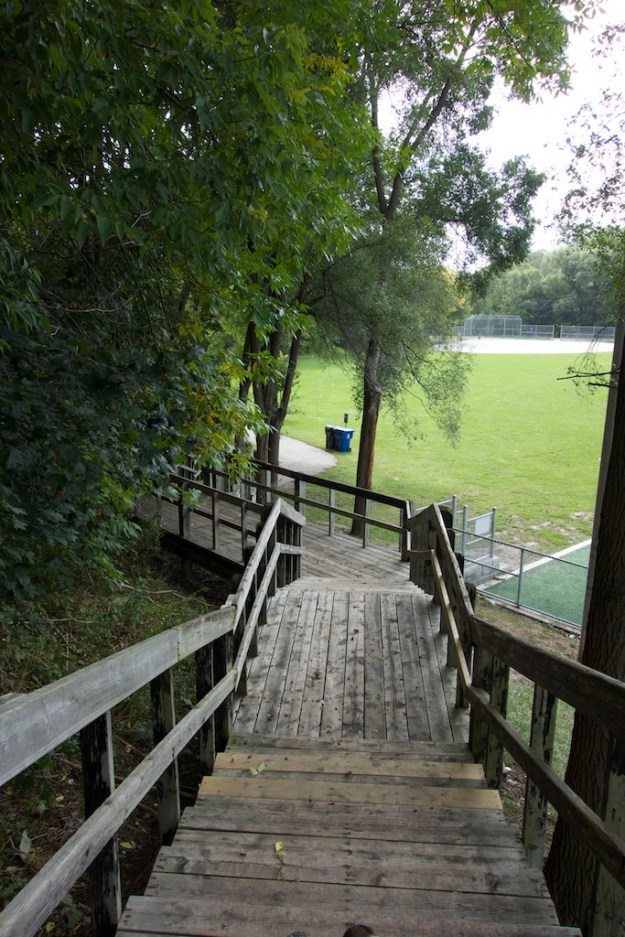
People can now see a bin when descending the stairs.

People can now see a bin when descending the newly cleaned stairs.
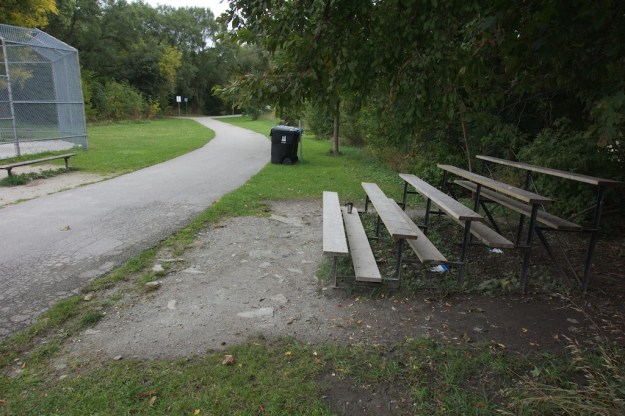
Bleachers have a bin that's closer.

These bins are harder to ignore.

Bins at the foot of the stairs (as well as at the top).
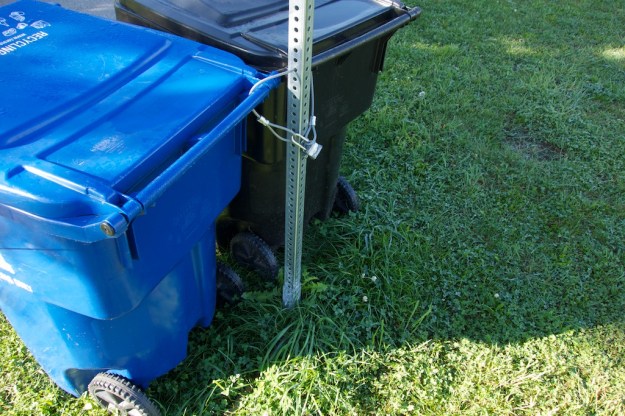
Bins at the foot of the stairs (as well as at the top).

The clincher - padlocks to stop bins from wandering.

The clincher – padlocks to stop bins from wandering.

I’m guessing that such intervention by an ordinary citizen is rare. The level of cooperation was outstanding – after all, park staff want clean parks too. They can’t be in every park every day but rely on knowledgeable citizen responses much of the time to point out problems and suggest solutions. By politely pointing out a concern and offering a workable solution, private citizens and parks management can work together to solve park problems.

Incidentally, the people who drop much of the litter are probably still doing so. Despite that, the new bin placement acts as a visible nag to do the right thing, makes things easier for responsible citizenry as well as for ‘park angels’ who actively pick up litter when they see it.

Want to get involved? – It’s a great thing to do. Just remember the three ‘P’s, Politeness, Persistence, and a well thought out Plan.

Signs of Fall: tree planting

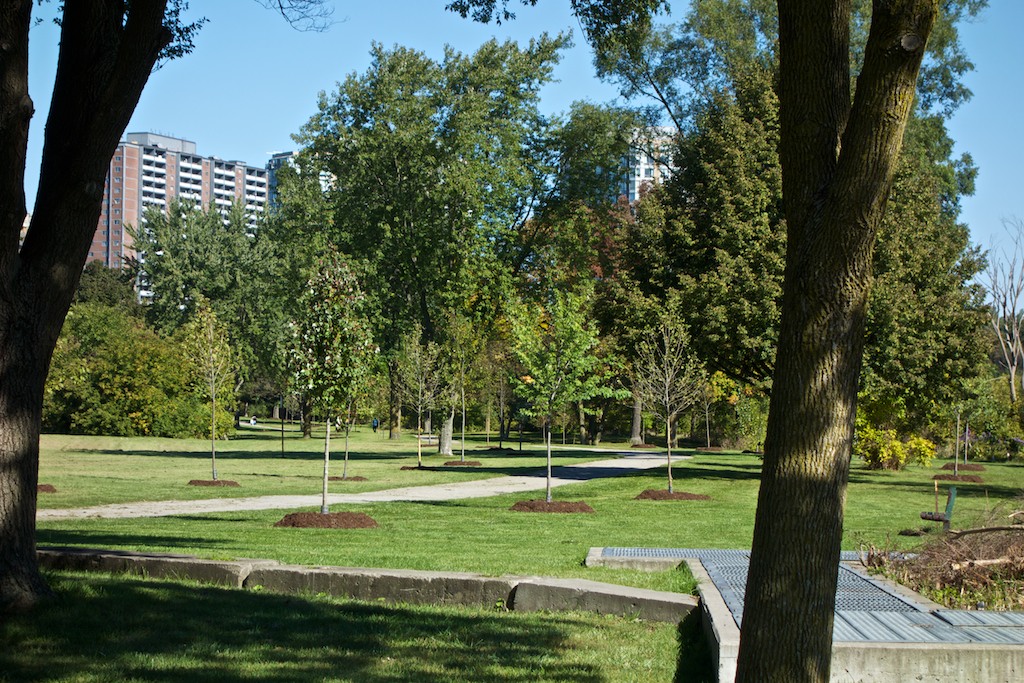
In the last 20 years, thanks to old age and disease, there has been a steady reduction in the number of mature trees in Raymore Park. Quite a number of these trees are invasive non-natives such as Siberian elm and Norway maple. While many hundreds of native saplings have been mass planted in the wild areas, no mature boulevard trees have been planted to line the pathway.

On Monday September 23rd, 43 trees were planted along the entrance and pathway as far down as the weir. This will make a big difference in years to come as the path is quite exposed in both winter and summer. I only have one slight quibble with the choice of trees; quite a number are black walnut and the park has no shortage of those already. There are quite a few water-loving weeping willows where the path comes near the river and some maples too.

A couple of Toronto Forestry workers were inspecting the trees yesterday and they told me that for the most part the trees were planted to the correct specifications by the contractor. A few have been planted too high and will need to  be adjusted and some look a little straggly, but for the most part it has been a successful planting.

This is the perfect time of year to plant trees as the ground is still warm and autumn rains will ensure lots of moisture for roots to grow.

Count 'em - it's 43!

Count ’em – 43 new trees!

Signs of Fall: Atlantic Salmon are climbing the ladder.

Two hundred years ago, Atlantic salmon along with many other varieties of fish were plentiful in the Humber. Gradually, settlers built dams and toxic waste from sewers, factories and pulp mills was dumped into the river. The combination killed just about everything in the water and Atlantic salmon were extirpated from the Humber as a result. In 1959, the opening of the St Lawrence Seaway saw the accidental introduction of the parasitic sea lamprey which killed the rest. An ambitious program lasting several years aims to restore a self-sustaining wild Atlantic salmon population to the Humber. Each spring until 2015, salmon fry are being released all along the Humber. Most weirs along the river have been adjusted to be too high for lamprey but low enough for migrating fish.

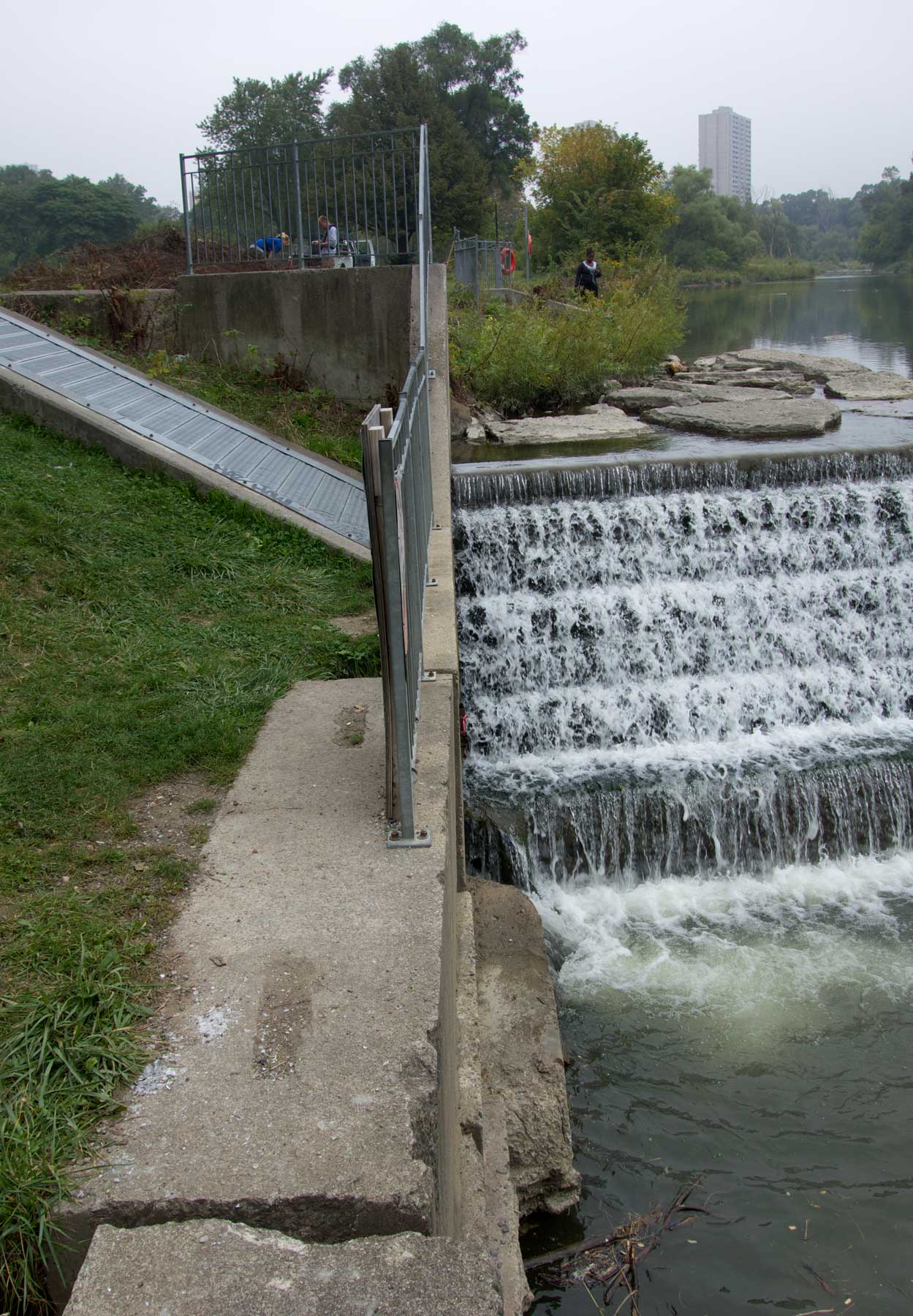
In Raymore Park, the 3 metre weir remains an insurmountable barrier to all aquatic life and to work around that, a denil fishway, (better known as a fish ladder) was built around 13 years ago.

The fish ladder entrance is on the left just below the weir.

The fish ladder entrance is on the left just below the weir.

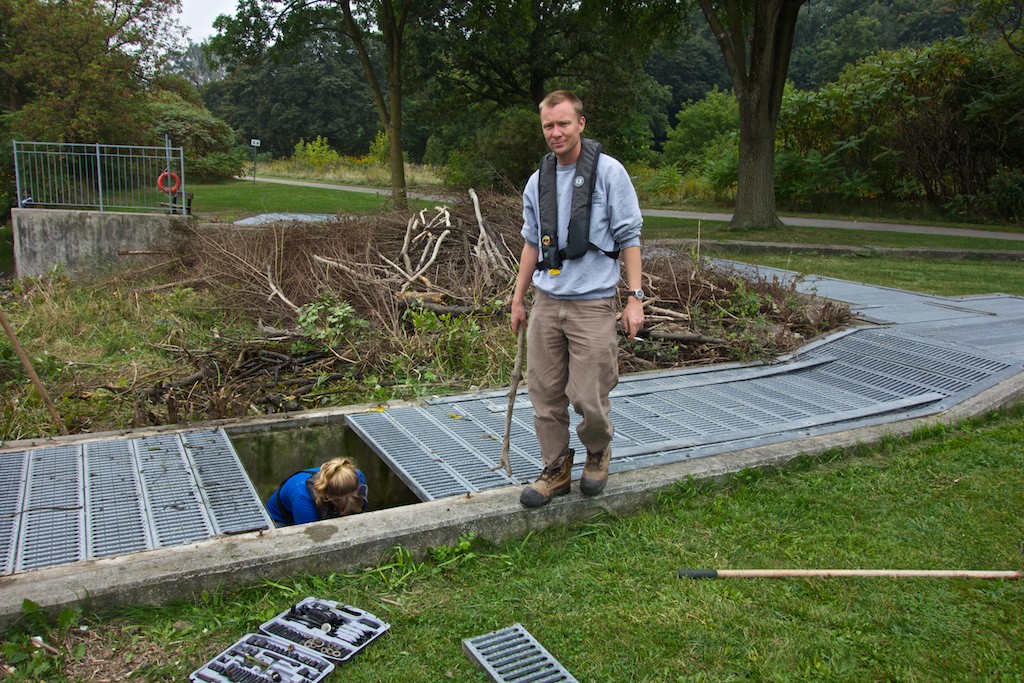
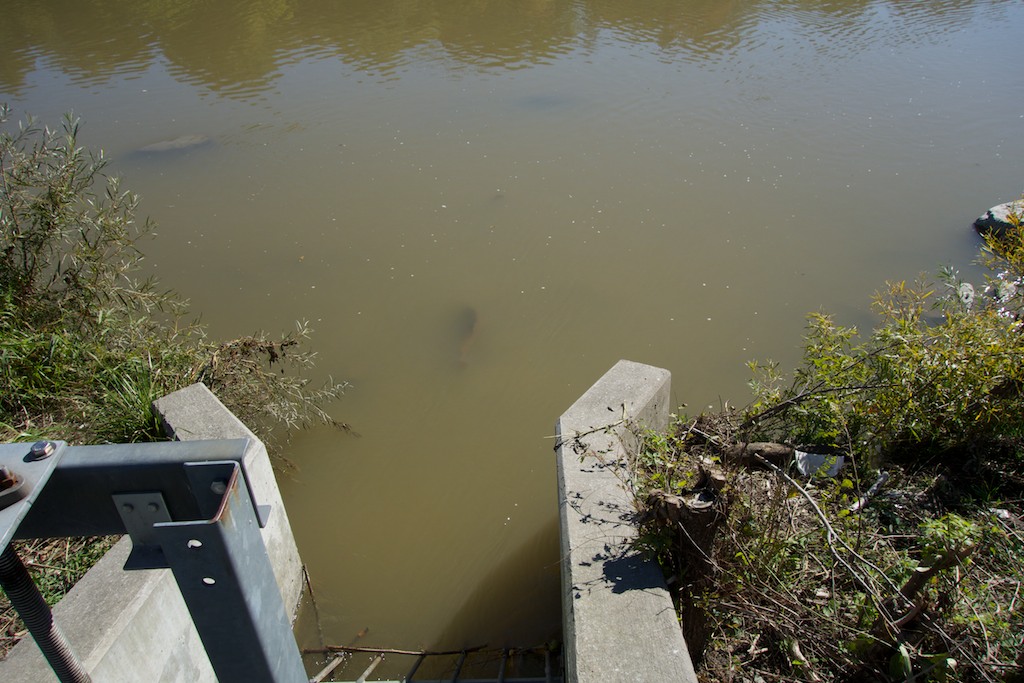
The fishway provides a gentler current and slope so that large fish can make their way up the ‘ladder’ with rest stops along the way. Unfortunately, beavers stuff the fishway with wooden debris in the hopes of creating a dam. Needless to say, the blockages need to be cleared several times a year so that fish can migrate to their spawning grounds.

On Friday, two workers were clearing the way for the salmon and told me that when water levels rise (as they did on Saturday), these large Lake Ontario fish will be able to access and use the ladder. From there they will swim upstream to their birthplace, spawn and return to the lake – assuming they can run the gauntlet of people out to get them.

TRCA workers clear the top of the fishway.

Toronto and Region Conservation Authority workers clear the top of the fishway.

Since the ladder was built I have watched in vain for a fish to appear at the exit. Today, (Tuesday September 24th) I had a premonition and with the camera ready, just like that, a fish emerged. The water was a little murky and I was a little late but here’s the evidence; the ladder works.

The salmon continues its journey up the river.

The salmon (middle top of photo) continues its journey up the river.

In spite of their impressive size, salmon will soon be seen along the Humber as far upstream as Bolton and Palgrave.

For its part, the TRCA is studying the further removal of obstacles to fish migration along the Humber and the weir in Raymore Park is the highest. Lowering and notching of the weir will allow the fish to leap upstream the old-fashioned and low-tech way. This will end the high maintenance costs of the fishway and finally allow the beavers to block it to their hearts’ content.

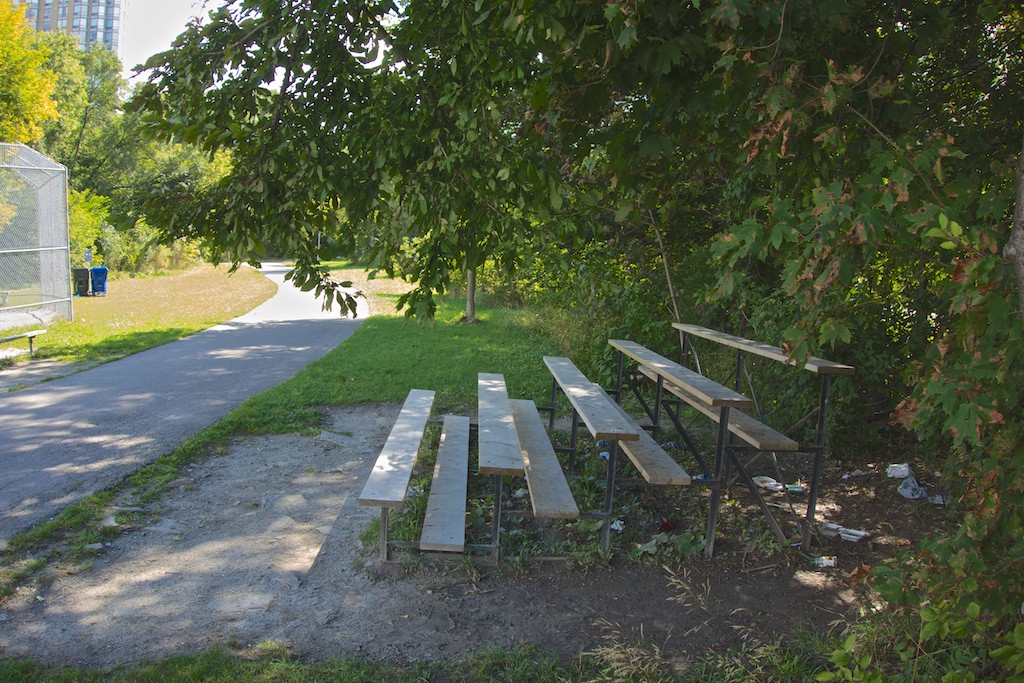
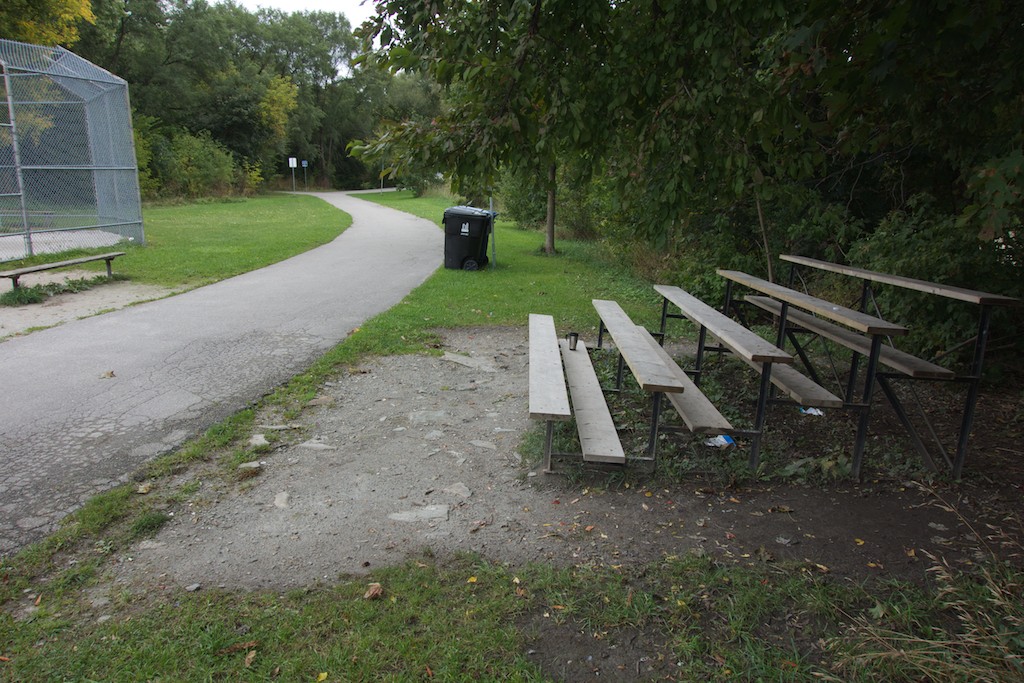
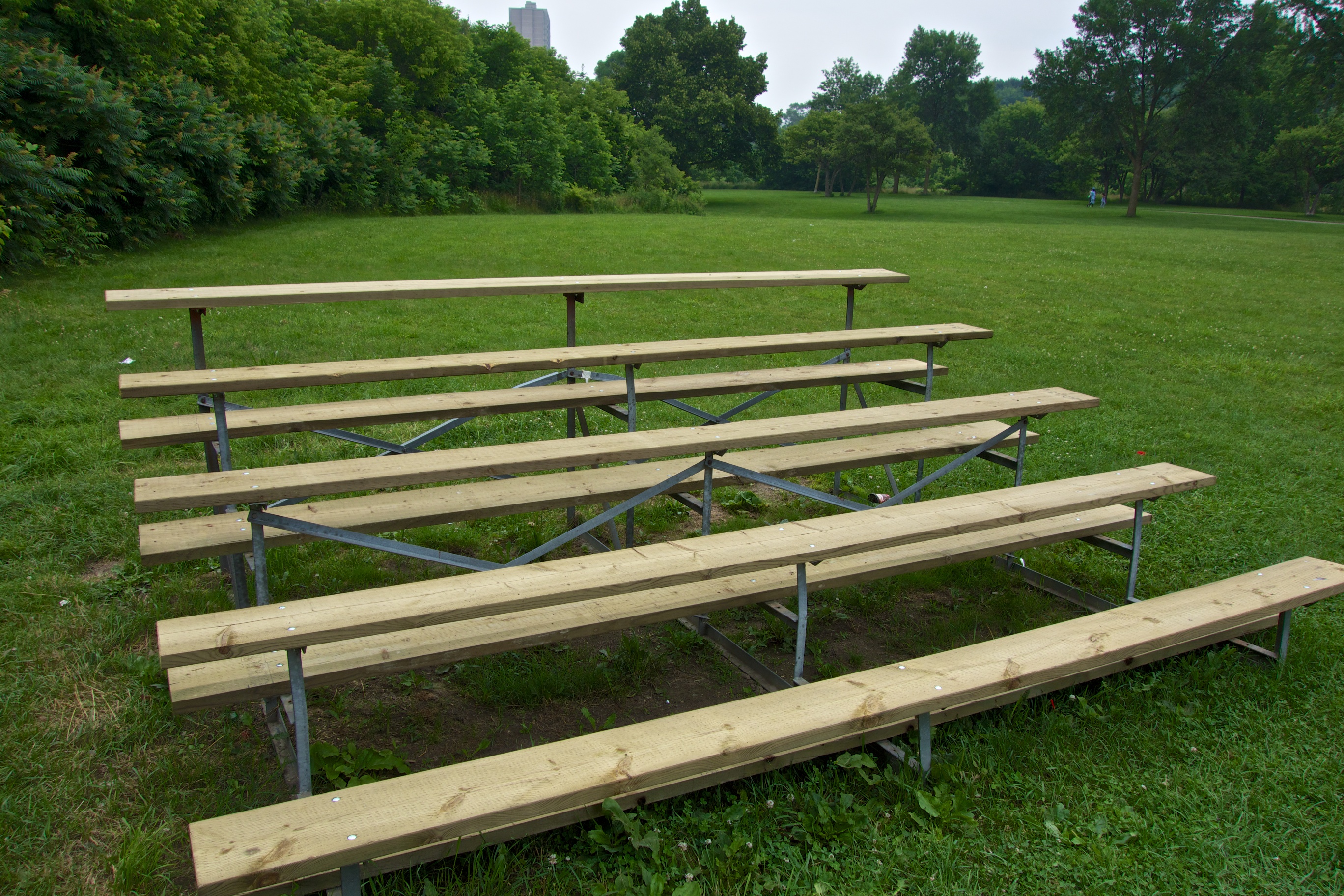
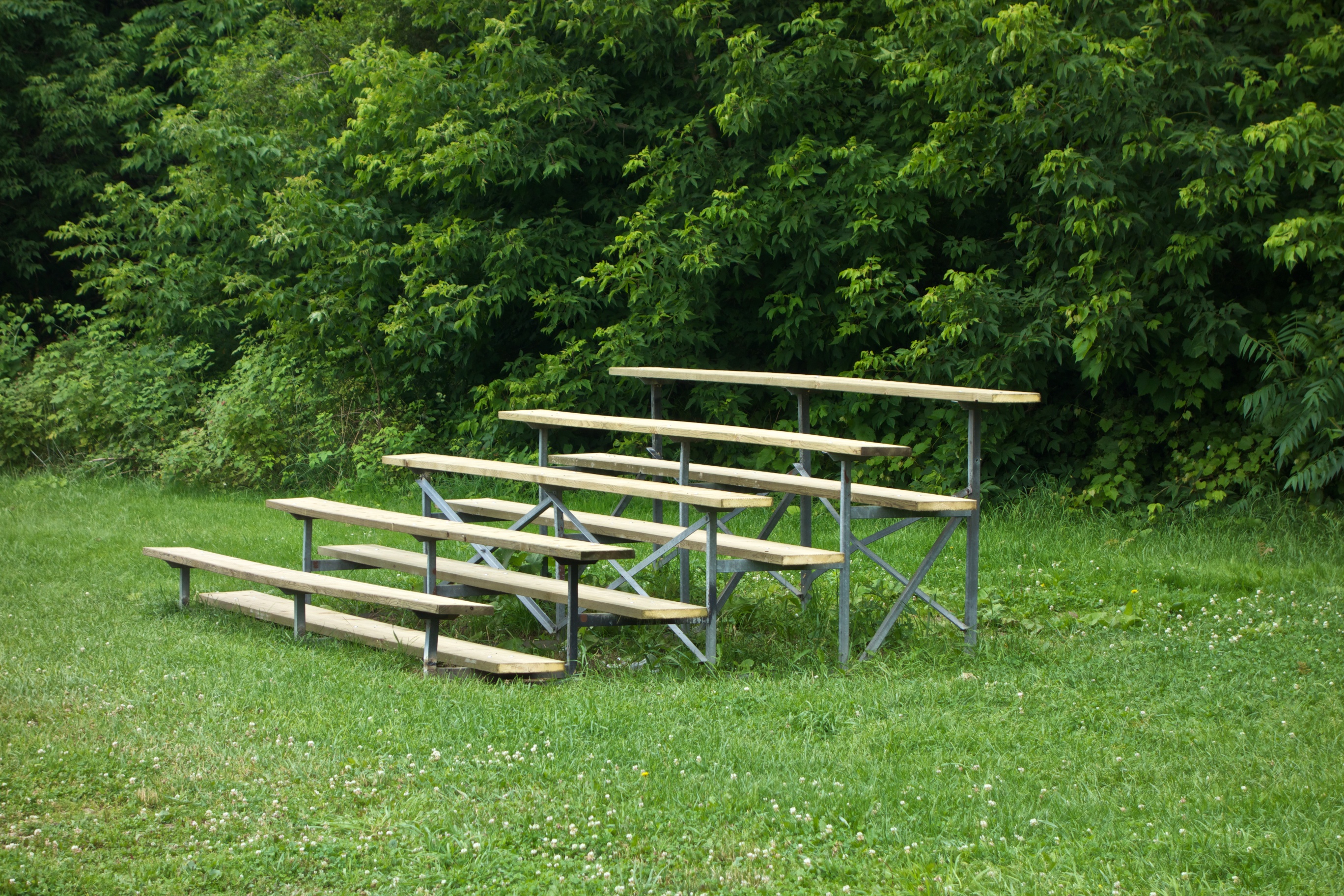
Bleachers are repaired

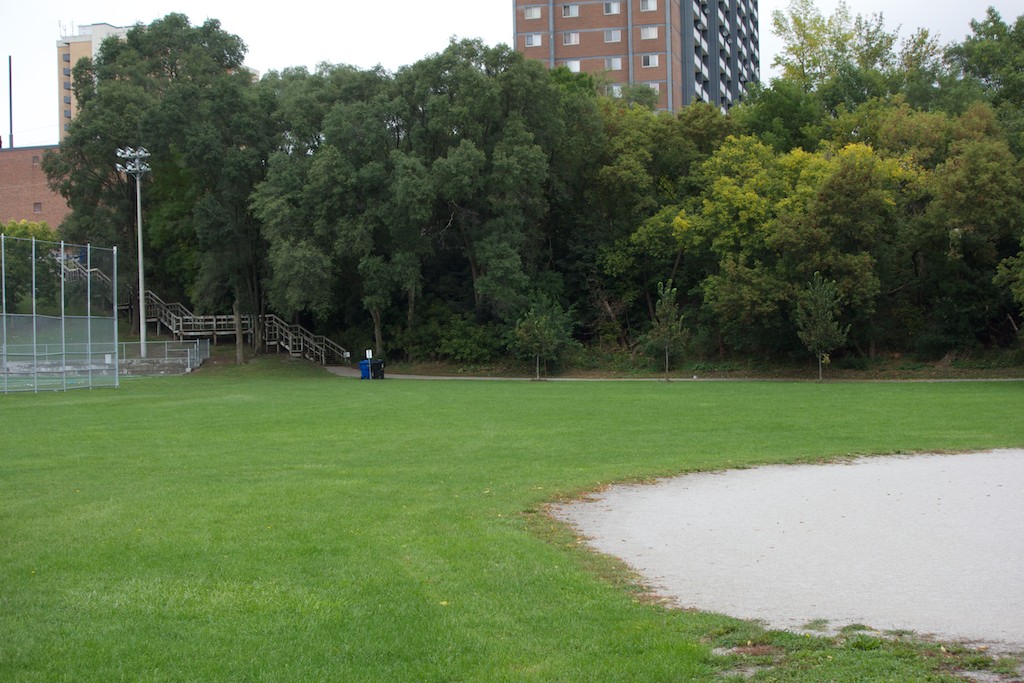
Not a particularly momentous occasion but the bleachers have been repaired by the smaller baseball diamond. New wood has been installed and while the bleachers’ principal use is to host late night drinking parties, at least they are safe and don’t add to the air of general air of dilapidation in that corner of the park.

It might be nice to install some garbage bins nearby.DSC02371 DSC02372

This ‘n that…

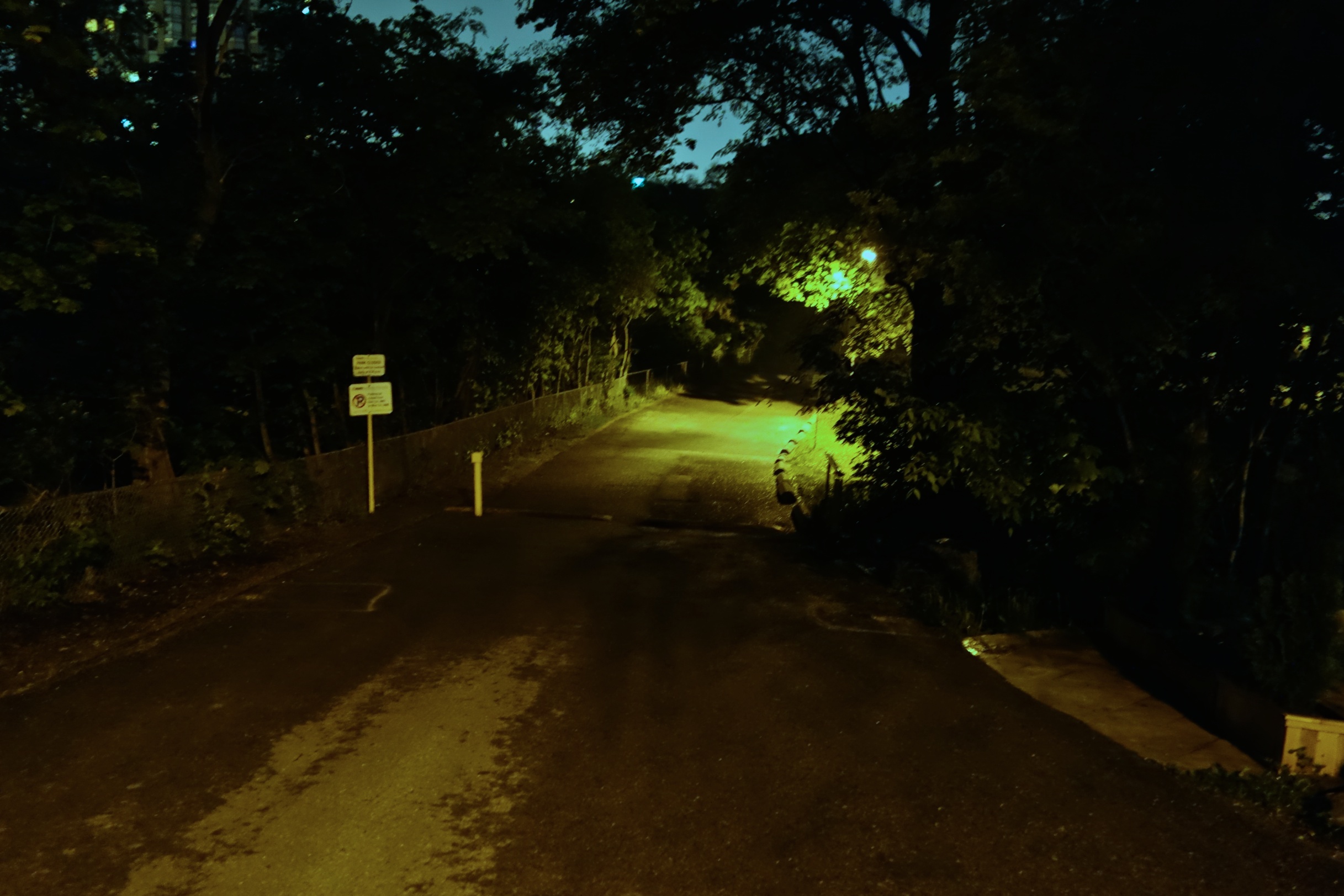
It’s already May 22nd and yet the gates to Raymore Park are left wide open every night. This despite a call to 311 last week.

Park gates open at 11:00 pm May 21st.

Park gates open at 11:00 pm May 21st.

May 20th was the Victoria Day holiday. Because the gates were left open, a group of people held a fireworks party on the grass by the parking lot.

Every year it’s the same. Surely the date cannot come by surprise? Gimme the friggin’ key and I’ll lock it up.

Postscript: As of early June, the park is being locked up regularly but interestingly it re-opens between 3 and 4 a.m.

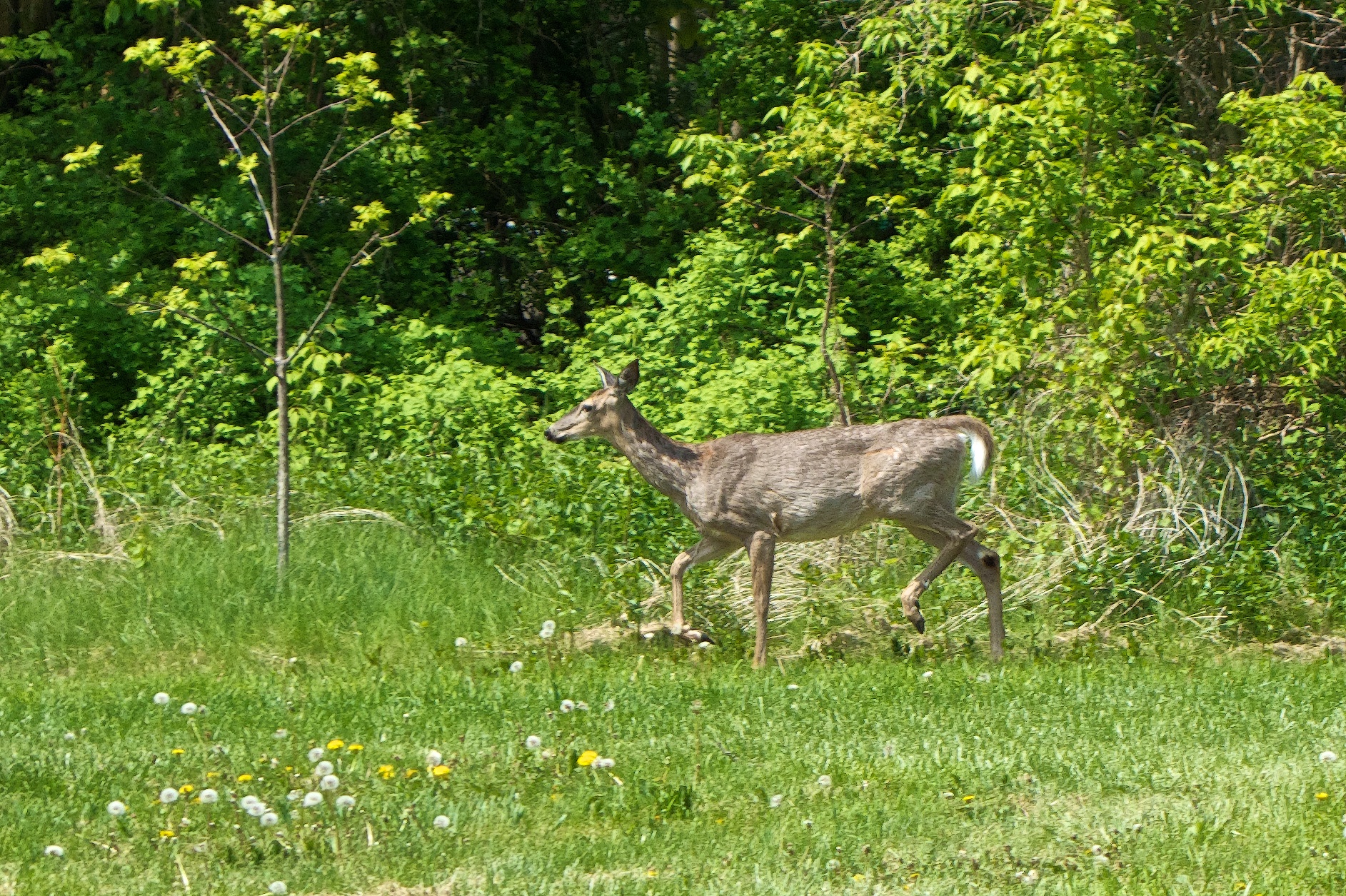
Earlier on the 20th, a young deer ambled down through the park quite unconcerned with the large numbers of people. A few people stopped to watch before it disappeared into the sumac behind the unused ball diamonds.

DSC02015

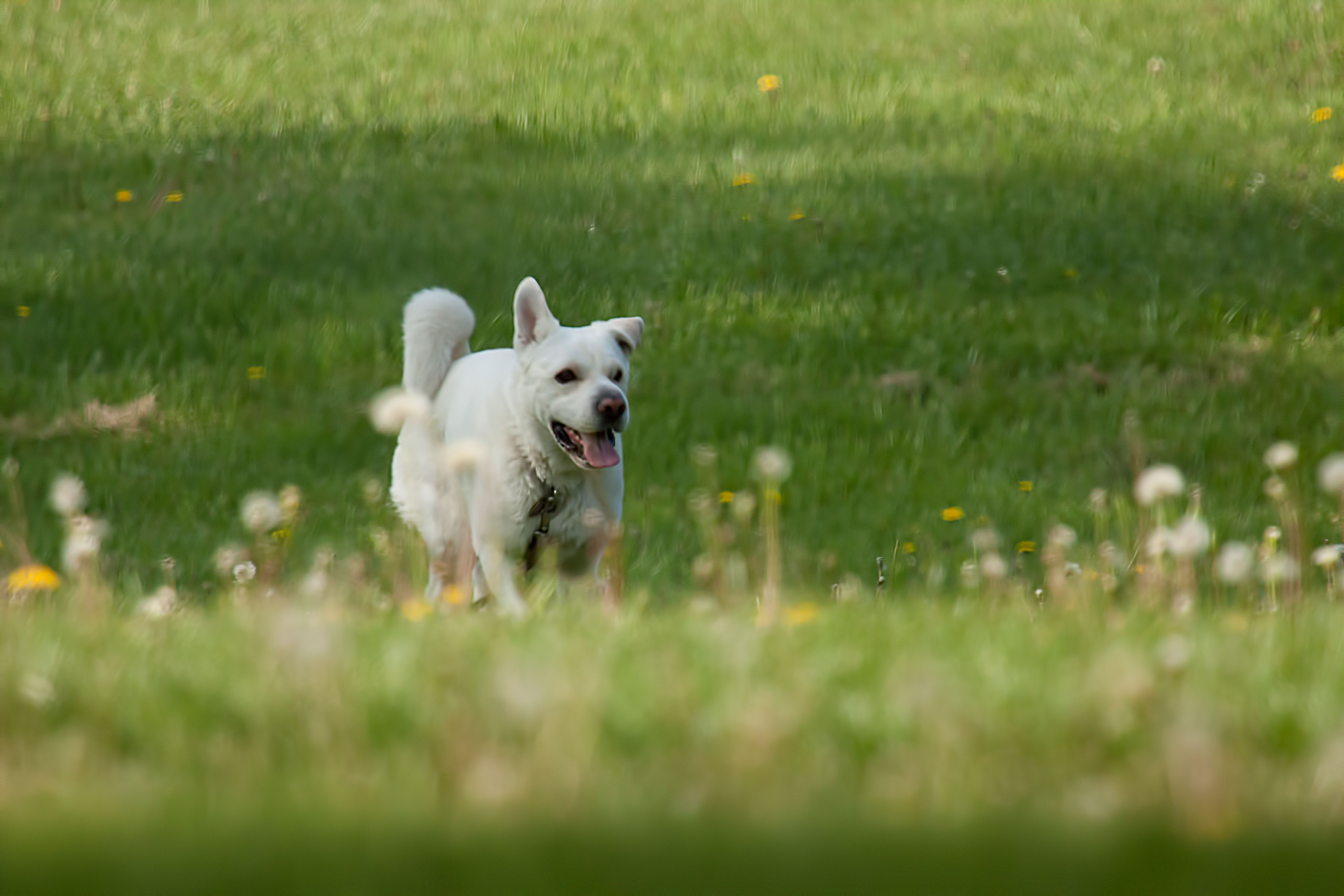
Fortunately there were no dogs on the loose – like this one that is allowed to chase park wildlife.

diablo

Image courtesy of Code Monkey.

On a further seasonal note, mosquitoes are back. The woods at the bottom of the park are home to some of the most aggressive bugs known to humanity. They managed to give me a matching welt on each arm.

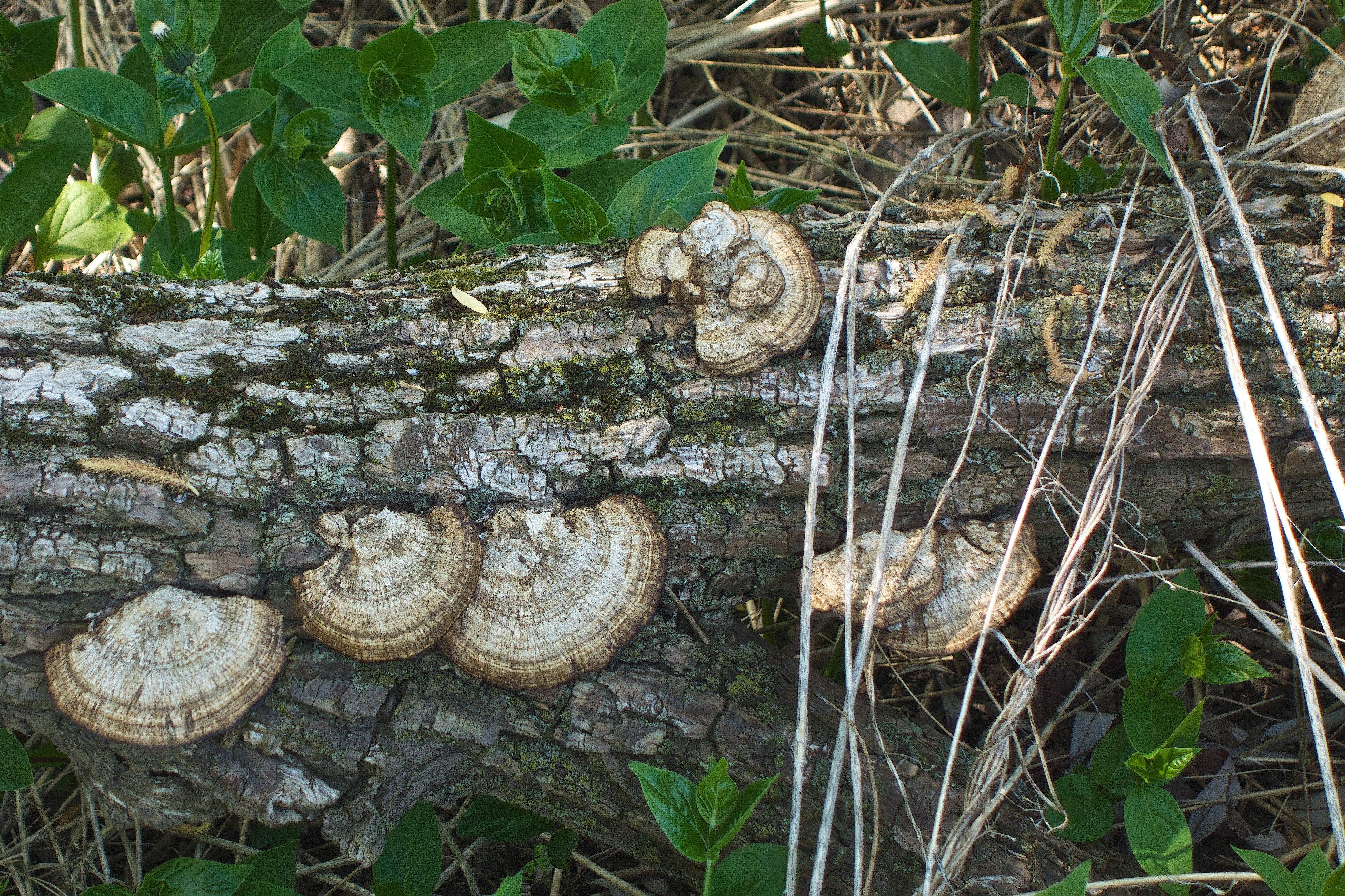
Lastly, some fungus caught my eye. It’s a type of bracket fungus commonly named Turkey Tail. It breaks down dead and diseased wood.

Trametes versicolor - Turkey Tail Fungus.

Trametes versicolor – Turkey Tail Fungus.