Category Archives: TRCA

Retaining Wall Update March 23

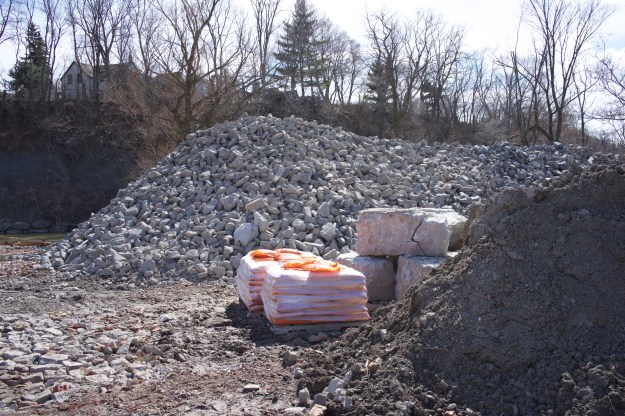
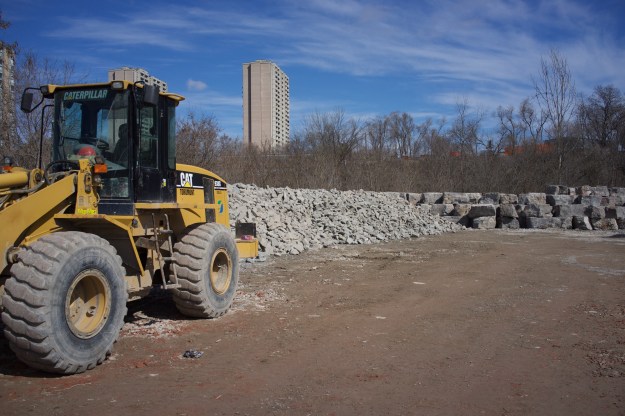
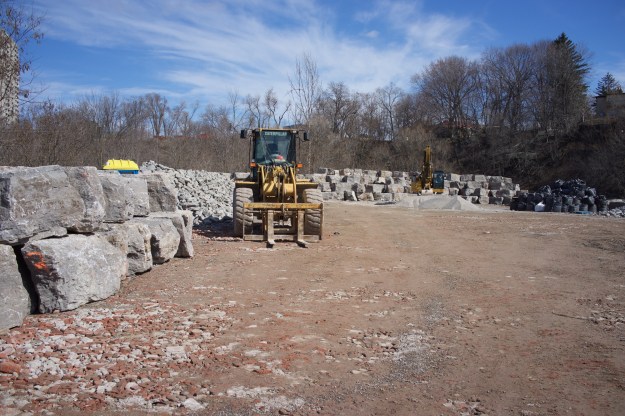
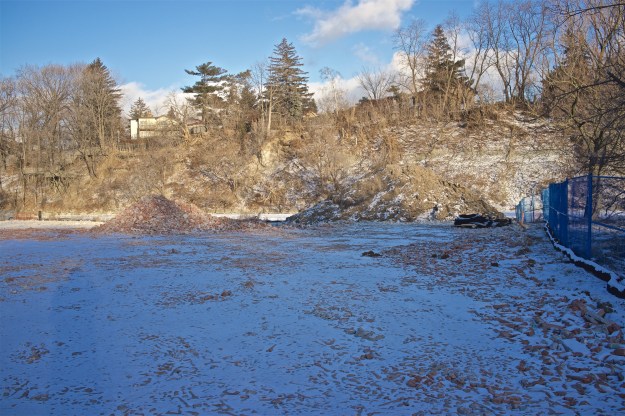
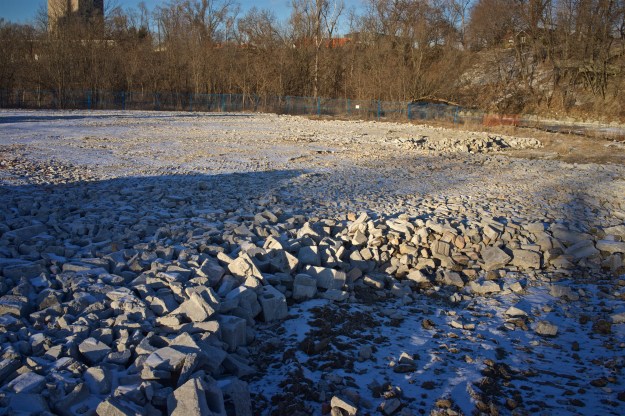
Materials are still being amassed on the staging area and while it looks as if the blocks are all set to go, the bridge decking has arrived along with large amounts of limestone rubble and bagged gravel. Actual construction shouldn’t be long in coming.

Limestone rubble at the south end of the site.

Limestone rubble at the south end of the site.


Limestone rubble stored by the blocks at the north end of the site.

Limestone rubble stored by the blocks at the north end of the site.


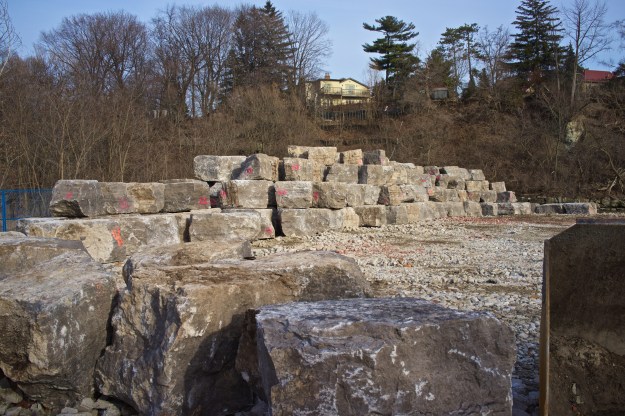
Blocks with limestone rubble.

Blocks with limestone rubble behind the forklift.


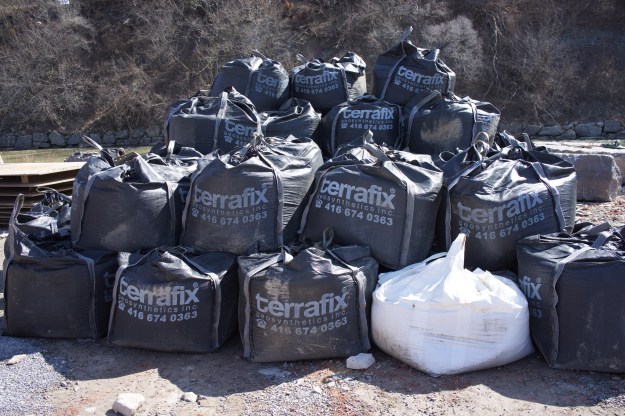
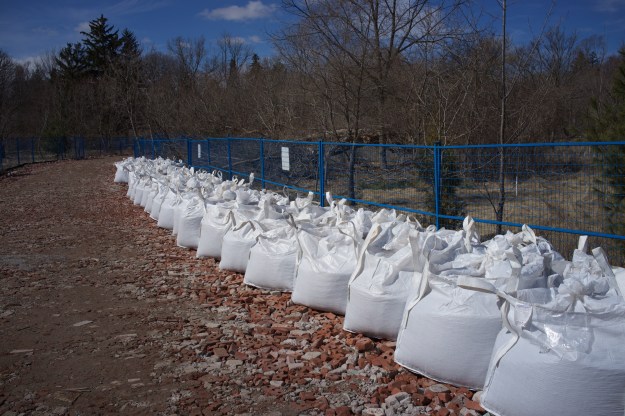
Bags of gravel.

Bags of gravel.


Bags of gravel stored by the staging area entrance.

More bags of gravel stored by the staging area entrance.


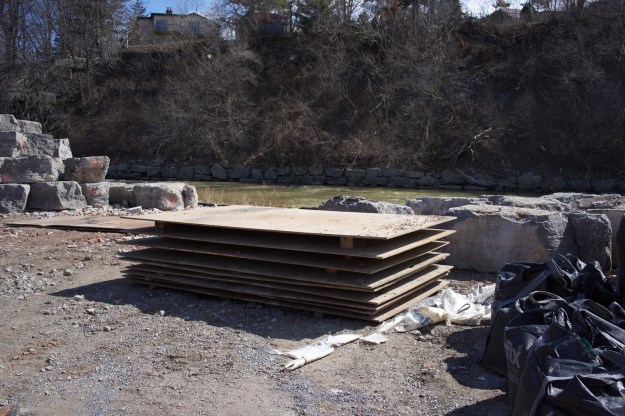
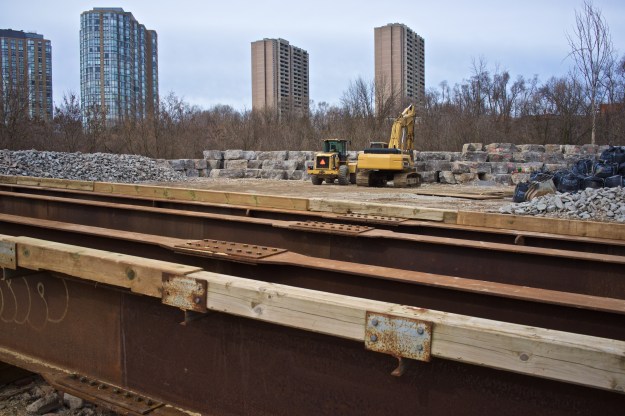
Steel plates that will form the decking of the bridge.

Steel plates that will form the decking of the bridge.


Another view with the bridge decking in the foreground.

Another view of the site with the bridge decking in the foreground.

Retaining Wall Update March 16.

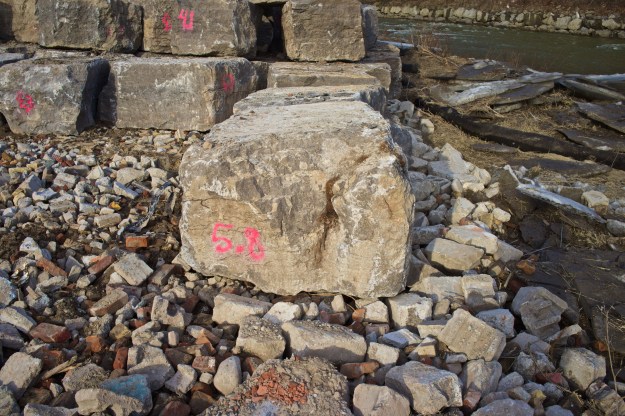
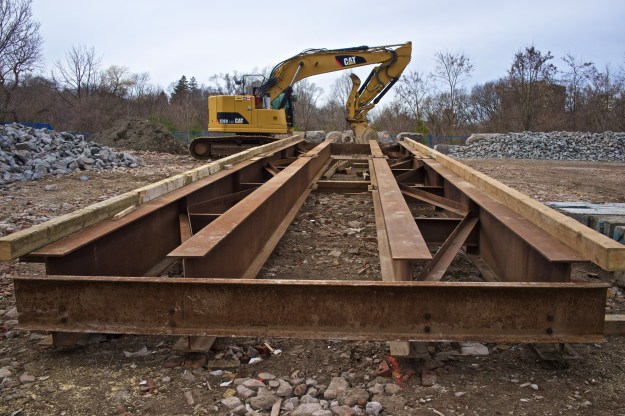
Work continues unabated at the site and the size and scope of the job is becoming apparent. More and more blocks are piling up in the staging area and the components for a temporary bridge that will straddle the river have arrived. The bridge will be placed across the river and support the crane that will build the retaining wall. Each block is labelled with its weight which is vital knowledge for the crane operator. The bridge will be re-positioned along the banks as required.

The project was originally scheduled for completion for the end of March but clearly there is still a massive task ahead.

Interestingly, the second photo was taken on February 29th and in the top right of the image can be seen the very small amount of ice pushed ashore during the thaw. This is the smallest amount of ice I have seen in years and quickly melted.

Blocks are piling up awaiting placement.

Blocks are piled up awaiting placement.


Each block is labelled with its weight.

Each block is labelled with its weight. Notice the small amount of ice freshly deposited as a result of the thaw.


The bridge.

Girders that will be used to make a bridge to straddle the river.


The bridge and blocks in the background.

The bridge girders and limestone blocks in the background.


The bridge platform.

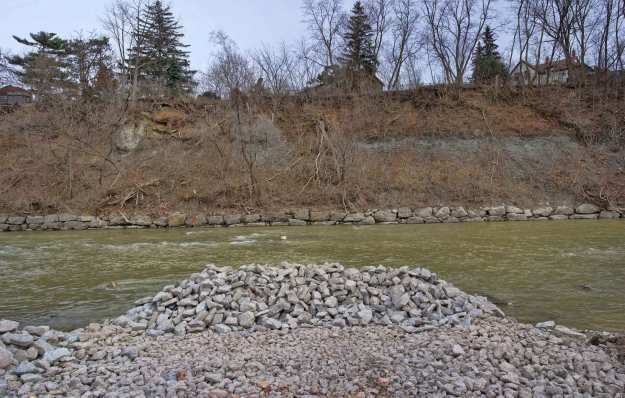
What looks like the beginnings of an abutment on which the bridge will rest.

Off-Leash Area Update

Raymore-Proposed-Leash-Free-Zone

The proposed area may have grown (probably northwards) by a small amount because of the addition of a separate small dog section. There was some discussion as to the nature of the surface of the area which apparently will be 4-6″ of pea gravel on top of a mesh filter which will help with drainage. As mentioned, plans are to divide the area into two parts for small and large dogs so there will be two gates and two paved pathways from the Pan-Am Trail for access. The small dog area would be for dogs 20 lbs and under. Regardless, all dogs should be under the owner’s control at all times. Dangerous dogs should not use the area. See Code of Conduct below.*

Fencing will be post and paddle, 1.5 m tall and made of northern pine. It will be reinforced with wire mesh 4-6″ deep to deter dogs that dig. Benches will be installed for owners.

There will be a delay in the opening of the area because of work currently ongoing on the retaining wall. This is taking longer than expected. There is only one entrance to the park and so the retaining wall and another job – an upgrade to the path will be done first; after that, sewer work will be ongoing. The reckoning is that the area will take about a month to set up and will be open by ‘Thanksgiving at the latest’.

One piece of good news is that TRCA has plans to plant trees along the north end of the area and between the area and the ravine slope. This will provide storm runoff relief and shade for the area (and perhaps some sound mitigation for nearby homes).

Hours of operation: 7 am – 9 pm but locals will be able to access the area at any time. The parking lot will continue to be locked at 9:30pm daily and re-open at 8:00am and will be closed for the Winter between November 1st and April 30.

There was a reminder to residents that the area will be self-policing and that they should supervise and pick up after their pets. There was confusion as to where to put dog waste – in the garbage or the recycling. This will be cleared up later (the location not the waste).

Sadly there is still no link on the City website to the plans or even the current state of off-leash parks.

*Code of Conduct for Off Leash Area

Municipal Code Chapter #608

  1. Comply with all signs and boundaries.
  2. Dog(s) must be on leash at all times except when in the designated off-leash area.
  3. All dog(s) must have a visible municipal license affixed to the dog(s).
  4. Dog(s) must remain in off-leash area so as not to trample or endanger plant material and other park resources.
  5. Dog(s) excluded from off-leash areas include:
    1. Pit Bulls or other dangerous animal
    2. Female dogs in heat
    3. Any dog(s) that has been issued a muzzle order by the Medical Officer of Health.
  6. Dogs shall not chase wildlife.
  7. Pick up after your dog(s) and place waste in receptacle or take home for disposal.
  8. Keep dogs in sight and under control at all times.
  9. Do not leave dog(s) unattended while in off-leash area.
  10. Repair holes dug by the dog(s) under your control.

Violation of Bylaws are punishable by fines.

Retaining Wall Update: Blocks Arrive

Screen Shot 2016-02-22 at 9.48.53 AM

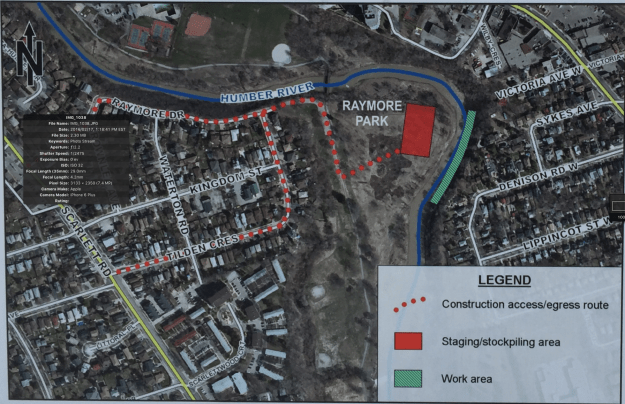
The official diagram showing the working area of the project.

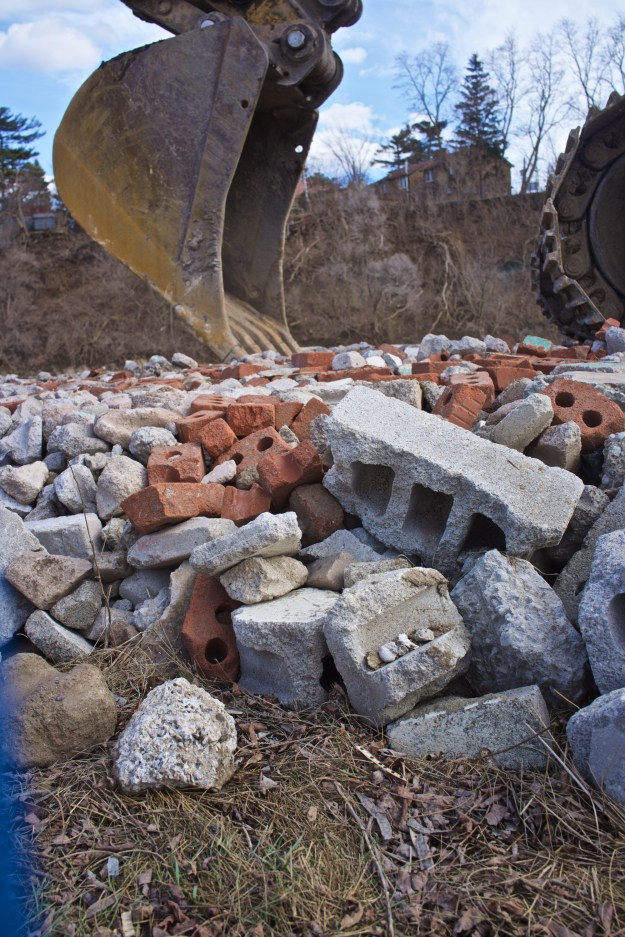
Truck after truck of old brick rubble came trundling into the park last week to consolidate the staging / stockpiling area. All of this material will eventually have to be scraped up and carted off again; probably late next month. No doubt this will have added substantially to the cost. Meanwhile, big blocks that will form the new retaining wall have arrived.

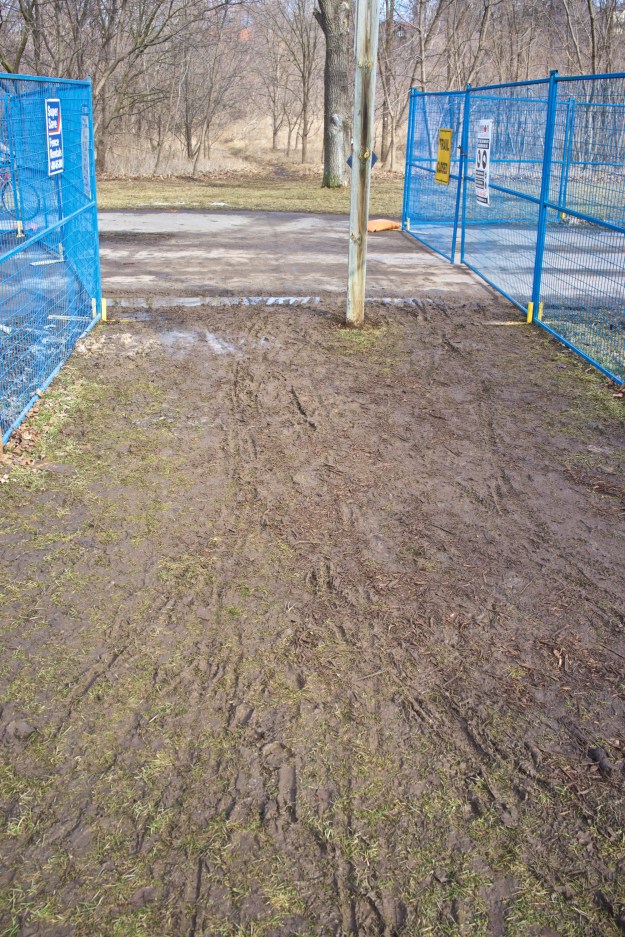
Mild weather has brought new problems, this time for pedestrians and cyclists; mud. This mud is unavoidable for anyone wishing to travel past the construction. It might be helpful if the construction crew – ever vigilant for pedestrians (wishing to stay clean) straying through the paved area – could spread some wood chips to make life easier and cleaner for people.

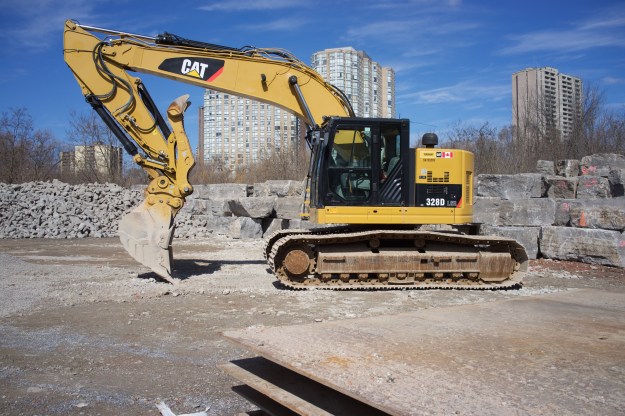
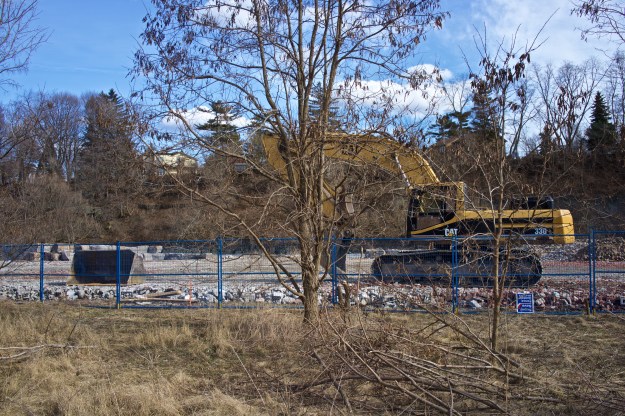
Large machinery resting on the base.

Large machinery resting on the base.


A close-up of the base.

A close-up of the base.


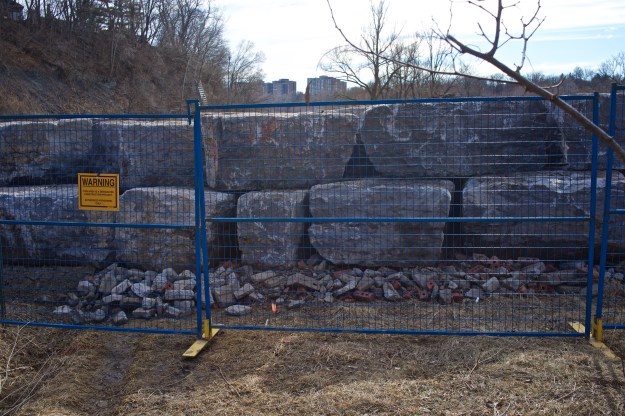
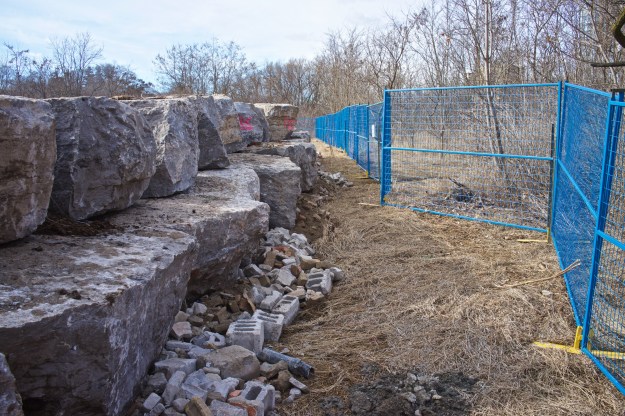
Blocks for the retaining wall are waiting to be installed. The fence is about 6' high.

Blocks for the retaining wall are ready to be installed. The fence is about 6′ high.


The blocks are natural stone.

The blocks are natural stone and should last a few years!


This is the treacherous route for people moving past the construction.

This is the slippery quagmire for pedestrians and cyclists. Wood chips will help greatly here.


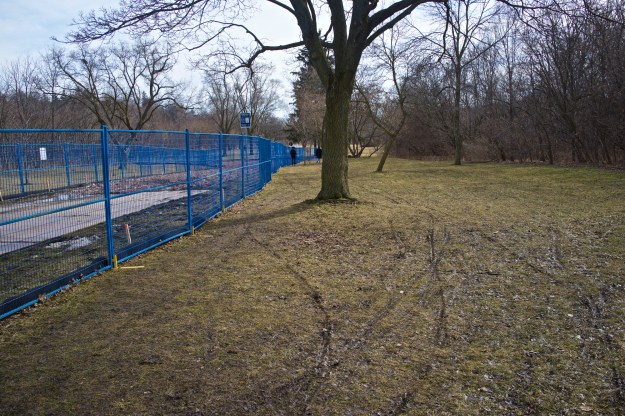
Cyclists have obviously made their mark.

Cyclists are making their mark.

Update: Wood chips were quickly applied to the quagmire making things easier for the pedestrians who must pass through.

Humber Bank Stabilization Update

All last week, trucks rumbled into Raymore Park delivering old bricks and concrete blocks (clean fill).

I braved the bitter cold this afternoon to find out what was going on. Rather than building a stable roadway along which trucks can approach the river, the whole of the fenced off land is being laid with about 40cm of clean fill to create a working area that stretches to the river’s edge from which the retaining wall can be constructed.

Topsoil scraped from the area can be seen (right) and brick rubble ready to be spread over the remainder of the land is on the left. To get an idea of the scale of  this endeavour, there’s a person standing by the orange fencing (far left).

The depth and size of the rubble layer can also be seen here.

Apparently the plan is for the rubble to be carted away again and the topsoil replaced after the job is completed.

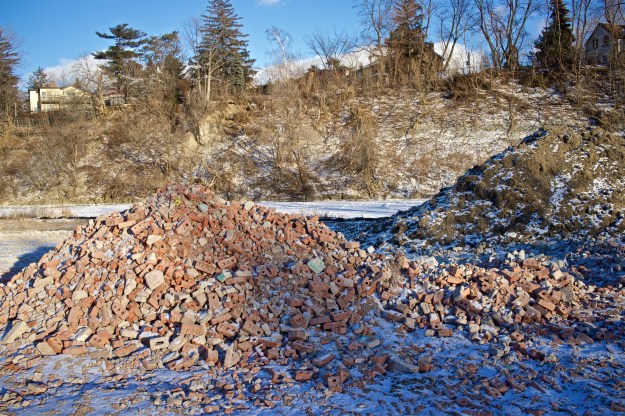
Bricks waiting to be spread over the park surface.

A closer look at the brick rubble and (eventually) the old topsoil waiting to be spread over the park surface.

One permanent change that may have been made; the old basement depressions from homes swept away during Hurricane Hazel are probably gone.

Work begins on Humber bank stabilization and sewer rehabilitation.

More than a decade ago, the owner of a house on Sykes Avenue in Weston suddenly lost several feet off the back end of their property. The house overlooks a sharp curve of the Humber River as it turns to the south. During April rains in 2004, the rear of the property abruptly vanished along with several mature trees and other vegetation. Luckily nobody was standing near the edge.
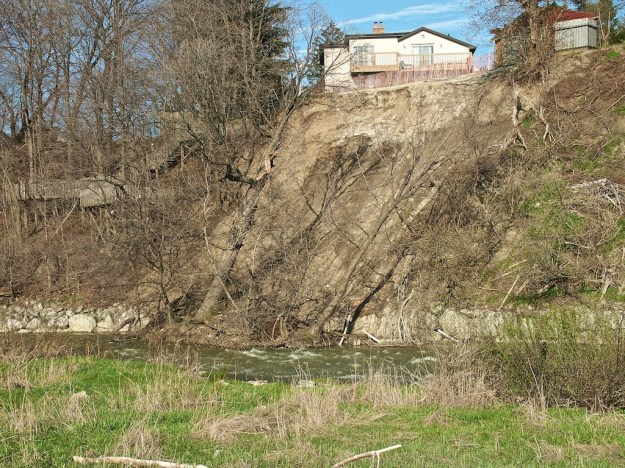
Shortly after the landslide in April 2004.
Shortly after the landslide in April 2004.

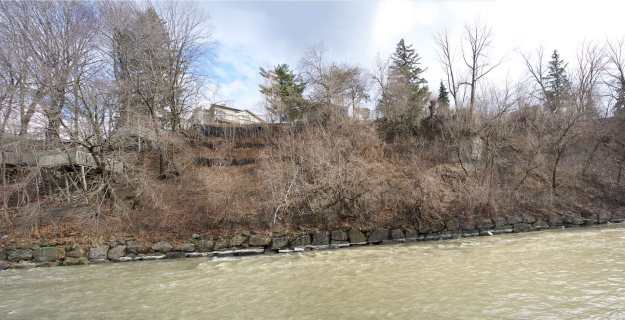
Panorama view of the bank as it looks today.

A panorama view of the bank as it looks today. Note the current retaining wall and the precarious position of the tree on the right.

That summer, the fallen trees actually went into leaf and remained in place for most of the season but were eventually washed down the Humber. What caused the erosion? Who knows; it probably didn’t help that each autumn, the owner at the time drained the pool over the top and into the river. The likely explanation is that the slope was simply too steep to withstand the shearing forces and nature adjusted the angle. TRCA is responsible for erosion control and has a handy guide for those ‘living on the edge’. It must have been painful to update the property deeds to reflect the new reality. After this event, the owner put in some vegetation and other stabilization measures but by then the rot had started and moved downstream taking chunks of other back yards into the river.

A retaining wall of sorts is already in place, built in 1981 and it has been high enough to provide ‘toe protection’ for most flood events. Unfortunately it wasn’t tall enough to cope with major events such as the storm of July 2013.

After extensive study, TRCA has decided that in order to stabilize this stretch of the Humber, a 6.5 metre tall ‘replacement armourstone wall’ and stabilization measures need to be put in place on 170 metres of the east bank before more land disappears downstream.
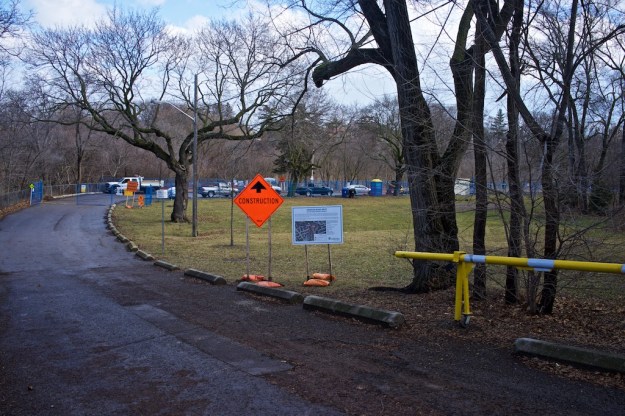
Raymore Park entrance.

Raymore Park entrance. Notice that the pathway and direct footbridge access is blocked to pedestrians. This could have been avoided by fencing off a narrow gap on the left.
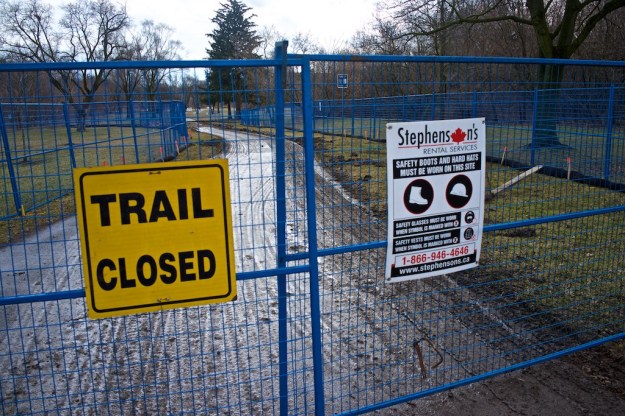
Looking south from the parking lot.

Looking south from the parking lot. The trail resumes further down.

Since construction from the top of the east side is impossible, the plan is to access the wall through Raymore Park.

Unfortunately the solid winter ground from the bike path to the river expected by the construction crew has failed to materialize (so far) and a steady stream of trucks has been offloading fill onto the site in order to construct a stable road down to the river.

Sadly dozens of native trees that were planted several years ago have been removed from a surprisingly large area. Presumably these will be replaced but this will delay the expected native canopy planned for this section of the park.
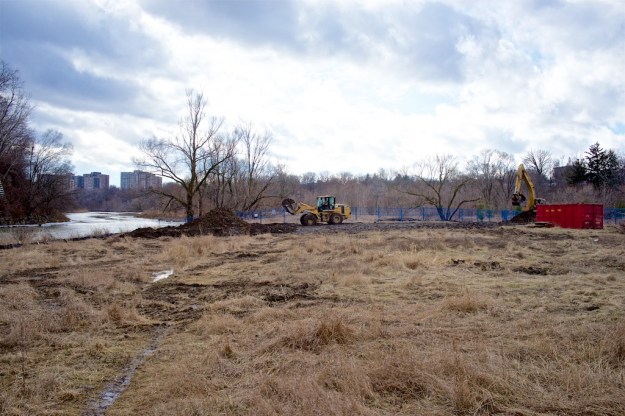
The new road under construction leading to the river. Notice the clearance of all trees and shrubs.
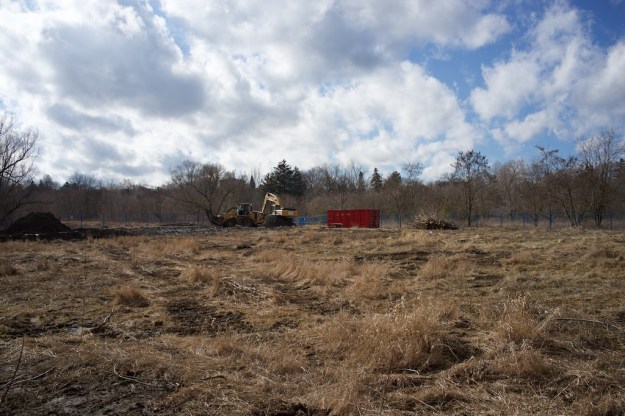
The new road under construction leading to the river. Notice the clearance of all trees and shrubs.

Another view showing the extent of the clearance.

Another view showing the extent of the clearance.

In the meantime, pedestrians are having a messy time getting access to the footbridge from Raymore Drive, the continuation of the path further down the park and there are questions regarding the replacement of trees and shrubs lost when the land was cleared.

According to the leaflet delivered to homes in the area, the work is scheduled to be completed by the end of March and restoration of the land will take place in the fall. Projected cost: up to a maximum of $250,000.

At the same time, more sewer rehabilitation work is ongoing along the Humber that will necessitate further tree clearance along the path of the sewer line between now and the end of March and this will extend along the river between Raymore Drive to well past Eglinton. The City of Toronto has more information here.

Later this spring will begin the construction (if given final approval) of the proposed leash free zone (Many dog owners seem to have declared Raymore Park leash free already). This will bring even more heavy equipment through the park. A final meeting is scheduled for February 25th at 6:30pm in Westmount Junior School, 95 Chapman Rd. Councillor Rob Ford will be in attendance.
Raymore Park Leash Free Zone Likely

In spite of the fact that Raymore Park was rejected as a candidate for leash free zone consideration as recently as June 2014, organizers of the recently held residents’ meeting seemed to confirm that the zone is a done deal. Apparently ‘someone’ applied last June, and the City must consider the site. Oddly the city’s reasons against a leash free zone in Raymore were the same as those for rejecting adjacent Lions Park, namely, ‘TRCA, ravine,  natural heritage’. The document may be accessed here.
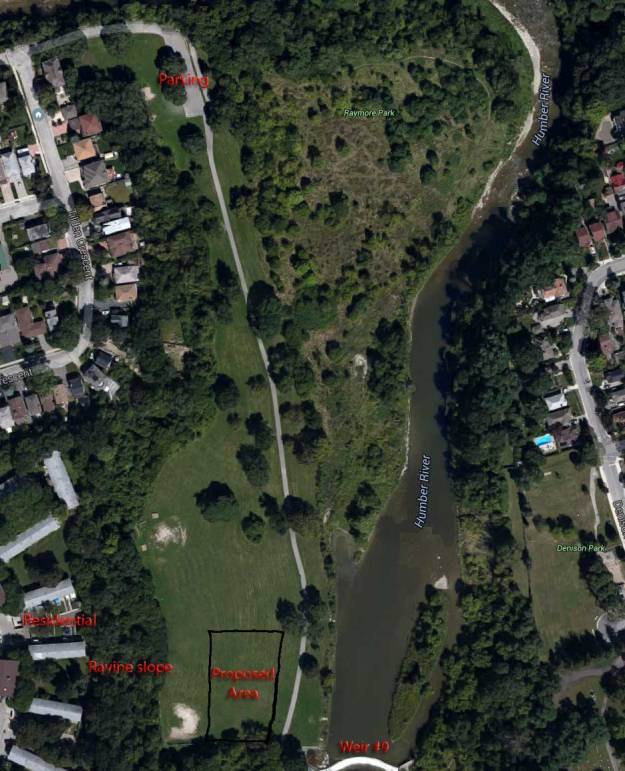
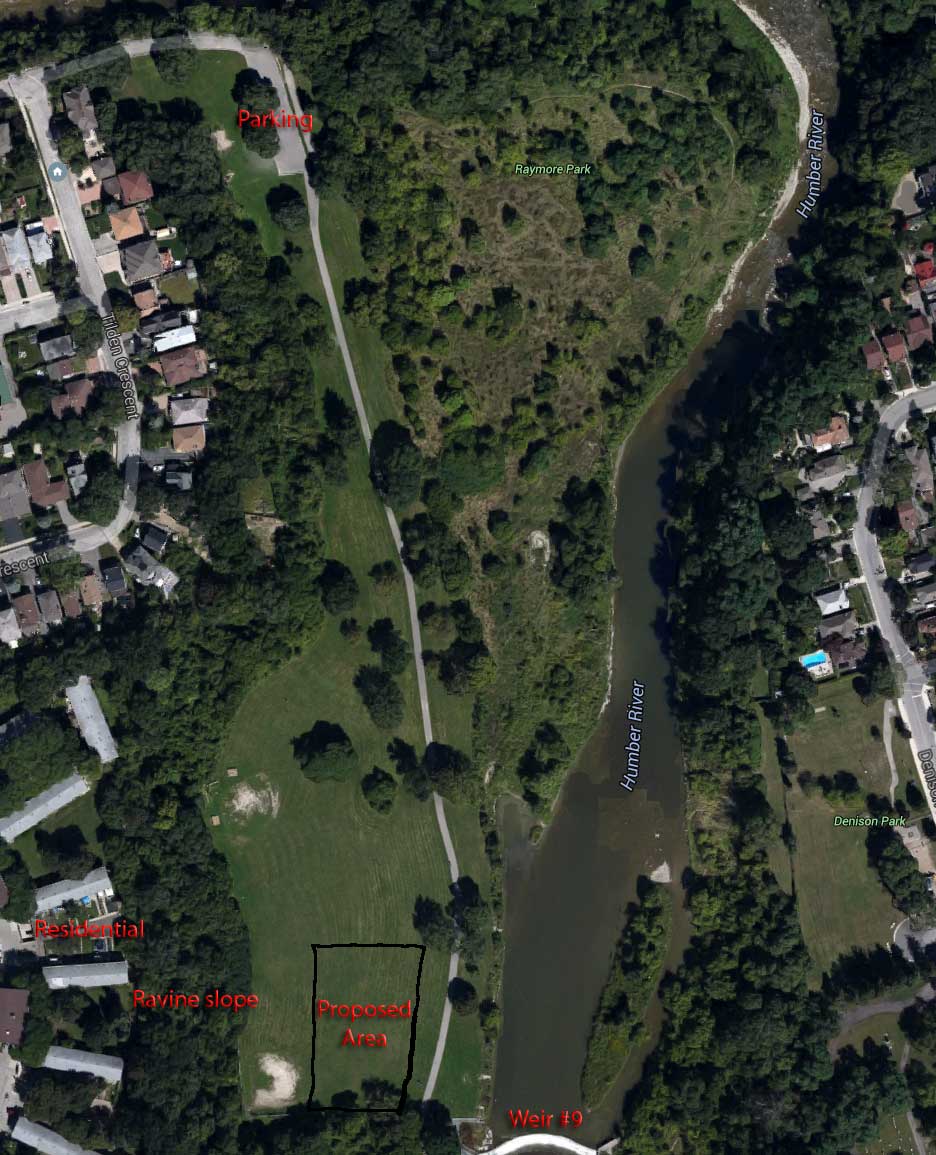
The meeting was attended by about 25 people and the proposed zone was illustrated – I have outlined an approximation as the organizers distributed no hard copy:

Raymore-Proposed-Leash-Free-Zone

Raymore Park showing the proposed off-leash zone. Google Earth.

The site as it looks now (September 2015)

The site as it looks now (September 2015).

The zone will be about 450 metres from the parking lot yet only about 100 m from nearby residences (the fact they are TCH homes may have eased concerns). The baseball diamonds will remain in place as removing them would involve park owners, TRCA and it’s ‘too much hassle’ according to the meeting organizer. The zone will occupy ¾ of an acre down at the southern baseball diamond in a rectangle following the river about 15 feet from the far side of the path. It will be fenced with pine wood rail fences so at least it won’t look too bad. Its northernmost tip will be about half-way up the open field (perhaps a little further than what I have drawn). I did suggest planting trees to the north of the zone which would hopefully dampen the sound somewhat. The organizers’  positive response to this suggestion may have been a way of easing my concerns; we’ll see. Trees to the south will provide shade. Water and lighting will not be supplied as the location is too remote and the budget small. Supervision by city staff will be minimal thanks to budget restraints and may I cynically suggest, the long walk from the parking lot.

When I suggested that the majority of people using the zone will be with unlicensed dogs, the response was a bit of a metaphorical shrug. From what I gather, nobody will be checking for dog licenses – even in the early days of this thing. Professional dog walkers will be allowed to use the zone.

The proposed opening hours are 7:00 a.m. to 9:00 p.m. year-round (even though the park gates are locked from November until April). This will create parking issues along Raymore Drive and Tilden Crescent. Organizers then talked about keeping the gates open year-round which some in the crowd thought was unlikely as even the ploughs get stuck occasionally.

The zone will be installed by spring of next year.

The organizers claim that traffic and noise levels won’t increase by much but they don’t like getting complaints about the zones it will be up to residents to phone 311 if people are abusing the area or being noisy.

There will be one more meeting to discuss the plans based on community input.

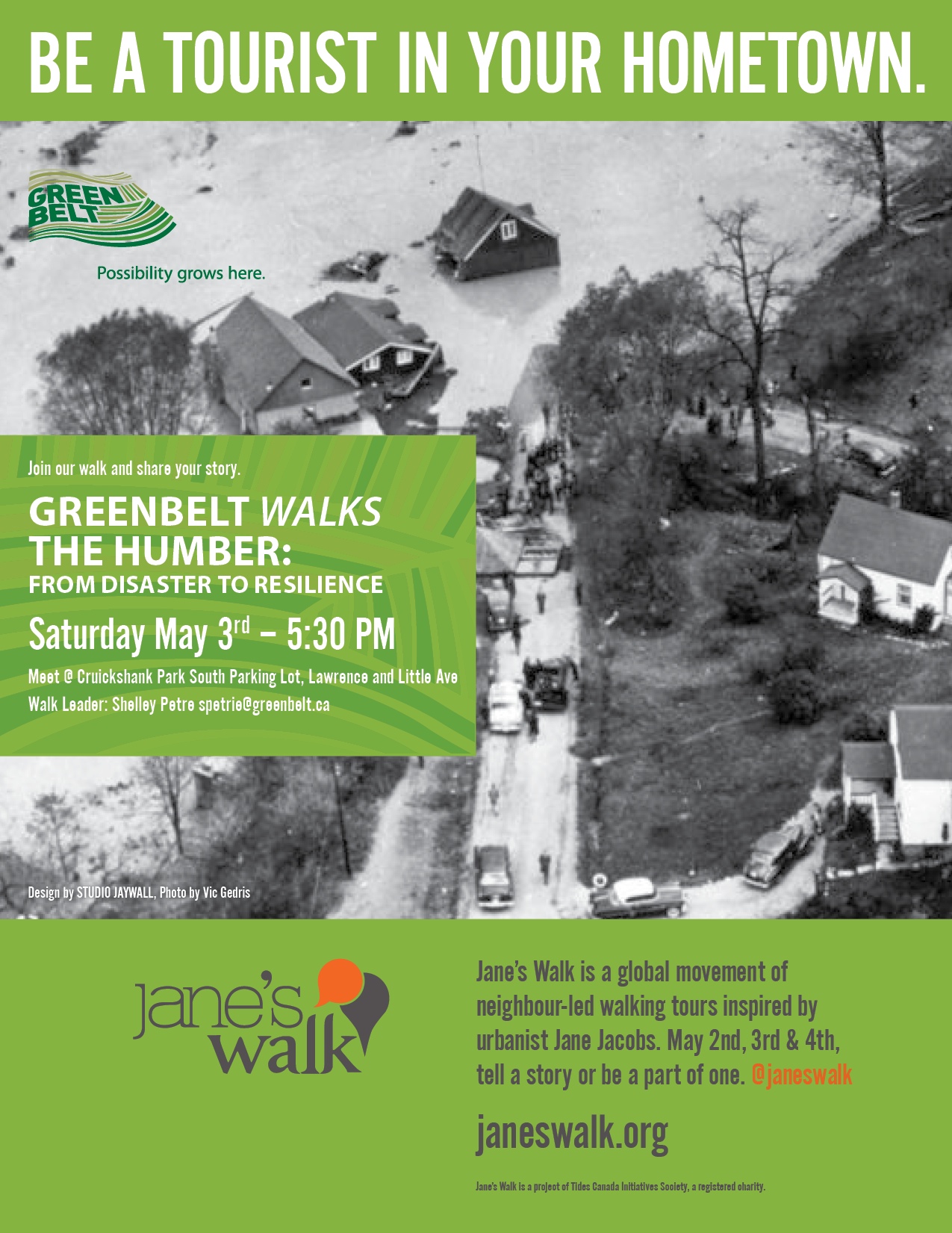
Jane’s Walk May 3rd at 5:30pm

Jane's Walk2014-GB

On Saturday, May 3rd, a ‘Jane’s Walk’ will feature the Humber between Lions Park and the weir in Raymore Park. The emphasis will be on Hurricane Hazel and its effects on the environment both natural and human. Some of the stops along the way will be:

Stop 1: Lawrence Avenue Bridge

The effects of Hurricane Hazel and its deluge of water on the bridge and surroundings.

Stop 2: Lion’s Park / Weston Fairground

Stop 3: Raymore Foot Bridge

The history of the footbridge that once existed at this point and its current successor.

Stop 4: Raymore Drive (across bridge)

The ground where 36 people lost their lives; the role of the old bridge. View traces of the settlement that was destroyed.

Stop 5: Raymore Park

The aftermath of Hazel and the organization set up to acquire and manage flood plain land.

Stop 6: Raymore Park dam

The fish ladder and migrating trout. The future of weirs along the Humber.

Stop 7: Chapman Valley Park / Humber Creek

The flooding that occurred at the top of this creek on July 8 2013, and the impact development has had on rivers across the city

Stop 8:

Urban river valleys, the Greenbelt, and the upcoming staff report and vote in city council to add the Humber, Don, and Etobicoke Creek to the Greenbelt.

  • Option 1: Retrace our steps along the Humber path,
  • Option 2: walk through the streets, past the wooden church at Scarlett and Kingdom, down Raymore Drive, crossing back over Raymore bridge and ending back up at Lion’s Park.

Walk Leaders:

Mary Louise Ashbourne (Weston Historical Society)
Gaspar Horvath (TRCA)
Roy Murray (Humber Watershed Alliance)
Shelley Petrie (Friends of the Greenbelt)
Michael Cook (Lost Rivers)

Meeting point: Car park at Lawrence Avenue and Little Avenue (Cruickshank Park) at 5:30pm.


Signs of Fall: Atlantic Salmon are climbing the ladder.

Two hundred years ago, Atlantic salmon along with many other varieties of fish were plentiful in the Humber. Gradually, settlers built dams and toxic waste from sewers, factories and pulp mills was dumped into the river. The combination killed just about everything in the water and Atlantic salmon were extirpated from the Humber as a result. In 1959, the opening of the St Lawrence Seaway saw the accidental introduction of the parasitic sea lamprey which killed the rest. An ambitious program lasting several years aims to restore a self-sustaining wild Atlantic salmon population to the Humber. Each spring until 2015, salmon fry are being released all along the Humber. Most weirs along the river have been adjusted to be too high for lamprey but low enough for migrating fish.

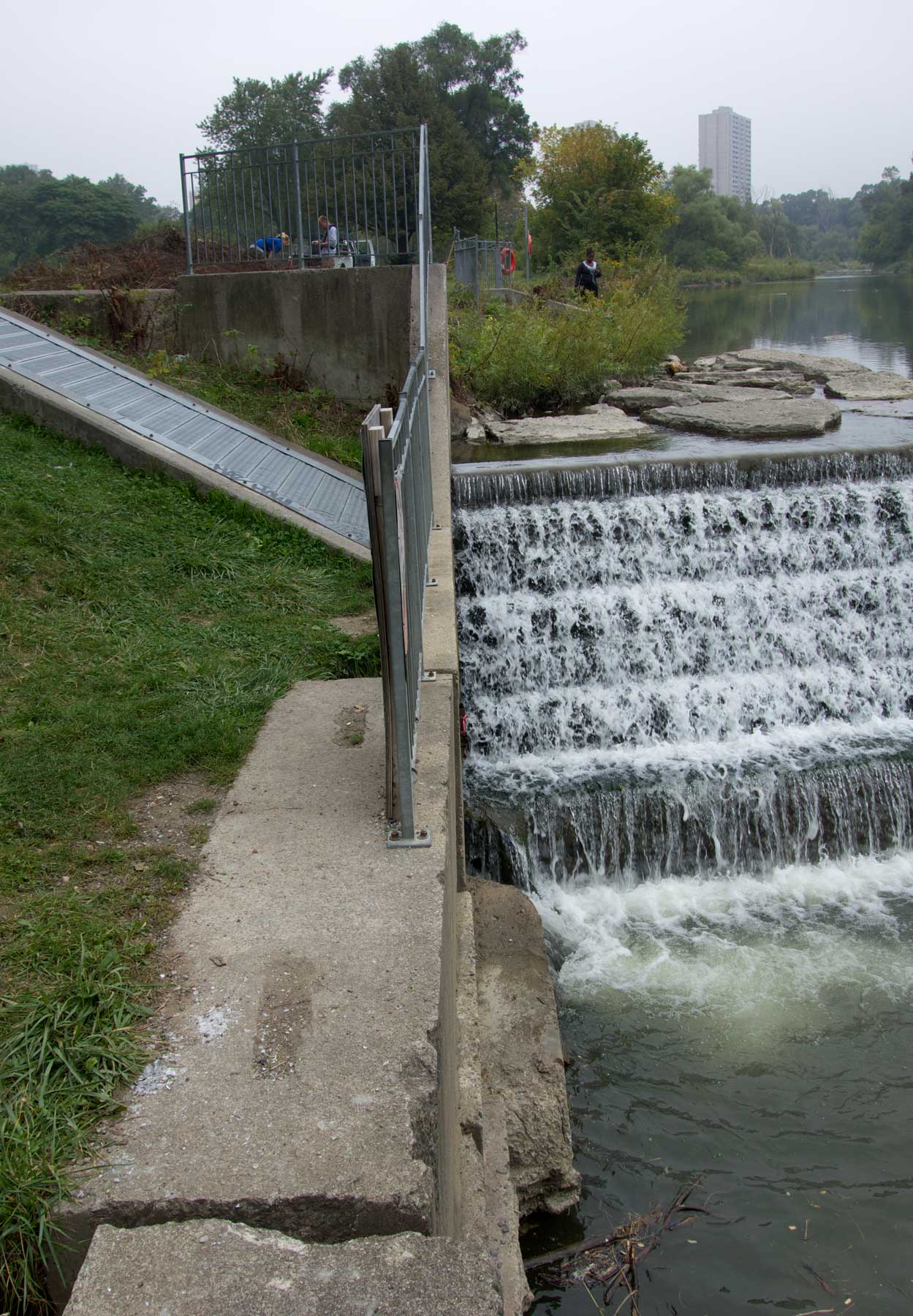
In Raymore Park, the 3 metre weir remains an insurmountable barrier to all aquatic life and to work around that, a denil fishway, (better known as a fish ladder) was built around 13 years ago.

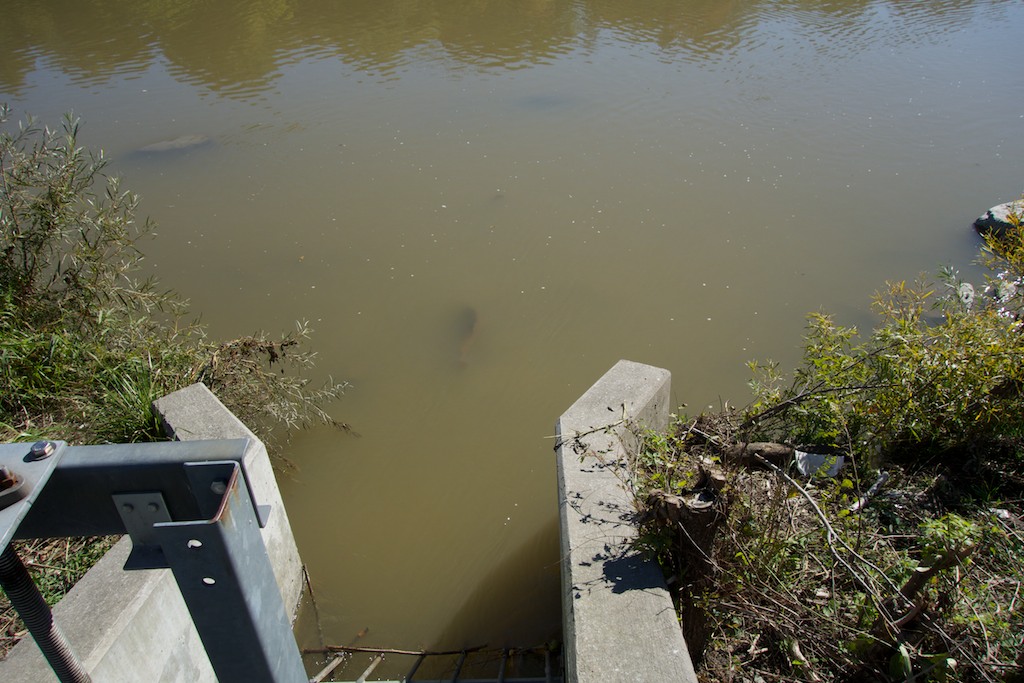
The fish ladder entrance is on the left just below the weir.

The fish ladder entrance is on the left just below the weir.

The fishway provides a gentler current and slope so that large fish can make their way up the ‘ladder’ with rest stops along the way. Unfortunately, beavers stuff the fishway with wooden debris in the hopes of creating a dam. Needless to say, the blockages need to be cleared several times a year so that fish can migrate to their spawning grounds.

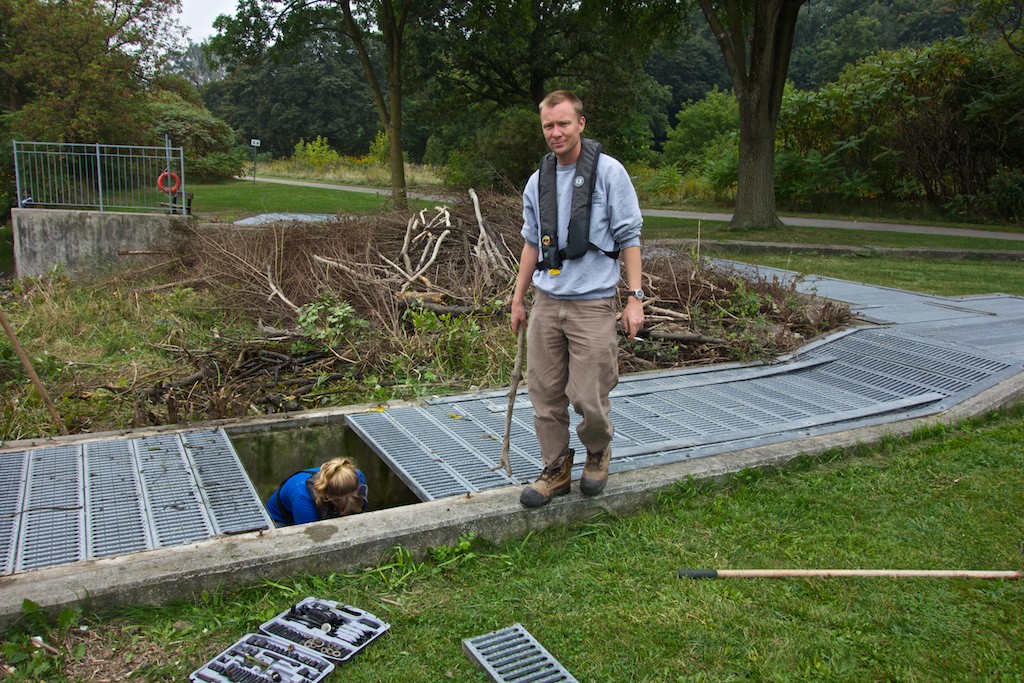
On Friday, two workers were clearing the way for the salmon and told me that when water levels rise (as they did on Saturday), these large Lake Ontario fish will be able to access and use the ladder. From there they will swim upstream to their birthplace, spawn and return to the lake – assuming they can run the gauntlet of people out to get them.

TRCA workers clear the top of the fishway.

Toronto and Region Conservation Authority workers clear the top of the fishway.

Since the ladder was built I have watched in vain for a fish to appear at the exit. Today, (Tuesday September 24th) I had a premonition and with the camera ready, just like that, a fish emerged. The water was a little murky and I was a little late but here’s the evidence; the ladder works.

The salmon continues its journey up the river.

The salmon (middle top of photo) continues its journey up the river.

In spite of their impressive size, salmon will soon be seen along the Humber as far upstream as Bolton and Palgrave.

For its part, the TRCA is studying the further removal of obstacles to fish migration along the Humber and the weir in Raymore Park is the highest. Lowering and notching of the weir will allow the fish to leap upstream the old-fashioned and low-tech way. This will end the high maintenance costs of the fishway and finally allow the beavers to block it to their hearts’ content.

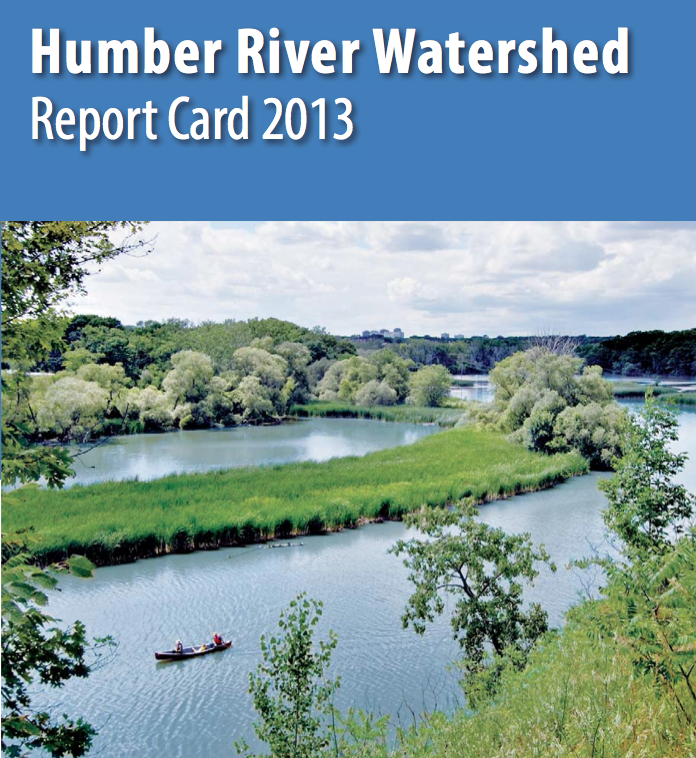
Humber River Watershed Report Card

Screen Shot 2013-04-25 at 5.05.34 PMAfter much study and gathering of data, the Toronto Region Conservation Authority (TRCA) has released its 2013 report card on each of the rivers in the Toronto watershed. Raymore Park is classified as being in the Lower Humber and understandably, nature along this most urban part of the river is under considerable pressure.

Four categories in each watershed are graded A-F.

Groundwater Quality……. Insufficient data.

Groundwater, especially in the Humber’s upper reaches can be contaminated by nitrates and nitrites from farm animals, septic systems and fertilizers while the more urbanized stretches can contain high chloride levels from winter road salt. TRCA needs to add more monitoring stations before a comprehensive grade can be given.

Surface Water Quality…..C

48 monitoring sites check for only three indicators of surface water quality; phosphorous, E.coli bacteria and Benthic Macroinvertebrates (BMI) (invertebrates that can be seen with the naked eye) The higher the BMI score the better. While the Humber as a whole gets an overall grade of C, as can be imagined, the lower down in the river, the poorer the results. On this basis, Black Creek and the Lower Humber are probably in the F range.

Forest Conditions………D

In the lower Humber, only 7% of the land is covered by trees. Nowhere in the Humber Watershed is the desired minimum of 30% achieved. Trees help with air quality, provide homes for many animals and protect and shade aquatic habitats.

Stormwater Management…..F

This category is directly related to Surface Water Quality and refers to the ability of municipalities to prevent rainwater emptying into the sanitary sewer system. Older municipalities (such as Toronto) operate combined storm and sanitary sewers and when rain falls, the system can overload, dumping raw sewage into the river. To combat this surge of water during rainstorms, municipalities are encouraging homeowners to disconnect their downspouts from storm sewers into rain barrels or onto land where it can be absorbed harmlessly. There are other ways to reduce this load; driveways made from interlocking brick absorb rain whereas sealed driveways (concrete, tarmac) add to the storm sewer load. Flat roofs can be made to absorb water using a membrane, then adding a soil equivalent and plants.

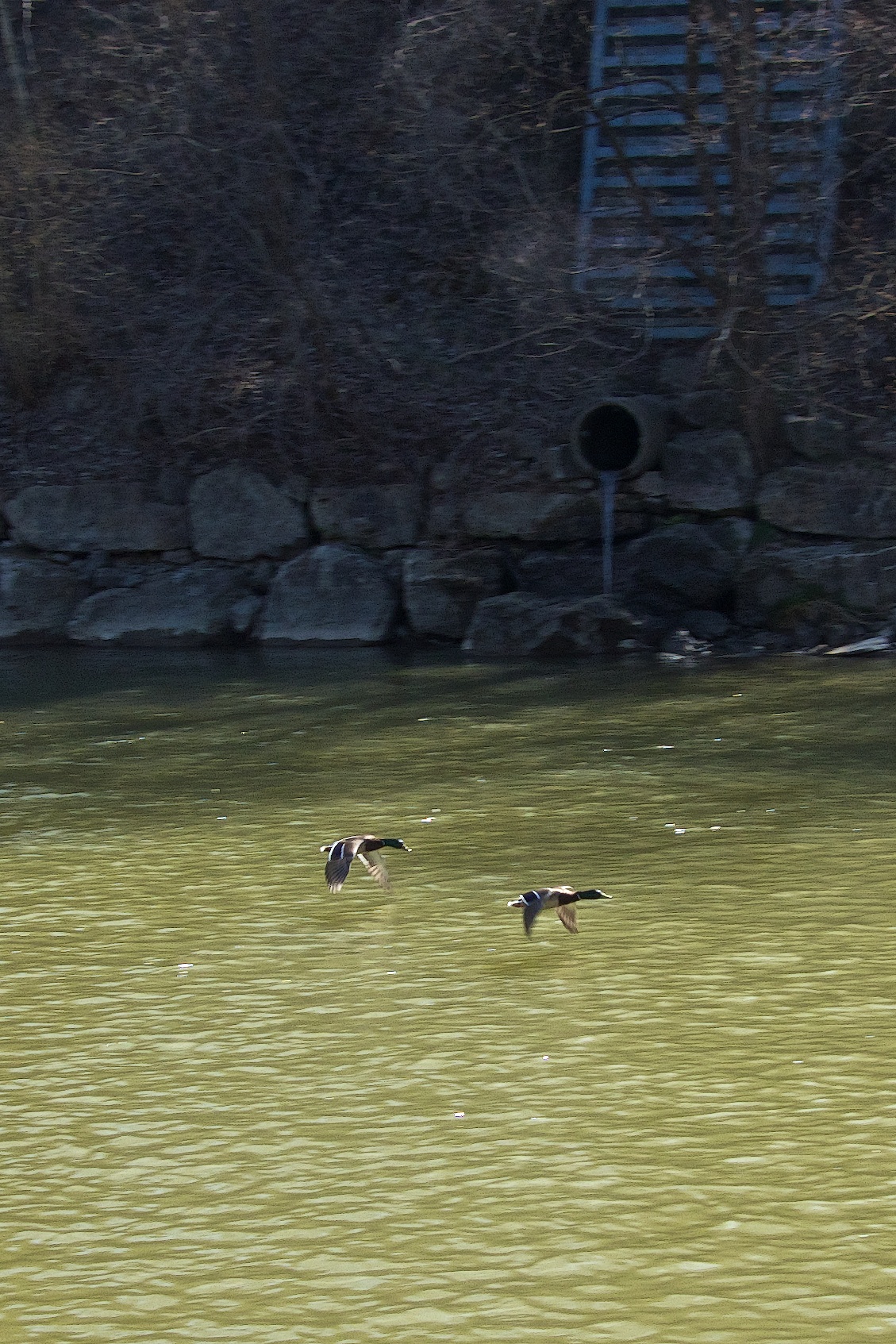
A pair of mallards passing a storm sewer outlet.

A pair of mallards pass in front of a mystery liquid gushing from a storm sewer outlet in Raymore Park.

This particular outlet spews forth its unknown liquid in both dry and wet weather seemingly with no particular reason.

Here’s what I think needs to happen in order to improve these scores and how residents can help.

TRCA needs to:

  • provide more opportunities for staff at all levels to observe, monitor and supervise what is happening in the watershed
  • set up more monitoring stations to detect sources of pollution
  • actively go after polluters and sources of pollution
  • plant more trees
  • acquire land in critical areas
  • educate people on the need to reduce pollution levels in rivers and streams

Municipalities need to:

  • find more efficient ways of using salt so that less ends up in rivers and streams
  • actively go after polluters and sources of pollution
  • plant more trees
  • continue downspout programs
  • encourage green roofs and permeable paving

Homeowners can:

  • avoid washing cars etc. on sealed driveways
  • take unwanted liquids and chemicals to a recycling depot
  • disconnect downspouts from sewers
  • buy low-flush toilets
  • plant trees
  • reduce or eliminate the use of weed killers, salt and pesticides

It’s easy to forget that Toronto’s drinking water comes entirely from Lake Ontario. It just makes sense to ensure that water entering the lake is pristine.